
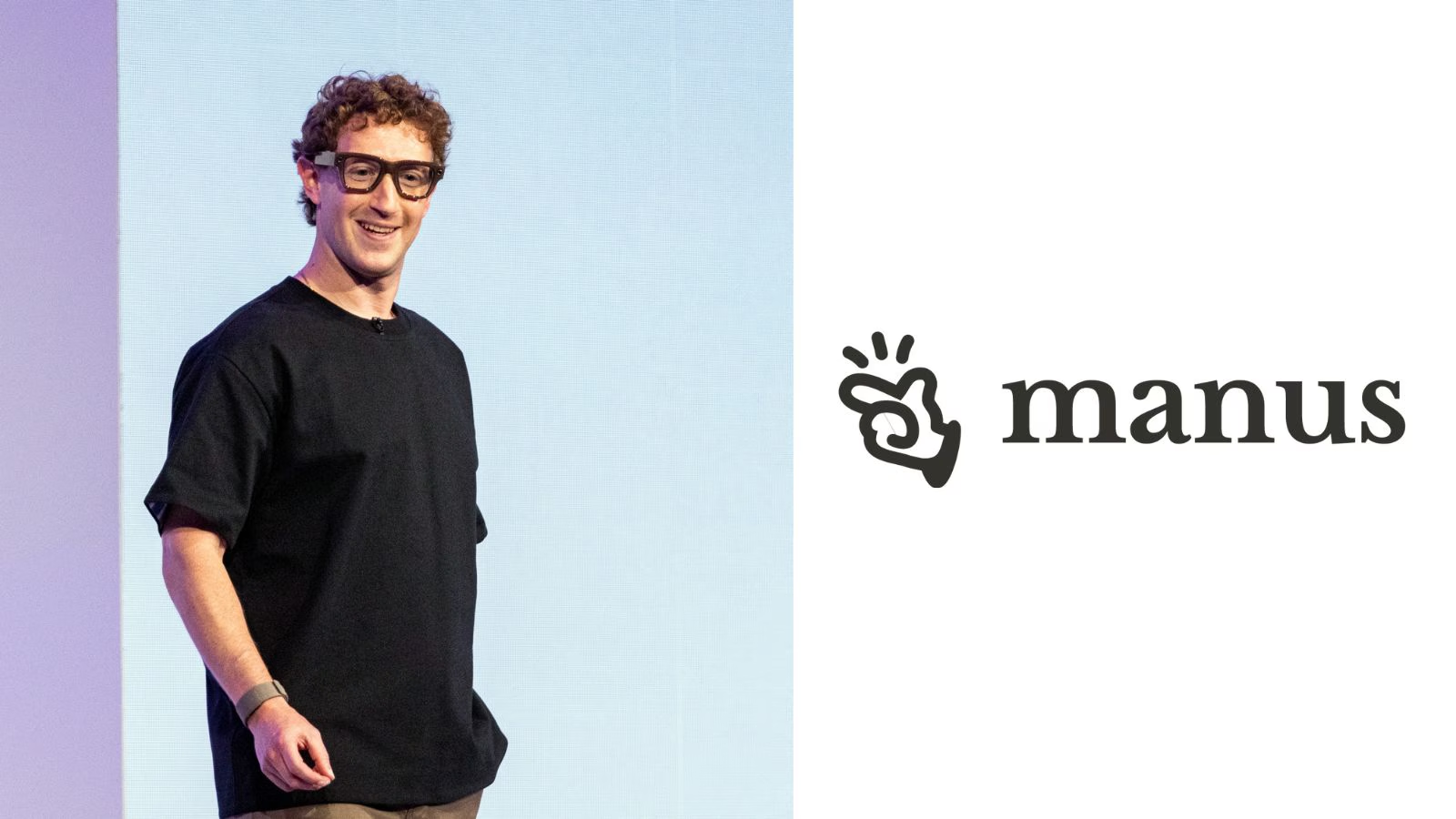

Manus, the Singapore-based AI agent developer, has been acquired by Meta for an undisclosed sum, as the social media giant steps up spending to close the gap with rivals such as Google and OpenAI.
Originally founded in China, Manus has since shifted its base to Singapore and earlier this year, made its debut with a general-purpose AI agent – LLM-powered systems that can autonomously navigate the web and complete tasks on behalf of the user. Manus was part of the wave of Chinese AI startups that sprouted and sparked buzz in the wake of DeepSeek’s triumphdrawing attention for developing AI agents capable of executing complex ‘general’ tasks such as market research, coding, and data analysis.
Meta’s acquisition of Manus is aimed at accelerating AI innovation for businesses and integrating advanced automation into its consumer and enterprise products, including its Meta AI assistant, the social media giant said in a statement on Monday, December 29.
The takeover will not affect Manus’ paid customers as the startup will continue operating its subscription service without disruption. Meta also said that Manus’ employees will be folded into its teams, with the tech giant having aggressively poached AI talent from startups and major rivals, including OpenAI and Google, this year.
Manus is entering the next chapter: we’re joining forces with Meta to take general agents to the next level.
Full story on our blog:
— Manus (@ManusAI) December 29, 2025
Meta’s move to snap up Manus fits squarely with its broader strategy of using its financial firepower to scoop up talent and buy capabilities in order to gain an edge over rivals in the AI arms race. At the start of December 2025, Meta announced – without disclosing the amount – that it has acquired an AI-wearables startup called Limitless (formerly Rewind) that developed an AI-powered pendant to record users’ conversations.
Perhaps its biggest bet came in June 2025, when the Mark Zuckerberg-led company invested over $14.3 billion in Scale AI and simultaneously hired co-founder Alexandr Wang as well as other employees of the data labelling startup to be part of its newly established Meta Superintelligence Labs (MSL) – a separate unit within the company that has been tasked with pursuing Zuckerberg’s lofty vision of ‘personal superintelligence’.
A term coined by the CEO himself, personal superintelligence is used to refer to AI systems that could eventually surpass human capabilities while helping people use these advanced systems to achieve their personal goals.
One key distinction between the Meta-Scale AI deal and its purchases of Manus and Limitless is that the former fits a wave of acqui-hires that swept through the tech industry this year, with other big tech companies such as Google (Character AI), Amazon (Adept), and Microsoft (Inflection AI) looking to secure AI talent and purchase assets in lateral moves rather than traditional, full-scale takeovers.
Commenting on the acquisition, Meta said, “Manus is already serving the daily needs of millions of users and businesses worldwide…We plan to scale this service to many more businesses.” “Joining Meta allows us to build on a stronger, more sustainable foundation without changing how Manus works or how decisions are made,” Xiao Hong, CEO of Manus, said in a press release.
Beyond the nature of these deals, Meta’s acquisition of an agentic AI startup comes near the end of 2025, which was expected to be the year that AI agents took off, but the surge in their usage or adoption by enterprises is yet to fully arrive. Several experts such as Andrej Karpathy, a famed AI researcher, have also questioned the progress of AI agents.
What is Manus? What is the buzz around it?
Manus’ roots can be traced back to a Chinese startup called Butterfly Effect, also known as Monica.Im, before it was spun off and became a standalone company. The startup first grabbed headlines with the launch of its general-purpose AI agent, with demos on its website showing how the AI agent can be used to accomplish complex tasks such as buying real estate and programming video games.
Reactions to the rollout of Manus’ AI agent were overwhelmingly positive with the head of product at Hugging Face calling it “the most impressive AI tool I’ve ever tried.” AI policy researcher Dean Ball said that Manus was the “most sophisticated computer using AI.”
In a viral video posted on X, Yichao ‘Peak’ Ji, the chief AI scientist at Manus, “[Manus] isn’t just another chatbot or workflow. It’s a completely autonomous agent that bridges the gap between conception and execution […] We see it as the next paradigm of human-machine collaboration.”
The startup claimed that its AI agent outperforms OpenAI’s Deep Research and Operator tools on a popular benchmark for general AI assistants called GAIA, which evaluated an AI agent’s ability to carry out work by browsing the web, using software, and more. However, early reports on social media suggested that Manus’ AI agent is not powered by an LLM developed from scratch and is instead, wrapped around a combination of existing and fine-tuned AI models, including Anthropic’s Claude and Alibaba’s Qwen. In March 2025, Manus announced a strategic partnership with Alibaba’s Qwen AI team.
“Behind every Manus session runs a dedicated cloud-based virtual machine, allowing users to orchestrate complex cloud workloads — simply by talking to an agent,” as per the company. “From generating tailored rental presentations to safely evaluating cutting-edge open-source projects in a secure sandbox, the Turing-completeness of the virtual machine is what gives Manus its generality — and opens the door to endless creative possibilities,” it said.
Manus said that it has processed more than 147 trillion tokens of text and data so far, and currently runs over 80 million cloud-based virtual computers on top of its large-scale virtualisation infrastructure and ‘highly efficient’ agent architecture which reportedly took “months of optimisation”.
The company made another splash in the crowded AI product market with Wide Researcha tool that that ropes in scores of AI agents in order to carry out complex, large-scale tasks that require information on hundreds of items. Unlike specialised AI agent managers or coding assistants, Manus has claimed that its AI agents are capable of carrying out general-purpose tasks.
Amid rising geopolitical tensions between the United States and China in July this year, Manus shifted its operations from China to Singapore, Tokyo, and San Mateo in California. It does not offer its AI products and tools in China, according to a report by Bloomberg. Before moving its headquarters to Singapore, Manus reportedly laid off most of its staff in Beijing.
In October 2025, Microsoft began testing Manus’ AI agent in Windows 11 PCs, allowing users to create websites from local files.
The AI startup raised $75 million in a Series B funding round led by US venture firm Benchmark at a $500 million valuation. Its early investors include Chinese tech giants such as Tencent as well as HSG (formerly Sequoia China) and ZhenFund. The company claimed it had achieved an annualised average revenue of more than $100 million eight months after launch, while its revenue run rate exceeded $125 million, as per a report by CNBC.

Comments are closed.