
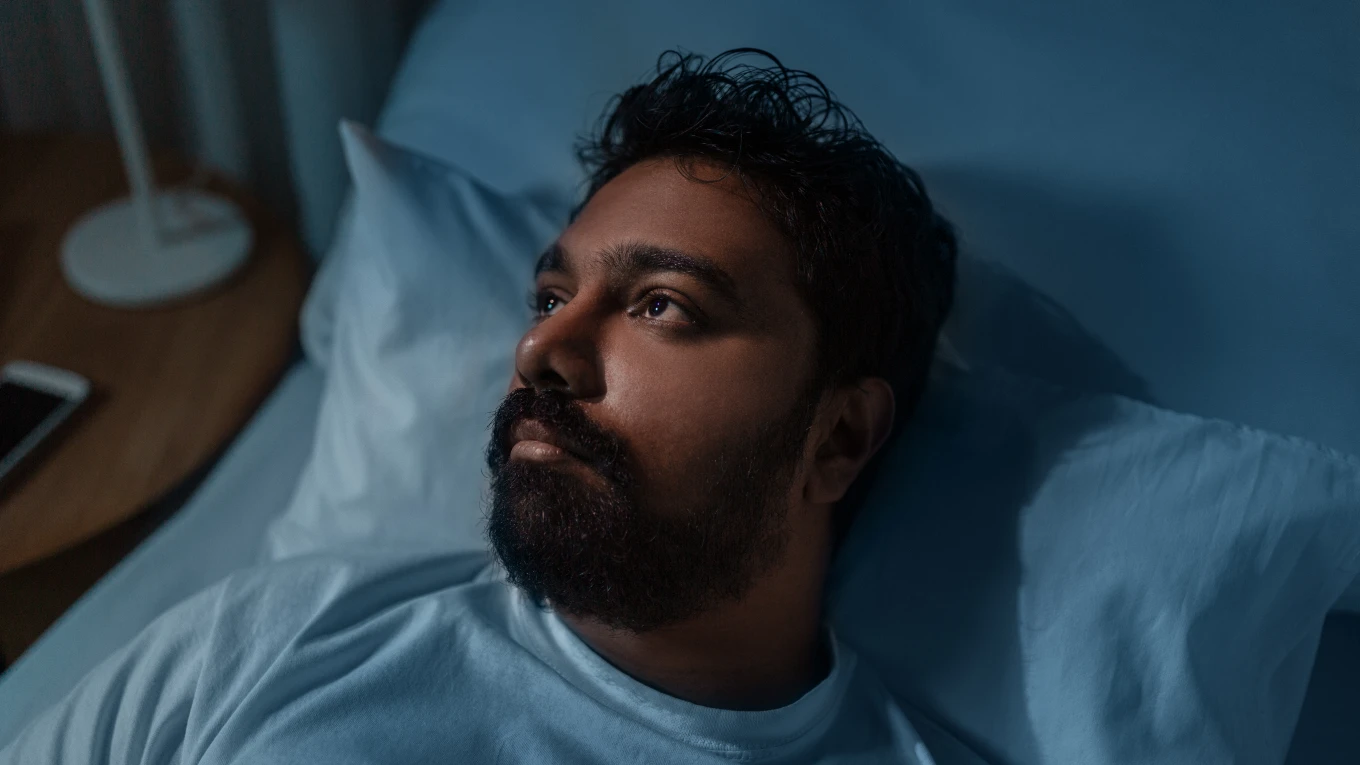

If sleeping is a struggle, there’s a good chance the solution you’ve employed is to keep the TV or a podcast on in the background. But it turns out those solutions might have a deeper psychological meaning.
While it seems like a harmless habit on the surface, listening to background noise at nighttime is actually a coping mechanism for those with trauma or mental health issues. Fortunately, there are certain types of noise that psychologists do recommend falling asleep to if you can’t avoid doing it.
The psychological reason why some people need background noise to sleep is linked to unresolved trauma and mental health issues.
“Not being able to fall asleep without background noise is extremely common with many mental health issues,” The TikTok account for DLCwellness wrote in onscreen text in a video. “[It’s] a trauma response to abandonment issues,” it went on to say, “the noise tricks your brain into thinking you aren’t falling asleep alone!”
If that resonates with you, you are definitely not alone. The video has hundreds of thousands of likes and comments and nearly 10 million views. One commenter reflected the experience of many people, saying, “I feel like I’m just used to it! I need my fan on every night without fail.” To most people, it doesn’t seem like that big a deal. However, according to psychologists, there is definitely something to it.
Psychologists say background noise is often about avoiding negative emotions at all times of day, not just when we’re sleeping.
If you’re a person who needs music or the TV on in the background to do basically anything, you’re probably avoiding your feelings. “Effectively, we fill our attentional capacity to the max with other stimuli in an attempt to have no resources left for the things we are trying to avoid,” therapist Juulia Karlstedt stated in a HuffPost article.
Psychologists say there’s nothing actually wrong with this to a point. “No coping strategy is inherently good or bad,” Karlstedt said. “Even distraction can have a time and place when it is useful.” But the key is to make sure you’re still making space for your emotions overall, and dealing with the negative ones instead of ignoring them entirely. According to psychologist Jenna Carl, “always distracting from or avoiding unpleasant thoughts…can reinforce the anxiety that’s behind the thoughts.”
So, if having music on helps you not burst into tears from anxiety at your desk at work, great, so long as you’re holding space for your emotions once you’re at home. But sleep habits, it turns out, are a bit more complicated.
When it comes to nighttime, scientists say going to sleep with background noise isn’t helpful unless it’s the right kind of noise.
Sorry to people who like to fall asleep to true-crime documentaries or Spotify playlists, the data shows that going to sleep with background noise doesn’t actually help you fall or stay asleep. But as neuroscientist Dr. Ben Rein laid out in a video, sleeping with background noise isn’t entirely without its benefits. “Biologically, the best-case scenario is probably sleeping in total silence,” Dr. Rein said. The problem, of course, is that virtually none of us lives in a place where total silence is even remotely an option, and that’s where the benefits of going to sleep with background noise come in.
SeventyFour | Shutterstock
“Things like passing cars, loud neighbors, airplanes — these are all bad because they’re unpredictable, they can change volume at any time and startle you awake,” Rein explained. “So if you deal with these unpredictable sounds at night, then continuous noise like white noise might help you sleep better” by masking those sounds.
But if you’re the type who sleeps with the TV on, you’re out of luck. “Guess what else is unpredictable noise — it’s sleeping with the TV on. Don’t do it even if it’s muted,” Rein advised. “Just the light from the screen alone can harm your sleep.”
So there you have it. Turn off the TV, turn on the sound machine, and you can give that beleaguered mind a rest. As for the loneliness part? Well… we’ll have to wait for science to find a cure for the human condition on that one.
John Sundholm is a writer, editor, and video personality with 20 years of experience in media and entertainment. He covers culture, mental health, and human interest topics.

Comments are closed.