
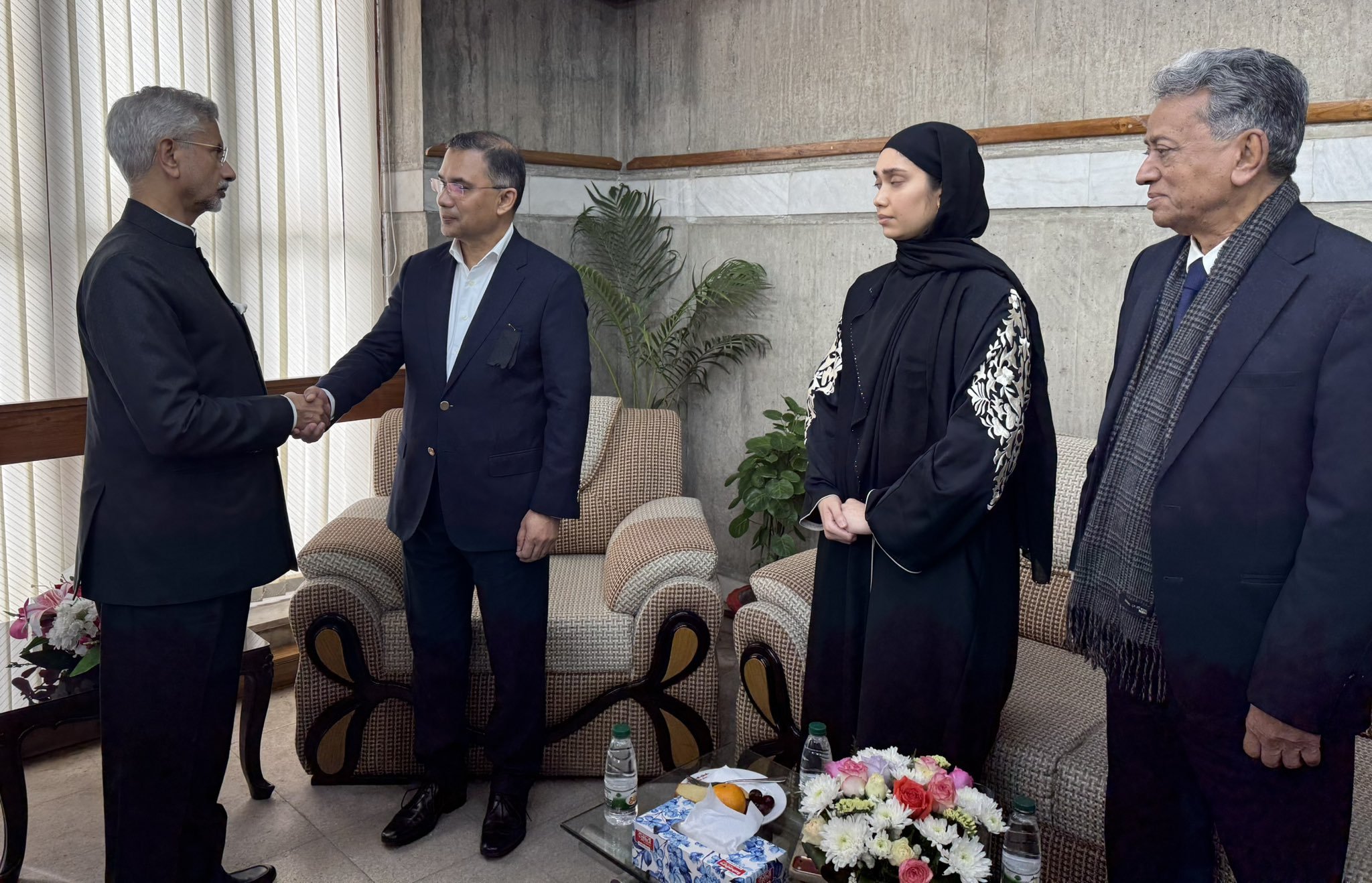
Foreign Minister S Jaishankar reached Dhaka with Prime Minister Modi’s message, handed over letter to Khaleda Zia’s son

Dhaka, 31 December. India has expressed deep condolences on the demise of former Bangladesh Prime Minister Begum Khaleda Zia. Foreign Minister Dr. S. received a letter of condolence from Prime Minister Narendra Modi and a message of tribute from the Government of India and the Indian people. Jaishankar reached Dhaka on Wednesday. He conveyed India’s condolences to the people of Bangladesh in their hour of grief and remembered Khaleda Zia’s contribution to democracy. Bangladesh High Commissioner to India, Riyaz Hamidullah, while giving information on social media, said that Dr. S. While handing over Prime Minister Modi’s condolence message in Dhaka, Jaishankar said that India stands with Bangladesh in this hour of grief.
Khaleda Zia died on Tuesday
Riyaz Hamidullah said that Jaishankar also respectfully acknowledged the long political career of former Prime Minister Khaleda Zia and her contribution to the democratic system. Let us tell you that Foreign Minister S. Jaishankar reached Dhaka by a special flight at 11:30 am on Wednesday. He was welcomed at the airport by India’s High Commissioner to Bangladesh Prannoy Verma. Begum Khaleda Zia died on Tuesday in Dhaka after a prolonged illness. She was 80 years old. Khaleda Zia was one of the most influential leaders of Bangladesh politics and became the Prime Minister of the country three times. She was also the president of Bangladesh Nationalist Party for a long time.
Khaleda Zia’s political journey was quite long
Khaleda Zia’s political journey has been more than 4 decades long, in which she touched the heights of success and also faced many difficult situations. While taking charge of BNP, he held the reins of power in the country, but allegations of corruption also had a deep impact on his image. His entry into public life was completely coincidental. She entered politics at the age of just 35 after the assassination of her husband, President Ziaur Rahman, in a failed military coup on May 30, 1981, and nearly a decade later became the first woman Prime Minister of Bangladesh. His move into politics was not part of any pre-planned strategy, but circumstances brought him to this path.

Comments are closed.