
Raipur News: Makhana farming will change the economic picture of rural women of Dhamtari – Keep an eye on every movement of the media world.

From Dabri to Samridhi
Women saw a new path to economic self-reliance in Makhana farming.
A group of 40 women farmers took practical training in makhana processing and modern farming techniques.
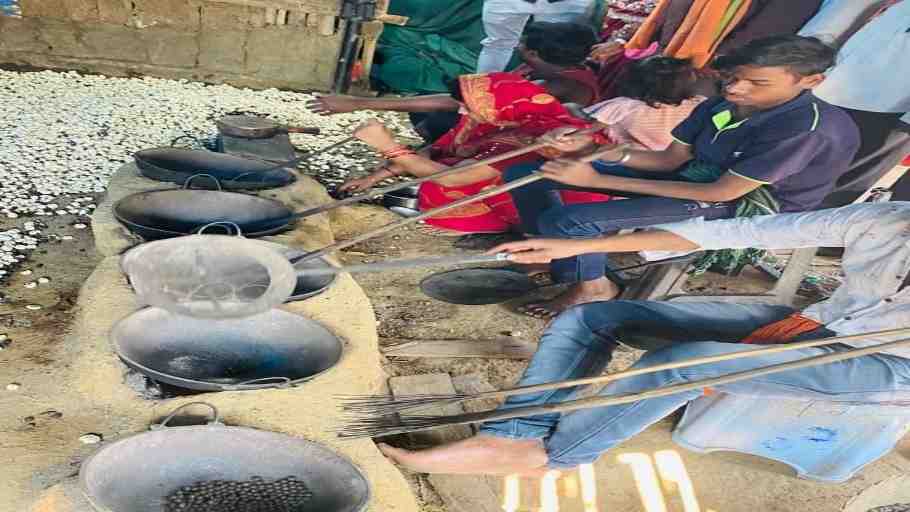
Raipur News: Dhamtari district has taken another concrete step towards agricultural diversification and women empowerment. A group of 40 interested women farmers from village Sankara of development block Nagari reached village Lingadih under Arang development block of Raipur district, where they received practical training in makhana processing and modern farming techniques. The entire arrangement for this study tour and training was done by the District Horticulture Department, Dhamtari.
Especially Collector Dhamtari is taking interest in promoting Makhana farming and providing training and technical information to the farmers.
The economic picture of rural women will change
Now soon, by thinking beyond paddy, Makhana farming will change the economic picture of rural women of Dhamtari. From small dabri to prosperity, the women of Dhamtari are seeing a new path to economic self-reliance in Makhana farming. The result of government efforts is that Makhana farming will bring economic empowerment in Dhamtari.
Detailed information given on production cost and market prospects of Makhana
Due to the continuous efforts of the Collector, Makhana farming has been started by marking Dabri in about 90 acres of area in villages Rakhi, Piparchedi, Dandesara, Rankadoh and Sankara of Dhamtari district. While visiting the local Ojas Farm, the women farmers understood closely the entire chain related to cultivation, harvesting, processing and marketing of Makhana. Farm manager Sanjay Namdev told the farmers that waterlogged ponds, ponds or water structures are suitable for the cultivation of Makhana. He gave detailed information on technical aspects, seed selection, production cost and market possibilities and also told that with proper training and government support, this crop can prove to be very beneficial for the farmers.
Develop a strong source of sustainable income
On this occasion, Shiv Sahu, while throwing light on the commercial aspect of Makhana farming, said that this crop is of low risk and a strong source of permanent income can be developed from it. Women farmers also shared their experiences and said that they are seeing a new opportunity to become self-reliant through Makhana farming.
About 200 to 250 grams of pops are prepared from one kilo of Makhana seeds.
Explaining the details of processing, Makhana processing expert Mr. Rohit Sahni Fodi, resident of Darbhanga, Bihar, said that about 200 to 250 grams of pop is prepared from 1 kg of Makhana seeds, the market price of which ranges from Rs 700 to Rs 1000 per kg. He clarified that if farmers do processing and packaging along with their own production, a significant increase in profit per acre is possible.
Also read: Raipur News: CM Vishnudev Sai released the book Gajrath Yatra-2025
Average production achieved up to 10 quintals
Giving information from the scientific point of view, the Chief Scientist of Indira Gandhi Agricultural University said that about 20 kg of seeds are required per acre and the average production can be achieved up to 10 quintals. He also said that in this crop which has a duration of six months, the incidence of pest and disease is negligible and there are no problems like theft, which makes it a safe option for the farmers.
of news media WhatsApp follow the group https://whatsapp.com/channel/0029VaBE9cCLNSa3k4cMfg25
Farmers gave information about the schemes of Makhana Board and State Government.
Under the guidance of Deputy Director Horticulture, Dhamtari Dr. Pooja Kashyap Sahu, the farmers who came along with Rural Horticulture Officer Chandraprakash Sahu and BTM Pitambar Bhuarya received information about the schemes of Makhana Board and State Government. Dr. Pooja said that facilities like training, technical assistance and subsidy are being provided to encourage the cultivation of Makhana.
State’s first Makhana processing center also established
It is noteworthy that the first commercial Makhana production in Chhattisgarh was started by Late Krishna Kumar Chandrakar in village Lingadih of Arang development block, where the first Makhana processing center of the state was also established.
Also read: Raipur: CM Vishnudev Sai inaugurated nutrition rehabilitation centers in Farsabahar, Kunkuri and Manora.
New direction for rural economy
Today Makhana production is becoming the new agricultural identity of Chhattisgarh. This effort of the women farmers of Dhamtari is not only an example of agricultural innovation, but also shows that with the right guidance, training and administrative determination, the rural economy can be given a new direction.

Comments are closed.