
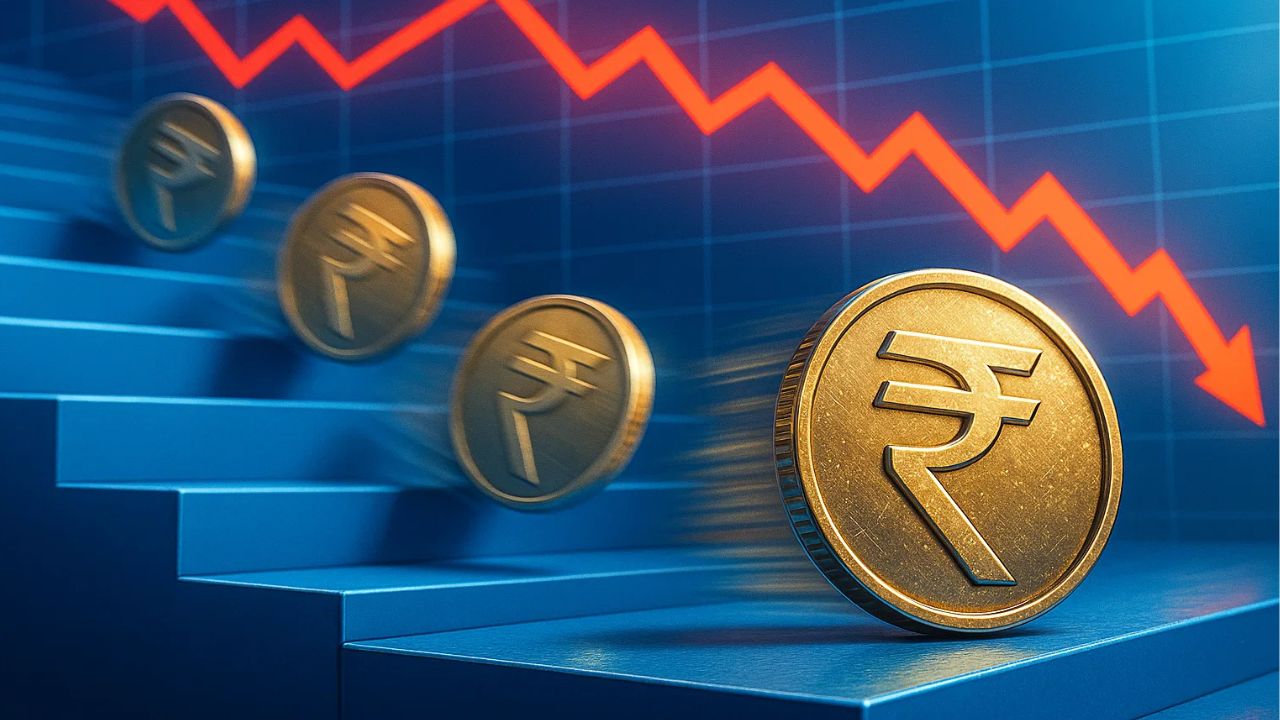

Indian rupee is continuously weakening. How does one become weak? This is determined by the value of the dollar. This is determined by the value of one dollar in rupees. Now the price of one dollar has crossed Rs 90. On Thursday, the price of one dollar was Rs 90.15. On Friday it increased to Rs 90.43. That is, the rupee weakened by 28 paise in a single day.
The value of the rupee against the dollar has reached its lowest level ever. The way this decline is happening, it is estimated that it may even cross Rs 91.
Experts believe that there is a meeting of the Monitoring Policy Committee (MPC) of RBI on December 5, hence the bank is not interfering in it right now. Apart from this, the demand for dollars has also increased worldwide. These two reasons have weakened the rupee.
Read this also– Who is Hiren Joshi on whose pretext Congress is asking questions to PM Modi?
Priyanka said- Where is his answer?
A lot of politics is also being done on the falling value of rupee. Congress President Mallikarjun Kharge said that the falling value of the rupee shows the economic condition of the country.
Kharge said, ‘The rupee has crossed 90. No matter what the government trumpets, the falling value of the rupee shows the real economic situation of the country. If the policy of Modi government had been right then the rupee would not have fallen.
Congress MP from Wayanad Priyanka Gandhi Vadra said that ‘questions were raised on the falling value of the rupee during the Manmohan Singh government. Now where is their answer?
Priyanka Gandhi Vadra, while answering the media’s question, said, ‘What did those people say a few years ago when the value of the dollar was high during the time of Manmohan Singh? Now what is their answer? Ask them, why are you asking me?’
Read this also–Putin coming to India after 4 years, what will happen during his 28 hour visit? know everything
But why is the rupee falling?
There are many big reasons for the rupee falling. Foreign exchange analysts are attributing the fall in rupee to selling by foreign investors.
Sharekhan’s research analyst Anuj Chaudhary told news agency PTI, ‘Due to selling pressure from foreign investors and rise in crude oil prices, the rupee has crossed 90. Uncertainty regarding the India-US trade deal has also put pressure on the rupee.
Data shows that foreign investors have sold heavily in the stock market. So far this year, foreign investors have sold more than Rs 1.5 lakh crore. On Wednesday itself, investors had sold shares worth Rs 3,207 crore.
Uday Kotak said in the post on X, ‘₹@90. The biggest reason for this is the selling by foreign investors. Indian investors are buying. Only time will tell who is smarter. For now the foreigners seem smarter. One year Nifty $ return is 0. But it’s a long game. It is time for Indian business to get out of the comfort zone.
Apart from selling, increasing demand for dollars has also pushed the rupee down. The demand for dollars has increased due to the sudden fall in cryptocurrency.
Rahul Kalantri, vice president of commodities at Mehta Equities Ltd, said, “Slow export growth, uncertainty over trade deals and continued exit of foreign investors have increased demand for the dollar. “Rising geopolitical tension and sudden fall in cryptocurrency have increased safe-haven flows into the dollar, putting pressure on the rupee.”
Read this also–What is Pakistan’s new scourge, CDF, which has increased India’s worries?
So is this a matter of tension?
Weakening of rupee affects many things. This affects business. There is no impact on exports but imports are definitely affected. Falling rupee means that the same goods coming from abroad will now have to be imported at a higher price. Due to this, there remains a danger of inflation increasing.
Chief Economic Advisor V. Anantha Nageswaran said that the falling rupee is neither increasing inflation nor affecting exports. He said that this makes imports expensive. He said that import dependent sectors like jewellery, petroleum and electronics may benefit less due to increase in input costs.
Meanwhile, a research report of SBI has said that the falling rupee cannot be considered as a weak rupee. The report says that a trade deal can be struck between India and America by March 2026, after which the rupee will stabilize. It said, ‘Sentiments are weak due to uncertainty regarding the India-US trade deal. It is expected that the trade deal will be completed before March 2026. Uncertainty is increasing due to obstructions in negotiations regarding trade deal, due to which there are repeated declines.
“The rupee may remain under pressure going forward and trade in the range of Rs 89.50 to Rs 91.20, especially if crude oil prices remain high and foreign investors remain risk averse,” Ashika Group Chief Business Officer Rahul Gupta told PTI.
Overall, there is little hope of strengthening of the rupee at present. Experts believe that until something is decided regarding the trade deal, the rupee will continue to fall.

Comments are closed.