
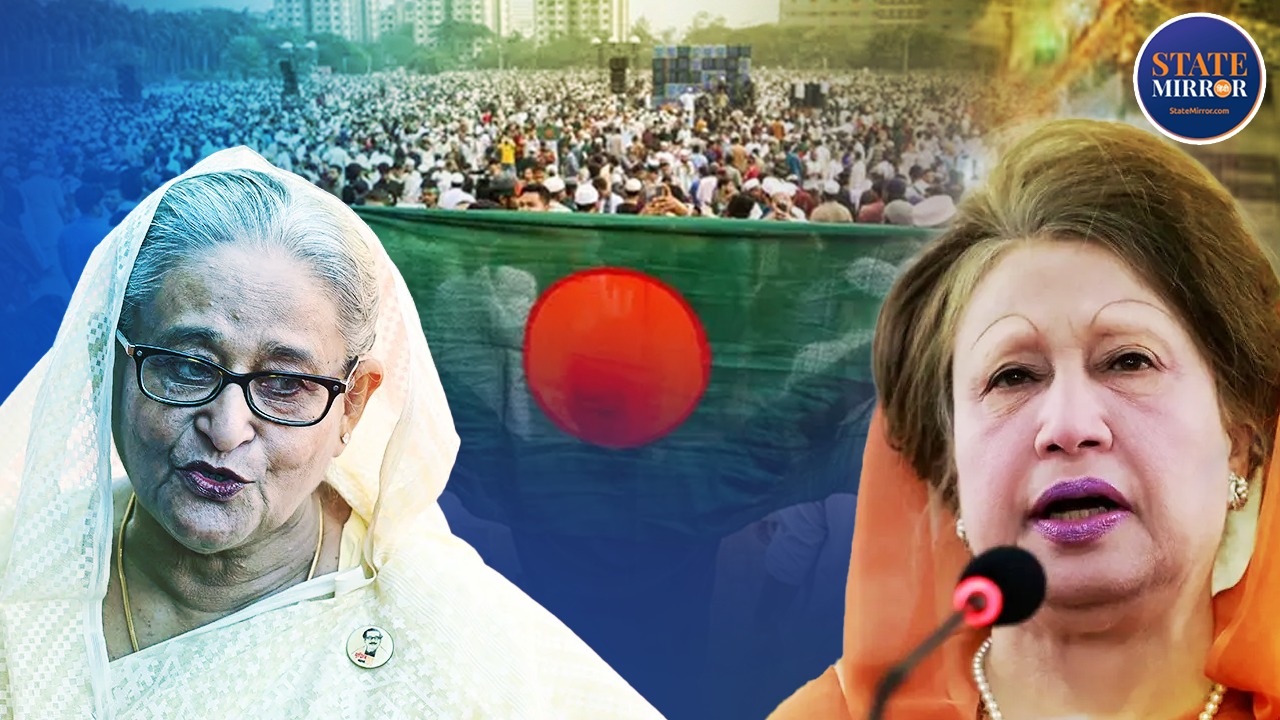
Battle of the Begums- 4 Decades, 2 Powerful Women and 1 Country! A story of blood, betrayal and enmity born of inheritance.

For more than four decades, Bangladesh’s politics was driven not by any policy, ideology or development model, but by the bitter personal rivalry of two women – Sheikh Hasina and Khaleda ZiaThe world came to know this conflict as the ‘Battle of the Begums’, but it was not just electoral rivalry, This was a fight for power, for revenge, and for the history that made Bangladesh what it is today,
Read now on WhatsApp also, click to subscribe
An era of Bangladesh came to an end with the death of Khaleda Zia on Tuesday at the age of 80. An era in which democracy often became hostage, Parliament came to a standstill, roads became battlefields and the governance system became a victim of personal enmity.
Enmity born of blood, betrayal and inheritance of power
This historic conflict has its roots in the early, extremely violent years of Bangladesh’s creation in 1971. Sheikh Hasina is the daughter of Sheikh Mujibur Rahman, the founder and first president of Bangladesh. Mujib, who won independence from Pakistan in 1971, became the Father of the Nation, but he and most of his family members were brutally murdered in a military coup in 1975. Hasina was out of the country at that time, and that became the reason for saving her life. After this he endured a long exile.
On the other hand, Khaleda Zia’s political identity was also created by a murder. Her husband, Ziaur Rehman, was an army general who seized power in the post-1975 chaos and became president. Zia gave a different direction to Bangladeshi nationalism – one where Islamic identity was given prominence and distanced from Mujib’s secular ideas.
Ziaur Rahman was also assassinated in a failed military coup in 1981, and it was here that Khaleda Zia entered politics – as the guardian of her husband’s legacy and the leader of the Bangladesh Nationalist Party (BNP).
A rare unity in the 80’s
The biggest paradox of history was that despite their staunch enmity, both the Begums had to appear on the same stage in the 1980s. At that time, Bangladesh was under the control of military ruler Hussain Mohammad Ershad, who took power in a coup in 1982. The country was seething against martial law, controlled elections and repressive rule. Sheikh Hasina’s Awami League and Khaleda Zia’s BNP were on the streets through separate movements. Strikes, bandhs, student movements and violent clashes had become common. Despite Ershad’s strictness, public anger continued to increase. Finally in 1989-90, both the leaders understood that it was necessary to unite to remove Ershad. Keeping aside personal enmity, both came together in a common front. The mass movement reached its peak in 1990 and Ershad had to resign on 6 December 1990. This was the turning point that ended military rule and opened the way for elections under the caretaker government.
From democracy to personal revenge
What came after 1990 was less democracy and more politics of personal vendetta. In the 90s and 2000s, elections became a battle of life and death. Parliament kept coming to a standstill, the opposition kept boycotting and the streets kept filling with violence. When Khaleda was in power, there would have been corruption, arrests and pressure on Hasina. When Hasina was in power, the same weapon was used against Khaleda. Politics became not about debating policies, but about eliminating the opponent. Result: Democratic institutions weakened, trust in elections was broken and intolerance became permanent.
Caretaker System: Democracy’s Shield or Battleground
The caretaker government system became the biggest institutional center of this conflict. Under this system, before the elections, power was handed over to a neutral interim government. Khaleda Zia continued to consider this as a guarantee of fair elections. But after consolidating power, Sheikh Hasina abolished it in 2011, calling it unconstitutional. BNP called it a betrayal of democracy. After this, the elections of 2014 and 2018 were surrounded by boycott, allegations of rigging and international criticism. The political space kept shrinking further.
2007 emergency arrest
In 2007, the army-backed caretaker government imposed emergency and arrested both the Begums. There were allegations of corruption and extortion. After a year, they were released under political pressure, but it became clear that the power system could now be used against both of them.
era of unilateral power
After 2010, the fight became unequal. Sheikh Hasina became the longest serving Prime Minister of Bangladesh. Economic growth, mega infrastructure and stability came, but critics alleged centralization of power, weakness of the judiciary, pressure on the media and repression of the opposition. Khaleda Zia went to jail and then under house arrest in corruption cases. BNP became leaderless. His longest imprisonment in 2018 almost forced him out of politics.
2024: Dramatic reversal
After the fall of Sheikh Hasina government in August 2024, politics took another turn. Khaleda Zia was immediately released on the orders of the President. He got relief in all the cases one by one. By the beginning of 2025, the Supreme Court acquitted him in the last corruption case also. BNP again became the main opposition force. Khaleda’s return after treatment from London and the political entry of her son Tariq Rehman was called ‘Politics of Return’.
end of an era
Khaleda Zia died at the age of 80 at a time when the country is moving towards elections. His death is not just the death of a leader, but the end of the politics that divided Bangladesh into two parts for decades. Now the question is, will Bangladesh be able to come out of the shadow of the Begums, or will history repeat itself in a new form?

Comments are closed.