
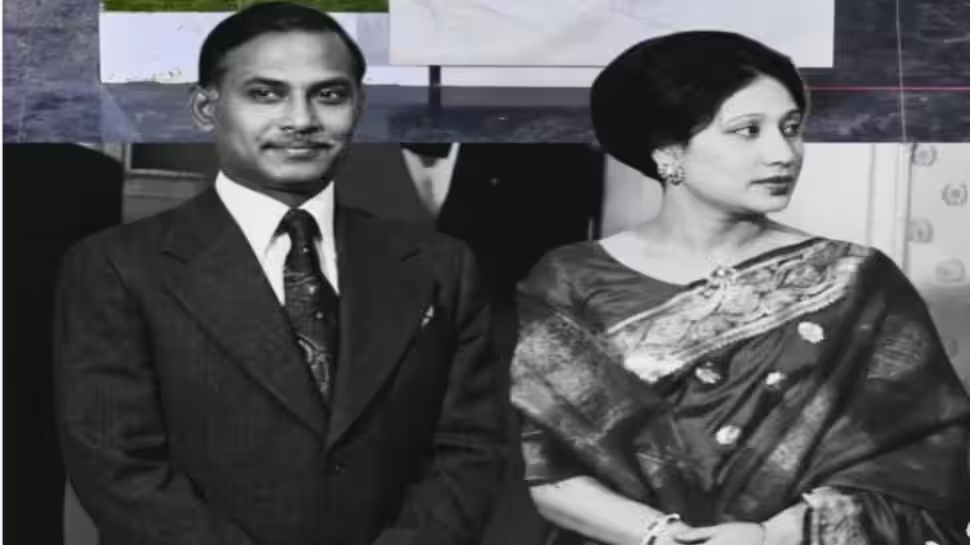
Why Khaleda Zia’s Husband, Ex-President Ziaur Rahman, Was Buried Twice – A Chapter From Bangladesh’s Turbulent Past | world news

Dhaka: With the end of a chapter that was part of the Bangladesh’s political memory for over four decades, former Prime Minister and BNP chief Khaleda Zia was buried beside her late husband, former President Ziaur Rahman, at Sher-e-Bangla Nagar in Dhaka.
A former president and a commander during Bangladesh’s Liberation War, Rahman was assassinated on May 30, 1981, during an attempted military coup in Chattogram. In the chaotic hours that followed his killing, his body was secretly buried in the hilly Rangunia area on the outskirts of the port city.
Later, on the initiative of the then government, his mortal remains were exhumed and flown to Dhaka, where he was reburied with full state honor at what was then Sher-e-Bangla Park, close to the Parliament complex.
Add Zee News as a Preferred Source
During the rule of Hussain Muhammad Ershad, the park was renamed Chandrima Udyan. A subsequent BNP government changed the name to Zia Udyan, while the Awami League later reverted it to Chandrima Udyan. After the fall of the Awami League government, signage at the site once again reads Zia Udyan.
Political commentators and historians say that regardless of the park’s name change, the decision to bury Rahman there with state honors was taken by the interim government led by Justice Abdus Sattar.
The proposal came directly from Justice Sattar and was approved unanimously by the cabinet. Army chief Ershad also supported the decision. The historians say Rahman’s role in introducing multi-party democracy in Bangladesh was the reason he was buried near the Parliament building.
Now, decades later, the BNP buried Zia beside her husband. She was laid to rest with state honors after passing away on Tuesday (December 31, 2025) at a Dhaka hospital following a prolonged illness.
The Assassination, Secret Burial
Rahman had traveled to Chattogram on May 29, 1981, for a two-day visit to resolve internal disputes among local party leaders. Accounts from party leaders and associates who accompanied him say that after a full day of meetings, he retired to bed close to midnight.
A few hours later, a group of army officers stormed the Chattogram Circuit House and opened fire, killing him on the spot. News of his death was first broadcast on the radio on the morning of May 30. In the wake of the assassination, Vice President Justice Sattar assumed office as interim president and officially announced Rahman’s death in a radio and television address later that day.
Within hours of the killing, the president’s body was secretly moved to the hilly Rangunia area. Contemporary newspaper reports said he was buried at the base of a hill. A June 2, 1981 report in Dainik Sangbad, citing eyewitnesses, stated that a group of soldiers arrived at the Circuit House between 8 and 9 am on May 30, placed the bodies of President Rahman and two others into a vehicle and drove them to an unknown location.
At the same time, the government maintained that it had attempted to bring Rahman’s body to Dhaka on the day of the assassination. Then Prime Minister Shah Azizur Rahman told journalists that, due to a lack of direct contact with local authorities, the government had requested the International Red Cross to help transport the body. A subsequent government statement said the request was rejected by then Chattogram GOC Major General Abul Manzoor.
A Dainik Sangbad report dated May 31, 1981, said that the interim president’s cabinet met formally for the first time on May 30 at Bangabhaban and adopted a condolence resolution. Justice Abdus Sattar later said the government had performed funeral prayers in Dhaka without the body after receiving no response to its requests.
The Body’s Recovery, State Funeral
On May 31, divisions emerged among the coup plotters, and several officers pledged loyalty to the interim government. As events unfolded rapidly, Major General Manzoor and Colonel Matiur Rahman fled the Chattogram cantonment that night. After government forces regained control, Manzoor was arrested and later died from gunshot wounds.
On June 1, then Brigadier Hannan Shah located Rahman’s grave. In a later interview with BBC Bangla, he said the search party moved along the Kaptai Road and identified a fresh grave based on local villagers’ information. Excavation revealed the bodies of Rahman and two other army officers.
The remains were taken first to the Chattogram cantonment and then flown by helicopter to Dhaka. On June 2, the body was kept at the Parliament building until 11 am to allow the public to pay their respects.
Newspapers reported that his funeral prayers were held at Manik Mia Avenue at 12:30 pm, after which he was buried beside the lake near the new Parliament complex.
A June 3 report in Dainik Ittefaq stated that the burial site was selected at Sher-e-Bangla Nagar Park, located north of the Parliament and east of the prime minister’s residence.
The interim government under Justice Sattar took several notable decisions at the time, including granting Rahman a state funeral and selecting the burial site. There was broad consensus on burying him near the Parliament. Several Awami League MPs were present at both the funeral and burial. People from all sections of society attended the funeral, setting aside political differences.
Nearly 44 years later, Zia has now been buried beside Rahman, uniting them once again at a site that is symbolic in Bangladesh’s political history.

Comments are closed.