
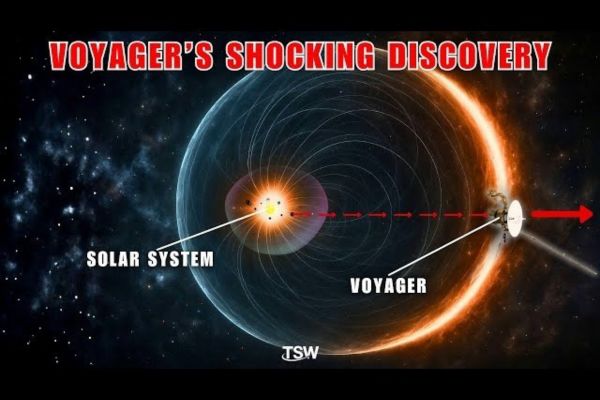

Voyager spacecraft human historyVoyager-1 and Voyager-2 hold a unique place among the longest operating and farthest reaching spacecraft in the world. Launched in 1977, these spacecraft were initially sent only to study Jupiter and Saturn, but even after almost five decades, they are sending us invaluable information from the most unknown regions of the universe. Recently, a discovery recorded by the Voyager spacecraft has aroused special discussion in the science world. An energetic plasma region with a temperature of about 30,000 to 50,000 Kelvin has been found near the boundary of the solar system. Which is popularly called “hot wall” or “thermal barrier”.
On hearing this news, a question arises in the common mind that is there really a wall of fire at the end of the solar system? Will the vehicle not burn there? In fact, this is not a brick-stone wall, but an invisible area made of charged particles and energetic gas. This region marks the boundary between the Sun’s influence and interstellar space and provides new direction in understanding the physical interactions between the heliosphere and the interstellar medium.
Let us understand the whole thing in simple language:
The sun not only provides light and heat; They continuously throw out a stream of protons, electrons and other charged particles, which is called the solar wind. This solar wind combines with the Sun’s magnetic field to form a huge bubble, which is called the heliosphere. This heliosphere is our solar systemPartially protects from galactic cosmic rays. Where the strength of the solar wind gradually decreases and the pressure of the external interstellar medium begins to become stronger, a transition region arises. This area is called heliopause.
Voyager 1 crossed the heliopause in 2012 and Voyager 2 officially entered interstellar space in 2018. But this border is not a sharp line; It is an extended, uneven and energetic plasma zone. Instruments like Plasma Wave Subsystem and Low Energy Charged Particle installed on Voyager have observed that the thermal energy of plasma near this area suddenly increases, whose temperature is 30,000 to 50,000 Kelvin.
Here the word “temperature” does not mean the heat we feel on earth. The density of particles in space is extremely low, amounting to only a few particles per cubic centimeter. Therefore, despite the temperature being thousands of Kelvin, heat is not felt there. Here temperature means the average kinetic energy of the particles. This idea challenges our daily experience, because heat and temperature on Earth are related to density.
Scientists believe that this high temperature is caused by collisions and shock waves between the solar wind and the interstellar medium. Just as foam and fog are formed when the flow of a river meets a sudden obstacle, here the energetic particles interact with each other. As a result, a thermodynamic transition zone arises where two different astronomical environments meet.
Why is this discovery important?
This discovery is important because till now we had estimates about the extent of the solar system mainly from theories and mathematical models. Now for the first time, direct measurements and observations have been made by man-made spacecraft. This data shows that the heliopause is a living, changing and “breathing” region that expands and contracts in response to the Sun’s activity. After crossing the heliopause, the intensity of Galactic Cosmic Rays increases and that of particles of solar origin decreases. This change establishes it as a de facto physical border.
This discovery also gives us new understanding about interstellar space. We usually think of it as “empty and cold,” but Voyager’s data shows that energetic processes are constantly going on there. This region is a small part of the vast atmosphere of the Milky Way Galaxy, where stars are born, die and their remains spread into space. This 50,000 Kelvin plasma region is also important for future interstellar missions, as future spacecraft will have to pass through such energetic regions.
Voyager vehicles are not just scientific instruments; He is a symbol of mankind’s incessant curiosity. Today, when Voyager-1 is about 24 billion kilometers away from the Earth, it is still sending us information. Its power decreases, but every bit of data is priceless. Voyager seems to tell us that there is still a lot to know about the universe.
Ultimately it can be said that this 50,000 Kelvin “invisible wall” found at the boundary of the solar system is not a dangerous obstacle, but a door opening towards knowledge. They remind us that the universe is full of mysteries and that humanity’s curiosity has the potential to understand them. The Voyager spacecraft will continue to advance, and perhaps in the coming years they will bring us even more unknown stories of the universe.

(Voyage-yatra on various subjects of science will continue like this every Friday, hope to stay connected and connect others too.)

Comments are closed.