
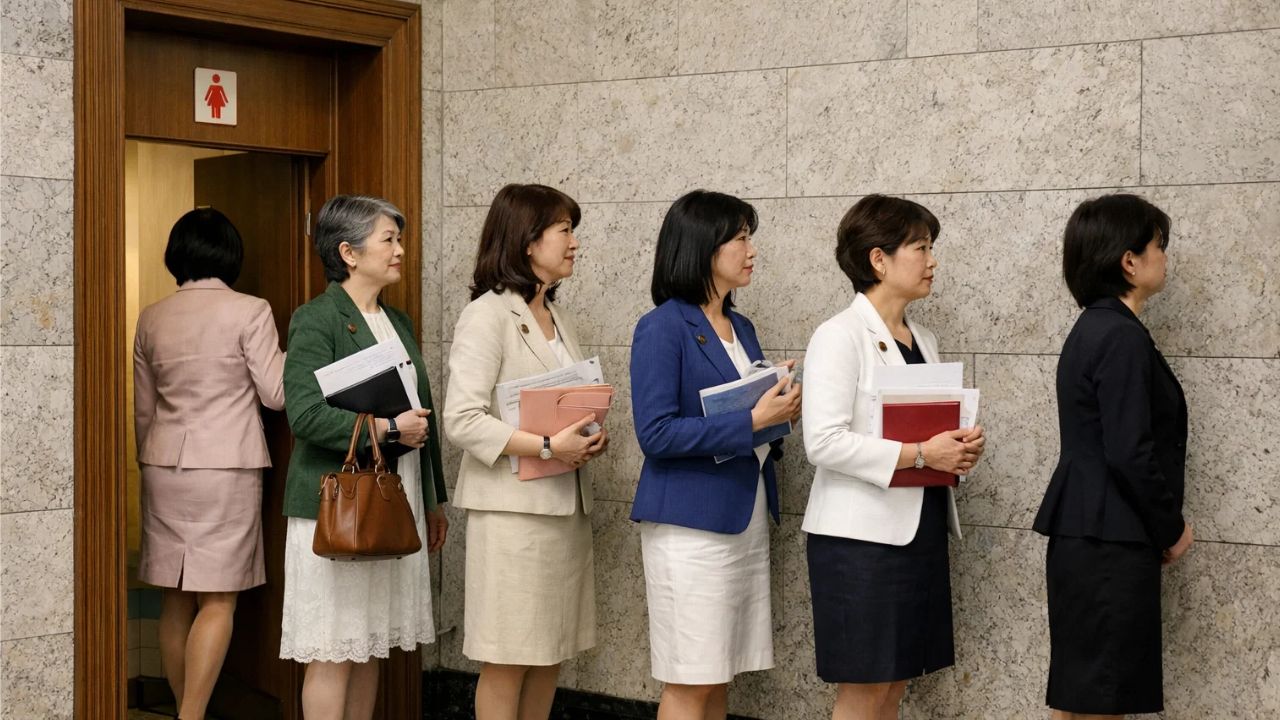
What is the toilet dispute between 73 women MPs in Japan? PM is also worried, Takaichi also has to stand in line to go to the washroom

These days, there is a heated issue in the Parliament of Japan, which has started a new debate on gender equality and basic facilities. country’s new Prime Minister Sanae Takaichi Including about 60 women MPs, there is more space for women in the Parliament House. Toilet A formal petition has been submitted demanding its creation. The petition clearly states that the number of women in Parliament has increased, but the facilities are still stuck in decades-old thinking.
Read now on WhatsApp also, click to subscribe
Women MPs say that during the Parliament session, they have to stand in long lines outside the toilet, which not only creates an uncomfortable situation but also affects their work. This demand has come at a time when Japan is already lagging far behind in the global gender gap ranking.
Only 1 toilet, 73 women MPs
According to the petition, there are currently 73 women MPs in the lower house of the Japanese Parliament, but there is only one toilet for women near the main plenary session hall, which has only two cubicles. On the contrary, there are several toilets available nearby for male MPs. Yasuko Komiyama, MP from the opposition Constitutional Democratic Party, said that ‘so many female MPs have to stand in long queues outside the toilet before the beginning of the plenary session.’ He made this statement after submitting the petition to Yasukazu Hamada, chairman of the Rules and Administration Committee of the Lower House.
Parliament was formed in 1936, when women did not even have the right to vote.
The Parliament of Japan (Diet) building was built in 1936. At that time, not only were there no women in Parliament, but women in the country had not even got the right to vote. After Japan’s defeat in the Second World War, women got the right to vote in December 1945 and in 1946, women were elected to Parliament for the first time. According to the Yomiuri Shimbun newspaper, in the entire building of the lower house, there are 12 toilets (67 stalls) for men and only 9 toilets (22 cubicles) for women.
Since there is only one toilet for women near the main Plenary Hall, women MPs sometimes have to go to another part of the building. In the World Economic Forum’s Global Gender Gap Report 2024, Japan ranked 118th among 148 countries. According to the report, women’s participation in Japan is very low not only in politics but also in business and media. During elections, women candidates say they often face sexist comments, such as advising them to leave politics and take care of children at home.
Women increased in Parliament, but equality is still far away
Currently, out of 465 MPs in Japan’s lower house, there are 72 women, which was 45 in the previous Parliament. Whereas in the upper house, 74 out of 248 members are women. The government’s official target is that at least 30% of the seats in Parliament should be held by women. ‘This is both a sign of progress and also evidence of inequality’, Yasuko Komiyama said, looking at this issue from a dual perspective, ‘In a way, it symbolizes that the number of women MPs has increased.’
He expressed hope that this demand will not be limited to toilets only, but will open the way for greater equality in other areas of life as well. It is noteworthy that Prime Minister Sanae Takaichi was recently in the news for calling a meeting at 3 pm. Her statements of ‘not believing in work life balance’ and ‘working like a horse’ have sparked a new debate on work culture and women’s health in Japan.

Comments are closed.