
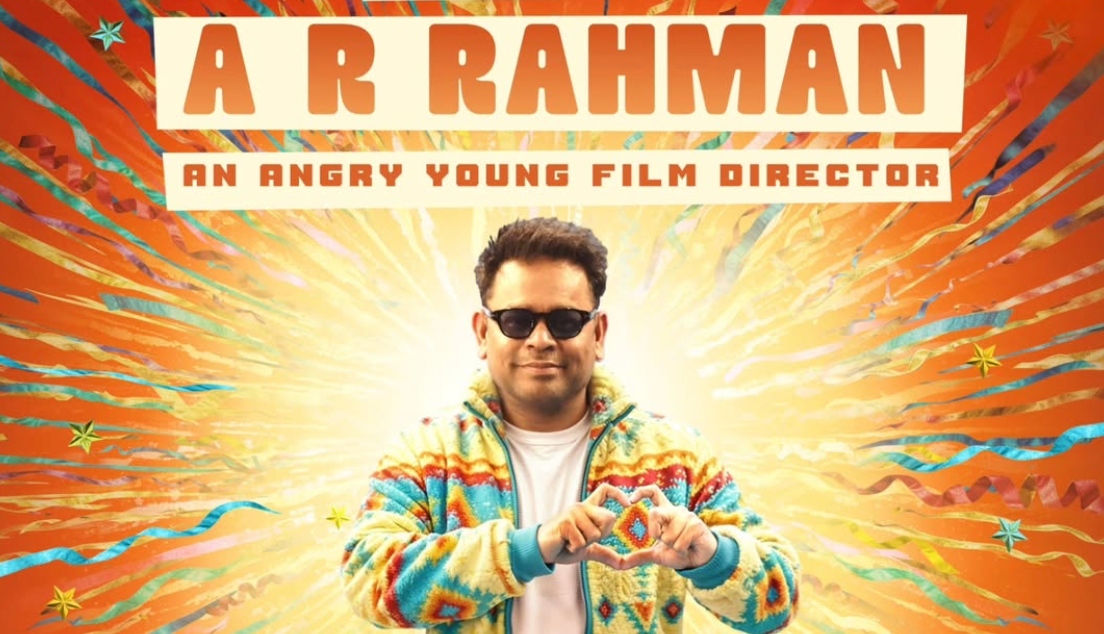

As we step into 2026, there is already an interesting development to look forward to — we might finally get to see the two-time Academy Award–winning composer A R Rahman, fondly known as Isai Puyal in Tamil, donning the greasepaint for a film. Directed by Manoj Nirmala Sreedharan, the film — titled Moon Walk — marks Rahman’s debut as a full-fledged actor. Prabhudeva, a frequent collaborator of Rahman, plays the lead role.
AR Rahman as an ‘angry young director’
Recently, Prabhudeva took to social media to release posters from the film, revealing the roles of the principal cast. Moon Walk is being positioned as a comedy drama, and the character descriptions offer an interesting contrast.
Also Read: Indian films to watch in 2026 that could take on the big-ticket releases
While Prabhudeva essays the role of a “happy young choreographer” named Babooty, Rahman will be seen as an “angry young film director”. In a recent interview, Manoj NS revealed that Rahman had initially come on board only for an appearance in a song sequence. However, when the director later approached him about an extended role integral to the narrative, Rahman agreed.
Not new to the camera, but new to the narrative
This, however, is not Rahman’s first on-screen appearance. Over the years, he has appeared on a handful of songs that fans remember fondly. He made a cameo in the song Singapenney from Vijay’s Bigilalongside director Atlee. He also appeared in the reprised version of Mukkala Muqabla in Mohanlal’s Plowed, Come Come Railthe end-credit song in Mother, Manja Nee Nee promo song from Come onand Yennai Izhukkuthadi promo song from Kadhalikka Neramillai.
Moon Walkhowever, is different. It marks the first time Rahman will play a character that is part of the film’s core narrative rather than appearing briefly as himself.
A welcome shift beyond music
In recent years, Rahman has been steadily expanding his creative horizons beyond music composition. He ventured into film writing with 99 Songs, which he also produced. The film traced the journey of a romantic hero who sets out to create 100 songs to reunite with his lover, only to discover much more along the way. While the film received mixed to positive reviews, it underlined Rahman’s willingness to explore new storytelling forms.
Also Read: AR Rahman opens up on childhood loss, faith, AI and the future of Indian music
He then went all in with Le Musk, a one-of-its-kind virtual reality film that he directed, wrote, and produced. The film premiered at the Cannes Film Festival in 2022. Speaking about Le Musk, Rahman had said, “We’ve aimed to create an unprecedented, subtle sensory cinematic surrealism. Aroma and music together bring warm memories subjectively for the audience.” Superstar Rajinikanth was shown the film, and his reaction has since become part of Tamil pop culture lore.
A more visible, inward-looking Rahman
Any ardent Rahman fan would notice that the music maestro — long known for his taciturn nature — seems to have become a little more visible and expressive in the past few years. From interviews to promotional appearances and even on-screen cameos, Rahman appears to be unveiling a dimension that many fans find refreshing.
Akshay Ramesh, an ardent admirer of the composer who recently attended Rahman’s Harmony of Hearts Sufi concert in Delhi, sees this shift as nuanced rather than dramatic. “Yes, one can sense he is trying to shed the introvert tag. But I think it’s mainly driven by the market. When on stage in New Delhi recently, he used words judiciously. But yes, this on-screen version of Rahman is fun to watch,” he said.
Also Read: Ikkis review: Dharmendra’s final bow, Agastya Nanda lift Sriram Raghavan’s anti-war film
For others, the change feels deeper and more organic. Tejas Alhat, who also attended the concert, felt that the performance revealed something fundamental about Rahman’s evolving artistic identity. “Rahman’s Sufi concert felt like a revolution,” he said. “Earlier, Sufi elements in his music came in bits and parts, but this concert showed it as a deeply thought-out, fully realised artistic direction. You realise that his Sufi depth is as profound as the Carnatic and Indian classical grounding that first made him stand out. What makes this concert different is that instead of high-energy spectacle, it makes you turn inward. It settles you. It reveals a spiritual side of Rahman we didn’t fully understand before.”
Seen in that light, Rahman’s turn as an actor in Moon Walk feels less like a detour and more like a continuation of an artist who is increasingly comfortable exploring newer, more intimate forms of expression — whether through sound, image, or now, performance.

Comments are closed.