
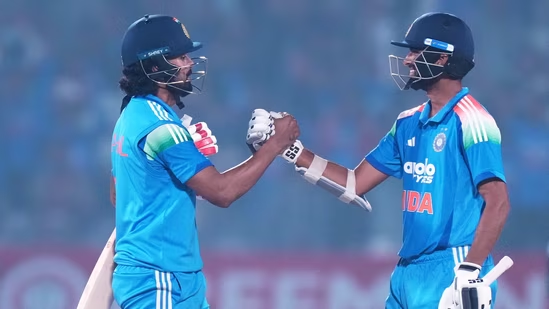
‘I didn’t know Washington Sundar couldn’t run’: KL Rahul left stunned in the middle but avoids disaster

India’s chase in the first ODI against New Zealand had a late complication that wasn’t immediately obvious from the scoreboard. Washington Sundar, battling a back issue picked up while bowling, was unable to run freely when he came out to bat. KL Rahul revealed it only after the game, explaining why India’s finish required far more control than the numbers might suggest.
Sundar’s problem began during New Zealand’s innings, when he left the field after completing his fifth over. Although he returned later to bat, his movement was visibly restricted — something Rahul said he only fully realised once the two were in the middle together.
“I didn’t know Washi couldn’t run.”
That single line reframes the end of India’s chase. In tight ODI finishes, running between the wickets is often as important as boundary-hitting. When one batter is limited, every single has to be judged, twos almost disappear, and dot balls suddenly become dangerous.
KL Rahul explained how that reality shaped his thinking in the middle: “He timed it well. We ensured dots didn’t pile up.”
The emphasis on dot-ball control is telling. With Sundar unable to push hard between wickets, Rahul’s role shifted from simply seeing the chase through to actively managing tempo — choosing safer scoring options, keeping strike, and preventing the game from slipping into a pressure spiral.
Rahul also stressed that this was a chase India would normally back themselves to complete comfortably, “We weren’t chasing too many, at this level you’re expected to chase 6, 6.5 rpo 9 out of 10 times.”
But circumstances change when mobility is compromised, and that’s where support from the other end became crucial.
“Rana did the job, took pressure off me. Chase became easier with his striking.”
Those late blows allowed Rahul to stay composed rather than force the issue himself, something he acknowledged directly: “I was calm towards the end.”
Rahul also placed the chase in broader context, pointing to how the surface behaved and why early momentum mattered “Pitch played the same for 100 overs, New ball is the best time to bat. Rohit, Gill, and Virat’s partnerships found the right tempo. It got slower later on…”
With Washington Sundar restricted and the pitch slowing, India’s margin for error narrowed — a familiar scenario against a New Zealand side known for dragging games deep.
Rahul’s closing remark reflected both relief and caution: “We’ve had a lot of last-over finishes vs NZ, they find ways to get back in the game. Look forward to the rest of the games.”
In that sense, Sundar’s inability to run wasn’t just a passing comment. It was the hidden factor that shaped India’s endgame — and the reason Rahul’s calm, controlled finish mattered as much as the runs themselves.

Comments are closed.