
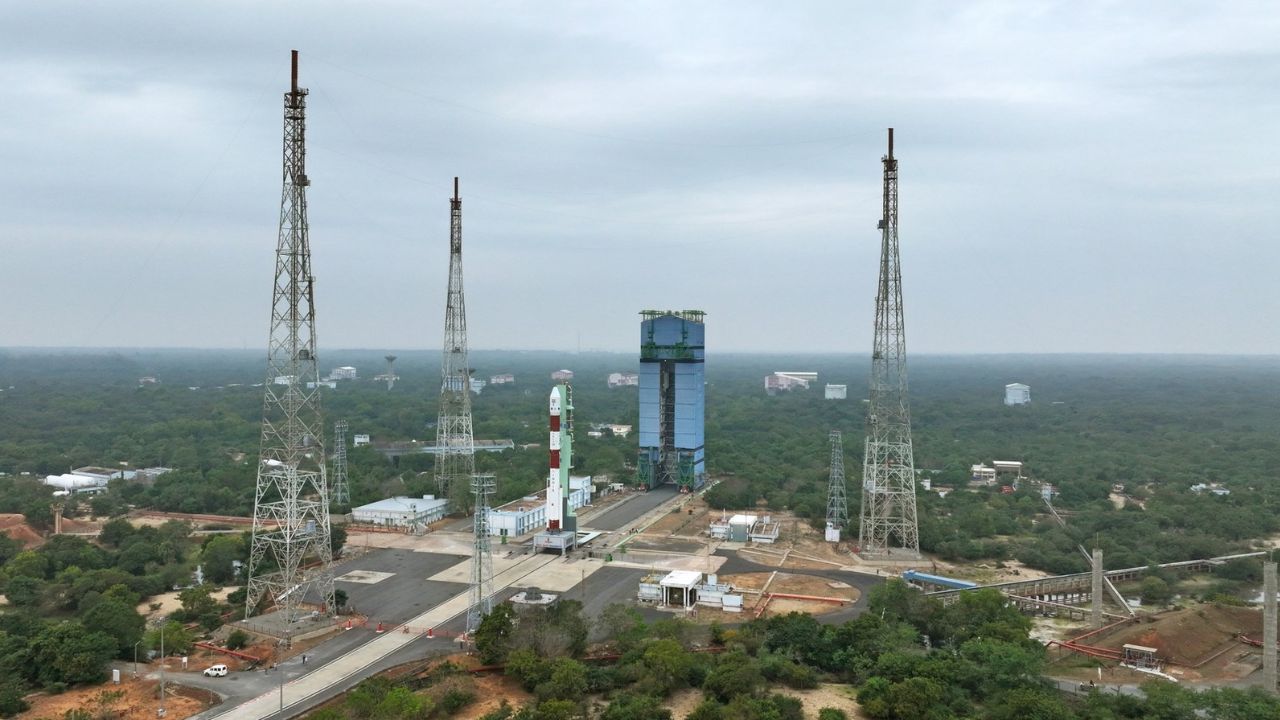
EOS-N1: Be it landmine or enemy, everyone is under eye, Anvesha satellite is the eye of India

The Indian Space Research Organization (ISRO) is ready for its first space program in the year 2026. With the help of Polar Satellite Launch Vehicle PSLV-C62, India is going to install Anvesha satellite in space. India’s space mission will start from Sriharikota in Andhra Pradesh. ISRO is launching its most reliable rocket PSLV-C62. This is the 64th flight of PSLV. The highlight of this mission is EOS-N1. This is an advanced Earth Observation Satellite, which has been prepared by DRDO. It will monitor the earth as if a drone is monitoring it. With its help, it will be of great help in defence, surveillance, agriculture, environment monitoring and disaster management.
A total of 15 small satellites will also be carried in this rocket of ISRO, which are from Thailand, UK, Brazil, United Arab Emirates and Singapore. Their job is to collect agricultural data, measure radiation and keep an eye on the marine area. A small satellite named Kestrel Initial Technology Demonstrator (KID) of a Spanish startup company is also being sent. It’s almost as big as a football. Its weight is 25 kg. This is a smaller model of the re-entry vehicle. It will be released last, then it will return to the Earth’s atmosphere and fall into the South Pacific Ocean. This is a test of the return technology of future spacecraft.
Also read: What is ‘Orange Economy’? On which the government increased its focus
What is Anwesha?
ISRO has prepared EOS-N1. It is also named Anvesha. In simple Hindi it means search or search. It has been prepared for DRDO. This is a hyperspectral imaging satellite, which is going to be very special for things hidden on the ground, crops and environment. In the border areas of India, it will act as the eye of the country, giving high definition images. The weight of this satellite is about 400 kg. It is a geostationary satellite, whose motion is relative to the Earth.
Which other satellites will be monitored?
15 small co-passenger satellites are also being sent in this mission of ISRO. These include satellites of startups and universities from countries like India, Thailand, Nepal, Brazil, Spain, UK etc. Some satellites are for environment, AI, refueling tests and amateur radio.
Also read: How can India benefit from the US occupation of Venezuela? understand
What is special about the mission?
About 2 hours after launch, the satellite will restart the rocket’s fourth stage and conduct a re-entry test using a 25 kg Kestrel capsule (KID) from a Spanish startup. Both this capsule and the stage will fall in the South Pacific Ocean. This is being considered a step towards reusable technology.
Why did PSLV rocket become a reliable rocket?
This is ISRO’s most reliable rocket. Till now 63 missions of ISRO have been successful through this. Much talked about missions like Chandrayaan-1, Mangalyaan and Aditya-L1 were sent through this. This time a rocket weighing 260 tonnes is being used. The PSLV-DL variant is also very special. It has 2 two-phase strap-on motors.
What is a strap-on motor?
Strap-on motor is also called stepping motor. This is a special type of motor that rotates in small, fixed steps instead of rotating continuously. Just like the hands of a clock move forward one second each. It works on the formula of digital pulse to control its precise position.
Also read: Will consumption reduce by increasing taxes? Complete account of tax on cigarettes
When did the mission start?
The countdown for this mission of ISRO had started on Sunday afternoon. ISRO has said that everything is ready and live streaming is also going on. This mission is very important for India’s space program. Will further strengthen India’s steps in defence, environment and commercial launches.
Where can you see?
The satellite launch can be seen on ISRO’s official social media handles and Doordarshan. Different TV channels are also going to do live coverage of it.

Comments are closed.