
America’s ‘King President’ Shows Why India Was Right To Choose Westminster Model | India News

From time to time, India witnesses a familiar argument resurface — scrap the Westminster-style parliamentary system and replace it with an American-style presidential one. The claim is that India’s federal democracy is noisy, fractured and inefficient, unsuited to a country of continental scale and ambition.
Supporters of the idea point to the United States as the model to follow. They argue that a strong president, elected separately from the legislature, offers stability, decisiveness and clarity of command. In their telling, America’s system is tailor-made for a large, diverse nation, firm at the center, yet respectful of federal autonomy. Parliamentary debate, coalition compulsions and floor management are dismissed as unnecessary “kich-kich”, slowing India’s march to greatness.
At the heart of this argument lies faith in the American doctrine of checks and balances.
Add Zee News as a Preferred Source
The Theory Of Checks And Balances
The US Constitution divides power neatly between the executive, the legislature and the judiciary. The president may command the armed forces and dominate foreign policy, but Congress controls the purse, ratifies treaties and can impeach. The Supreme Court acts as referee, striking down excesses when needed. This separation is often praised as political genius, a system that prevents tyranny while allowing strong leadership.
For decades, this structure was held up as proof that a presidential system could combine authority with restraint. A stable democracy, a united federation, and global influence were all credited to this careful balance. Power without paralysis, authority without chaos, at least on paper.
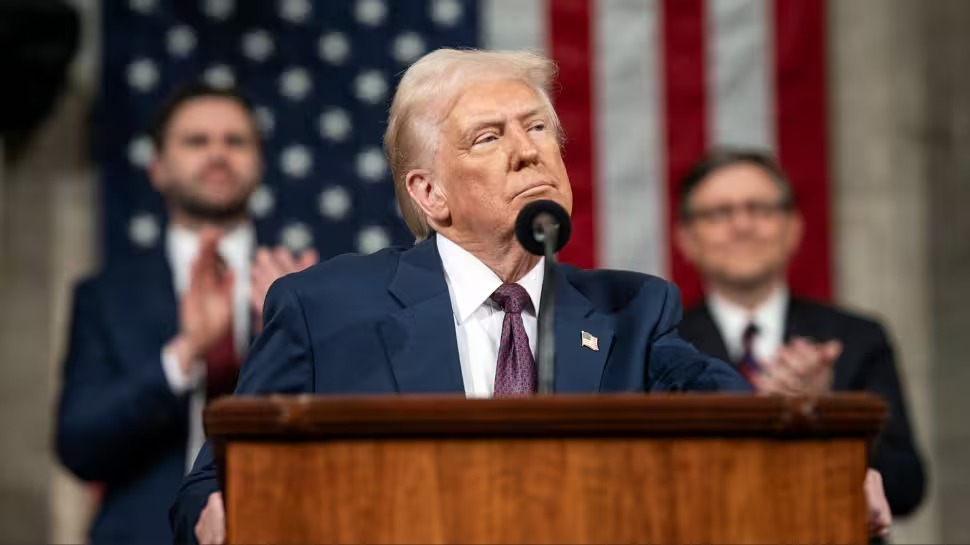
That theory, however, collided head-on with reality during the presidency of Donald Trump.
When Norms Collapse
Trump exposed a critical flaw in the American system: it relies heavily on unwritten rules and good faith. When those disappear, the safeguards weaken fast.
He showed open contempt for international agreements the US itself had promoted, the Paris Climate Accord, the Iran nuclear deal, NATO commitments and even strategic understandings with partners like India. These were brushed aside unilaterally, often without seeking congressional approval. Treaties became disposable, international law optional.
The most striking example was Venezuela. Trump publicly suggested the US would “run” the country temporarily, while American companies eyed its oil reserves. There was no United Nations mandate, no allied consensus, just raw assertion of power, in open violation of the UN Charter, which the US helped draft after World War II. Congress watched, divided and largely silent.
The Rise Of The “King President”
At home, Trump steadily hollowed out institutional restraints. Federal agencies were packed with loyalists. Ethical norms were ignored. Congressional subpoenas were treated like junk mail. Emergency powers were declared to redirect funds for projects Congress had rejected, including the border wall.
In his second term, the rhetoric and threats escalated further, talk of deploying the National Guard against protests, punishing cities by cutting funds, branding the press “fake news”, even floating the idea of delaying elections if outcomes were inconvenient.
The celebrated checks and balances now look threadbare. Practices that would be scandalous in many developing countries, a head of state profiting openly through family businesses, real estate ventures and cryptocurrencies, have become routine. Watchdogs barely whisper. Oversight collapses under partisan loyalty.
These are not isolated excesses. They point to a system where the president increasingly acts as judge, jury and executioner, while Congress hesitates and courts retreat behind claims of “executive privilege”.
A World Walking On Eggshells
Trump’s unpredictability has unsettled allies across the globe. Leaders tread carefully, unsure whether a phone call might lead to sudden demands or public humiliation. Diplomacy has become transactional and volatile.
European leaders hedge commitments, aware that a single social media post could upend trade deals or NATO obligations overnight. Partners such as India, Britain or Australia keep their distance, wary of promises with a short shelf life. Even close allies like Canada hesitate to sign long-term agreements when policy can reverse on a whim.
Threats against Denmark over Greenland, bullying of Mexico, pressure on South American nations to “fall in line”, the language often resembles that of a property tycoon, not the leader of a constitutional democracy. The Oval Office has turned into a bully pulpit, eroding trust built over decades.
The Illusion Of Restraint
Congress, meant to be the ultimate check, has largely failed. Arbitrary tariffs imposed under the guise of “national security” disrupted economies worldwide, yet lawmakers offered little resistance. A Supreme Court reshaped by presidential appointments has shown notable deference on foreign policy. Autocrats are welcomed, elected leaders mocked, and democratic norms dismissed.
The core problem is now clear. The presidential system assumes leaders will respect conventions, restraint and institutional boundaries. When they don’t, the system offers few immediate corrections. Impeachment becomes meaningless in a polarized environment. Power concentrates rapidly.
Why India Should Think Twice
For Indians debating constitutional change, the lesson is sobering. America’s experience shows how easily a presidential system can slide toward personalized rule when norms erode. What looks decisive can become dangerous. What appears efficient can turn arbitrary.
India’s parliamentary democracy is often chaotic, argumentative and slow. But that “messiness” distributes power, forces negotiation and prevents any one individual from dominating the state unchecked.
In the long run, a noisy ensemble may be safer than a solo act with absolute control. In democracy’s grand performance, wiser chaos may beat dangerous certainty every time.

Comments are closed.