
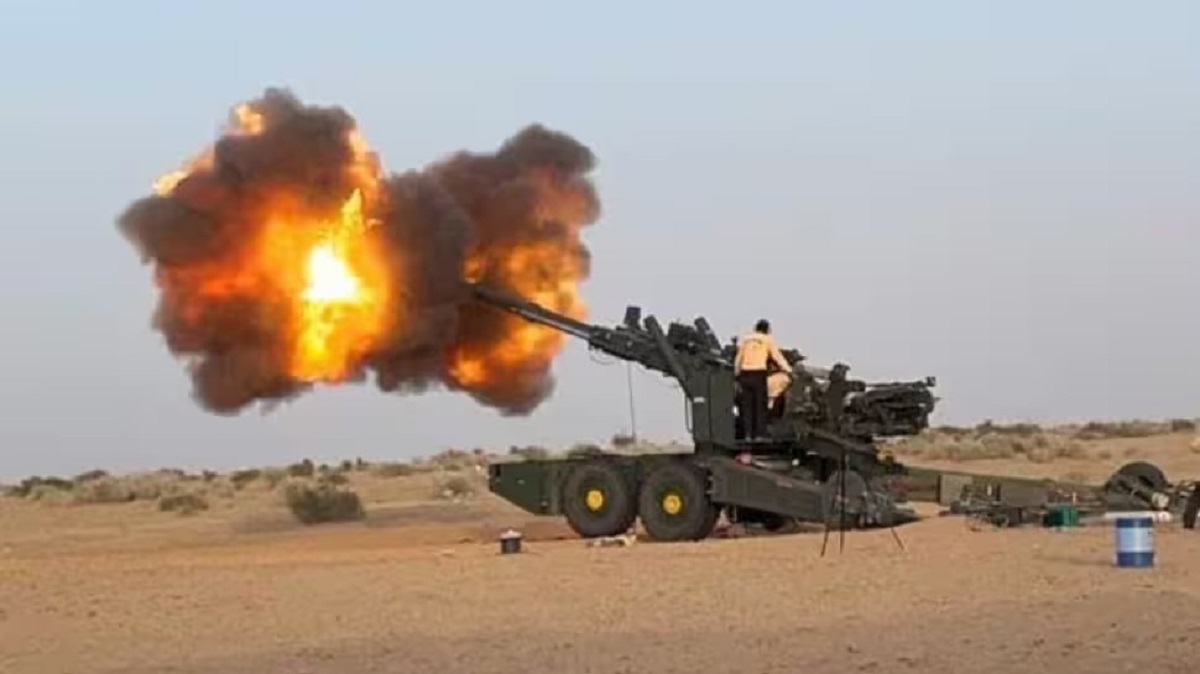

India’s defense export ambitions are getting a big boost. Following the successful demonstration of the indigenous Advanced Towed Artillery Gun System (ATAGS) in Armenia, many countries in the Middle East have started showing keen interest in Indian artillery systems. According to defense sources, this interest is reaching the stage of formal negotiations after the reliability and capability of ATAGS has been proven in war-like situations in Armenia.
The 155 mm/52 caliber ATAGS, developed by DRDO in collaboration with Bharat Forge and Tata Advanced Systems, is now emerging as the backbone of the Indian artillery capability. In trials conducted at the Pokhran Field Firing Range, the system demonstrated a range of over 48 kilometres, high accuracy and superior maneuverability in various terrains. The same capabilities also came to the fore during its use in Armenia.
Armenia ordered six units of ATAGS in the first phase and subsequently ordered 84 additional units under a deal worth approximately $155 million. According to defense analysts, this order is not just a commercial deal but a solid seal of confidence in Indian weapon systems.
Defense sources say that after this success, two to three countries of the Middle East have moved beyond initial inquiries to the stage of detailed technical briefing and evaluation. Saudi Arabia and the United Arab Emirates (UAE) are among the major countries that have shown special interest in ATAGS and other Indian artillery systems. These countries already have experience of defense cooperation and trials with India, due to which the possibility of new deals is considered strong.
India’s artillery portfolio is not limited to ATAGS only. This includes Kalyani Group’s MArG 155 mounted gun system, an ultra-light howitzer and precision-guided munition for high mountain areas. These systems have been developed keeping in mind the modern military requirements like desert warfare, mountain defense and “shoot and scoot”. Interoperability in line with NATO standards, relatively low cost and the offer of technology transfer make these more attractive than Western alternatives.
In a time of geopolitical changes, when countries in the Middle East are rapidly modernizing their armies, India is being seen as a reliable and neutral defense supplier. Prices for Indian systems are said to be 30–40 percent lower than many Western alternatives, while performance and quality are not compromised.
Defense officials are hopeful that the ongoing high-level discussions could result in concrete contracts. This will accelerate India’s annual defense export target of ₹50,000 crore by 2028–29. The success of ATAGS in Armenia is seen as a symbol of India’s maturing defense ecosystem, where globally competitive weapon systems are being developed in partnership with DRDO and private industry.
Also read:
Big relief to gig workers after Centre’s intervention!
Jammu and Kashmir turned from terrorism to tourism, 31 terrorists killed: Army Chief!
In Bihar, elderly people will get the facility of land-flat registry sitting at home!

Comments are closed.