
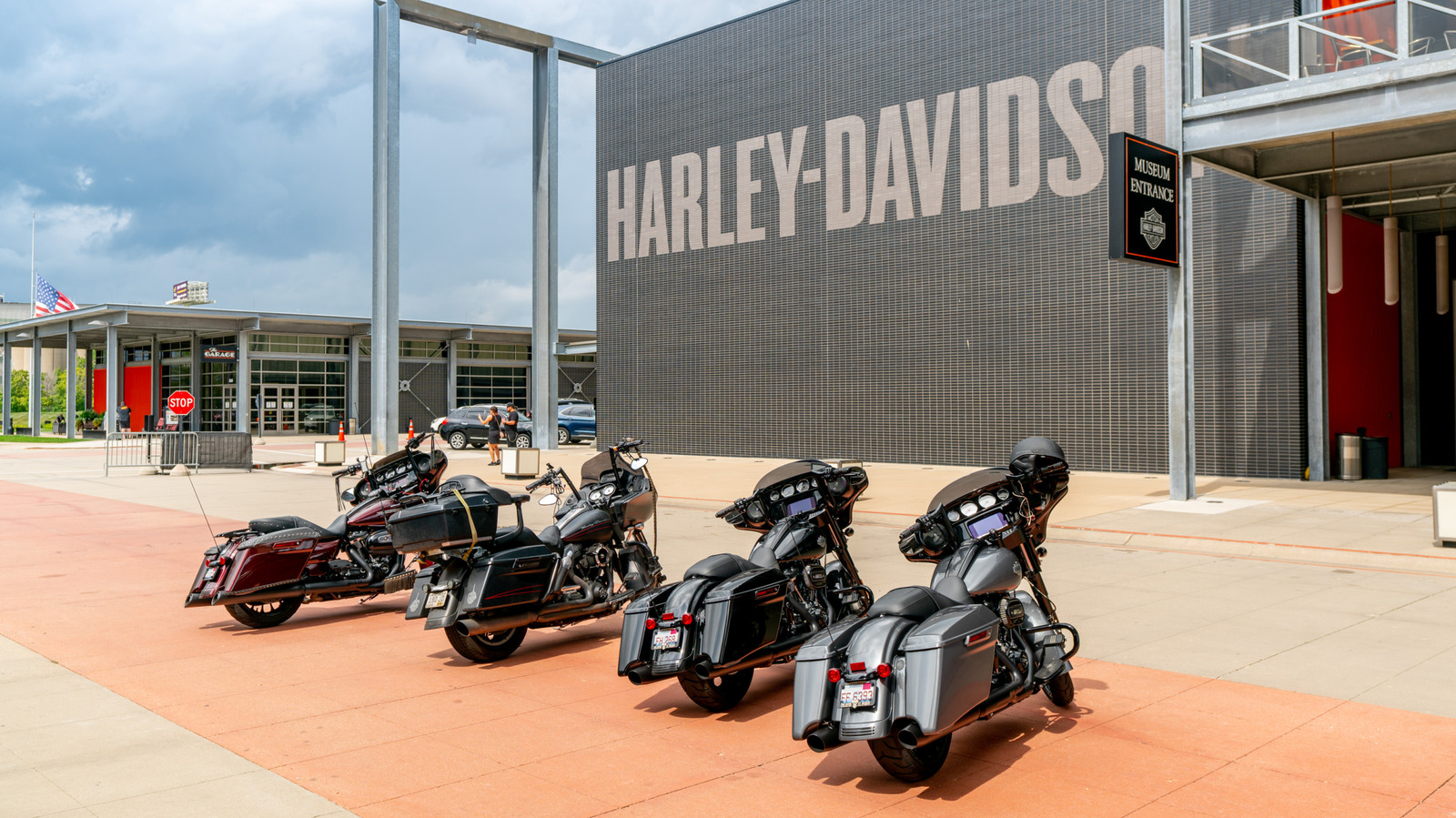

Located at 400 West Canal Street in Milwaukee, Wisconsin, the official Harley-Davidson Museum should be on the bucket list of any big fan of the brand. The museum has been open since 2008 and sits a few miles from the former Davidson household, where the first Harley-Davidson was built. It reportedly cost the company $75 million to build, and was designed to provide a permanent home for the brand’s heritage collection.
Within that collection, there is a wide variety of bikes from every era of the company. Each fan will have their own personal favorite era, and perhaps one or two bikes in particular that they want to see at the museum, but these 15 bikes are a small selection of the most notable models that visitors can expect to come across during their tour. Each has played a particularly important role in the company’s history or is a rare model — in some cases, these motorcycles are the sole surviving examples of their kind. Whether you’re planning a trip soon or are aiming to visit in the future, it’s worth making sure you don’t miss out on seeing each of these cool Harley classics.
1903/04 Harley-Davidson Motorcycle
The oldest Harley-Davidson at the brand’s official museum dates from 1903, and it was the first motorcycle ever produced by the fledgling company. Harley-Davidson was founded by William S. Harley and Arthur Davidson, and initially, their factory was nothing more than a 10 x 15 ft shed in the backyard of Davidson’s father’s house. It was there that the two built their initial motor-powered bicycle — back then, every Harley still came with pedals as well as an engine.
Harley-Davidson only built a small number of these initial motorcycles, and the Harley-Davidson Motor Company wasn’t officially incorporated until 1907. This early bike had a leather belt drive and a 24.74 cu-in engine and was reportedly capable of reaching a top speed of around 40 mph. Considering the early bike’s design was little more than a conventional bicycle with a motor attached, even that modest speed must have felt thrillingly fast to riders. However, it wasn’t long before the company’s motorcycles could reach much higher speeds.
Elvis Presley’s 1956 Harley-Davidson KH V-Twin
The King of Rock ‘n’ Roll was well known for his love of motorcycles and amassed an impressive collection of them throughout his life. He owned a string of Harley-Davidsons, including a 1956 KH V-Twin. He bought the motorcycle when he was 21 and still a rising star. The motorcycle cost $903, but Presley hadn’t yet released his biggest hits, and so was still relatively low on cash. As a result, he reportedly had to finance the motorcycle for around $50 per month.
This ’56 Harley has become one of his most famous motorcycles, partly because it can be viewed at the museum, and partly because it appeared in his cover shoot for “The Enthusiast” magazine. However, it isn’t actually the first Harley that Presley bought. Instead, his first purchase from the brand was a 165cc Hummer, which he picked up in 1955. The purchase of the KH was a notable step up both in power and looks, although Presley didn’t ride his now-famous bike for long.
Presley soon sold it to make room for a newer Harley, and his friend Fleming Horne was its second owner. After around four decades of ownership, Horne would eventually sell the ’56 KH back to Harley-Davidson in 1995, and it has remained part of the brand’s official collection ever since.
1936 Harley-Davidson EL Knucklehead
To say that the Harley-Davidson EL Knucklehead has been influential is an understatement. The model was hugely important for the company at the time, pushing it ahead of its domestic rivals with an all-new design that the brand’s designers would continue to borrow from for decades after the first example left the factory. The “Knucklehead” moniker was not created by Harley-Davidson, but rather it was a nickname given to the bike by customizers, with the “knuckle” being a reference to the shape of the bike’s rocker boxes.
Even though the EL Knucklehead is now one of the brand’s most valuable models thanks to its influence and success, company bosses originally weren’t sure if it would be a hit. In fact, some executives reportedly discussed plans to shelve it, but eventually the launch was given the green light. One of the earliest examples of the bike, a 1936 model, resides in the museum’s collection today.
1942 Harley-Davidson WLA V-Twin Military
Harley-Davidson’s WLA motorcycles were an important tool for Allied military forces during World War II, and the brand’s museum has a 1942 example in its permanent collection. Curiously, almost all of the WLA V-Twin Military motorcycles built from 1942 onwards were officially labelled as being from 1942, even though production continued sporadically until the early ’50s thanks to Harley’s lasting military contracts. Multiple slightly different variations were built during that time, but Harley just labelled them all as 1942 bikes regardless.
A small batch of WLA motorcycles was produced before the U.S. entered the war, with the first examples emerging in 1940. However, the vast majority were made during wartime, with around 88,000 examples thought to have been built in total. Few survive intact today, with the Harley-Davidson Museum among the most accessible places to see one in person. The museum also houses several wartime motorcycle prototypes, including a couple of sidecar motorcycles that never made it to production.
1909 Harley-Davidson Model 5-D V-Twin
In the early days of the company, Harley-Davidson was constantly improving its models, refining designs, and developing technology, even if some of its innovations weren’t a hit with customers at first. The 1909 Harley-Davidson V-Twin that sits in the brand’s museum is a great example of that development, since although the V-Twin engine is a core part of the brand’s image today, it wasn’t popular at launch. Just 27 examples of the original V-Twin bike were built, but Harley continued to work on the engine and eventually fixed the problems faced by the earliest model.
The V-Twin was just one of several variants of the brand’s Model 5, and was designated as the 5-D. Buyers weren’t sold on the 5-D’s performance, and it would take until 1911 for Harley to design a V-Twin engine that could sway buyers away from the rest of the brand’s range. Although the 1909 5-D was a sales flop, its failure paved the way for future development. The same cannot be said for some other ultra-rare Harleys, with the now mostly-forgotten VR1000 superbike proving that not all of the brand’s high-profile projects would end up being as successful as the V-Twin engine turned out to be.
1923 Harley-Davidson 8-Valve Board Track Racer
There are several good reasons why the sport of motorcycle board racing doesn’t exist today. The first was that it proved to be very dangerous, with several fatal accidents during the sport’s short existence. The second is that the wooden board tracks themselves would remain in raceable condition for only a few years before degrading to the point of being unrideable. It’s easy to see why such a sport couldn’t survive, but it’s also easy to see why it attracted such attention from spectators and motorcycle manufacturers alike while it was around.
One such manufacturer was Harley-Davidson, which produced a dedicated board track racing motorcycle in 1923. A total of 20 examples of the brand’s 8-Valve Board Track Racer were built, each producing 15 horsepower and reaching a top speed of 120 mph. For context, the first Harley-Davidson motorcycle, produced two decades earlier, had a top speed of 40 mph.
With board track racers reaching triple-digit speeds and needing to stay close to one another in order to take advantage of each other’s slipstream, the sport was always going to be extremely risky. It managed to survive until the late ’20s, but the economic downturn at the end of the decade saw it disappear altogether from motorsports calendars.
1941 Harley-Davidson V-Twins King Kong
Custom motorcycle builders are an integral part of Harley-Davidson’s heritage, adding their own individual twists to the brand’s bikes while retaining the bits that make each model great. Harley has even bought a few custom bikes for its heritage collection, with one of the wildest being “King Kong,” a motorcycle that features two V-Twin engines. It was built by Felix Predco, with the initial build taking four years to complete. Predco started in 1949 and had a finished, working bike in 1953, but he continued to tweak it further over the following two decades.
King Kong is constructed from two frames that have been joined together, with two Knucklehead engines providing the power. If that wasn’t enough, the whole build is festooned with weird and wonderful accessories, including air horns powered by scuba diving tanks. In total, King Kong clocks in at 148 inches long, only a few inches less than some economy cars like the Mitsubishi Mirage.
1936 Harley-Davidson VLH Police Motorcycle
Just over 2,000 examples of the 1936 Harley-Davidson VLH Police Motorcycle were built, and while it isn’t the rarest motorcycle at the brand’s museum, few are known to survive. It featured Harley’s side-valve engine, also known as a flathead, which had originally debuted in 1929. When it launched, buyers weren’t impressed, but Harley continued to improve the engine’s design and had fixed its early flaws by the time the police motorcycle was produced.
In addition to being desirable among enthusiasts in America, the ’36 VLH Police has also attracted the attention of some collectors across the pond. In 2023, an example of the bike appeared at a Bonhams auction in need of some restoration, eventually selling for £20,700 (around $27,900). It’s far from being Harley-Davidson’s most valuable motorcycle, but even collectors who could afford one will likely have to wait a long time before another example appears at auction. In the meantime, they can view the bike as part of the brand’s official museum collection.
1960 Harley-Davidson Topper
Every enthusiast’s mental image of the quintessential Harley-Davidson will look slightly different, but it’s safe to assume none will be thinking of a bike that looks like the Topper. It’s the brand’s only scooter, and for good reason. The short-lived Topper appeared at the start of the ’60s as an affordable alternative to the brand’s larger bikes, and was conceived in response to the rising popularity of Japanese and European motorcycles.
However, traditional Harley-Davidson buyers weren’t looking for a scooter, and the Topper wasn’t advanced or cheap enough to tempt other buyers away from foreign manufacturers’ showrooms. The scooter remained on sale until 1965, having sold only 3,000 examples in half a decade. The brand’s museum has one on display alongside a number of other oddities, including a Harley-Davidson boat and even a golf cart. Plenty of younger enthusiasts might not even be aware that Harley-Davidson ever made a golf cart, but they actually remained on sale for almost two decades, significantly outlasting the Topper’s production run.
1936 Harley-Davidson EL Streamliner
Sometimes referred to as the “Bluebird” because of its unique paint job, the Streamliner was a heavily modified 1936 EL Knucklehead that Harley-Davidson built in an attempt to set a new speed record. It was a success, with the Streamliner clocking a top speed of 136.183 mph thanks to the skill of its decorated rider, Joe Petrali.
The stunt took place on Daytona Beach in Florida, and to anyone watching, the bike must have looked incredibly futuristic. However, some of its modifications were not quite so cutting-edge on closer inspection. For example, the front fairing was not a bespoke, custom-made part, but was actually a chopped-up gas tank. The bike’s tachometer was also drawn by hand by a Harley engineer.
Petrali’s showcase of the EL Streamliner was just one of many Harley-Davidson speed record attempts. Cal Rayborn set another record in 1970, hitting 265.492 mph aboard a custom streamliner, while the Easyriders streamliner of 1990 clocked 322.15 mph thanks to the power of a pair of Shovelhead V-twin engines.
2008 Harley-Davidson WLA OHV V-Twin Captain America
As well as being ridden by movie stars, Harley-Davidson’s motorcycles have also occasionally become movie stars themselves. Several replicas of the World War II-era WLA OHV V-Twin were ridden by Captain America in 2011’s “Captain America: The First Avenger,” although underneath, each bike had modern underpinnings.
The Captain America replicas were all based on the 2008 Cross Bones, although they were painstakingly crafted by Marvel’s build team to look like they were destined for wartime service. Five replicas were built in total, with each one featuring period-correct extras, including a gun scabbard.
Using original 1942 examples of the bike was out of the question, thanks to the film’s many stunt scenes, with three replicas being subject to stunt duty and two used for other scenes. When filming wrapped, two of the surviving motorcycles were donated to Harley-Davidson’s collection, with one available to view at the brand’s Milwaukee museum.
1957 Harley-Davidson XL Sportster
A legendary model among fans of the brand, Harley-Davidson has been making the Sportster since 1957. The museum’s collection includes one of the earliest models, and unlike many surviving examples, it remains unmodified. Much like the Topper scooter of 1960, the XL Sportster was developed in response to foreign competition. However, unlike the Topper, buyers quickly came to appreciate the Sportster, both in stock form and as a basis for modified builds. It remains a popular model to modify today.
Development of the Sportster began as British motorcycles were growing increasingly popular in America. Harley wanted to tempt buyers back to its showrooms. The answer the bosses came up with was to borrow design elements from those British bikes and add an American twist — in this case, more power and a greater focus on touring. It proved to be an extremely successful formula, and one that would continue for many decades after the original 1957 bike was launched.
1972 Harley-Davidson AMF MC-65 Shortster
With so many rare and interesting motorcycles in Harley-Davidson’s museum, it’s easy to overlook oddball models like the 1972 Shortster minibike. Displayed alongside a Harley-Davidson golf cart and a boat, the Shortster is one of the brand’s least visually imposing models. Yet it’s arguably one of the most interesting, at least for enthusiasts who enjoy finding out about the more obscure chapters of the brand’s history.
The MC-65 Shortster only existed because of Harley-Davidson’s purchase of Aermacchi, an Italian motorcycle maker. It launched in 1972 and remained on sale for just a single year before being replaced by another minibike, the Shortster X90. The latter model was built until 1975, but despite also sporting the Shortster name, it was mechanically very different from the MC-65.
The MC-65’s tiny 63.8cc engine was about as far from the stereotypical Harley as possible, but thanks to the minibike craze driven by the likes of Rupp, it wasn’t a commercial flop in the same way that some of the brand’s earlier small bikes had been. However, survivors such as the museum’s example are still hard to find today.
1933 Harley-Davidson VLD Side Valve V-Twin
With sales figures slumping thanks to the Great Depression, Harley-Davidson didn’t have a whole lot of development cash to spend on its newest bikes for the 1933 model year. Rather than be seen to be resting on its laurels, the company decided to tweak its lineup in a different way, creating a range of color options for the first time. The 1933 VLD Side Valve V-Twin on display in the museum features a two-tone black-and-red paint scheme, but a long list of other paint options was available.
Buyers wanting a clean, simple look could opt for a white paint finish, while a blue-and-turquoise color scheme was available for those looking to stand out. A different shade, that Harley called “Police Blue”, could be optioned with cream accents, and a more traditional olive green was also still available. Craftsmen at the factory would complete every single motorcycle’s stripes by hand.
1981 Harley-Davidson FLH-80 Heritage Edition
After more than a decade of being part of AMF, Harley-Davidson was spun off into an independent entity once again in 1981. It was a significant milestone for both riders and executives, marking a new chapter in the brand’s history. To commemorate the change, Harley-Davidson organized a celebratory media ride that took the nation’s biking journalists on a tour of the brand’s dealerships. It also created a special Heritage Edition of its FLH-80, with one example now residing in the brand’s permanent collection.
The idea of the Heritage Edition was simple: combine contemporary power and technology with the looks and feel of Harley’s classic ’40s bikes. Around 1,000 examples were reportedly built, each one with an 81 cu-in Shovelhead engine making 67 horsepower. Unique features, such as leather-fringe bags, made the Heritage Edition stand out, but in the Harley-Davidson Museum’s collection, it’s simply one of many cool bikes that enthusiasts can admire.

Comments are closed.