
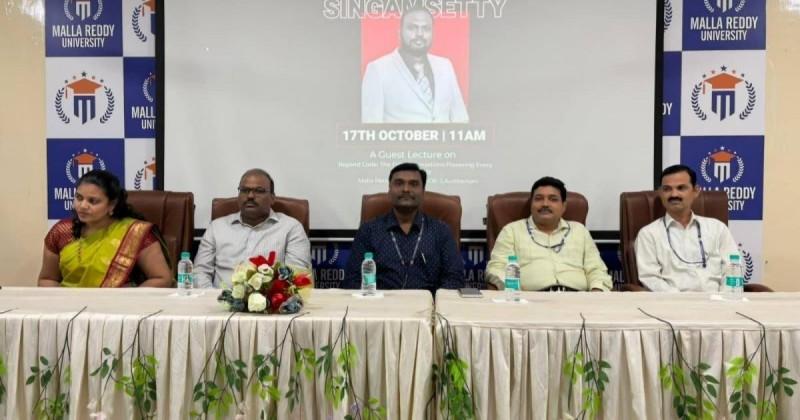
Industry Expert Saisuman Singamsetty Delivers Guest Lecture on Data Engineering and Governance at Malla Reddy University

Malla Reddy University’s Department of Artificial Intelligence and Machine Learning hosted a guest lecture on data engineering and data governance, delivered by Saisuman Singamsetty, a recognized industry expert in enterprise data governance with deep experience in regulated industries. The university selected Singamsetty for his practical expertise in implementing governance frameworks that address complex compliance and ethical requirements.
The lecture, titled “Data Engineering & Governance: The Foundation Every Tech Project Stands On,” addressed how data engineering practices influence system reliability, scalability, and long-term usability across sectors such as finance, healthcare, and technology.
The event was attended by senior academic leadership, including Dr. Gifta Jerith, Dean of AI and ML; Dr. R Naga Raju, Head of the Department of AI and ML; Dr. S Satyanarayana, Professor of AI and ML; and Mr. Dillep Kumar, Assistant Professor,reflecting the university’s commitment to bridging academic curriculum with industry realities.
Data Foundations as a Strategic Enterprise Capability
During the lecture, Saisuman Singamsetty drew attention to a recurring pattern observed in enterprise technology initiatives: advanced analytics and AI programs frequently underperform not because of model design, but due to fragmented data assets, unclear ownership, and the absence of consistent governance mechanisms. Using structured scenarios, he illustrated how legacy system integrations, conflicting reports derived from the same datasets, and the lack of a clear data roadmap can erode trust in analytics and stall decision-making.
The session examined data as a strategic anchor—linking business objectives, regulatory expectations, and technical execution—and highlighted how metadata, data quality controls, and well-defined roles across the data lifecycle enable stability and scalability in complex environments. Reference architectures for data modernization, metadata management, and data quality were discussed to demonstrate how organizations translate governance principles into operational practice rather than treating them as policy artifacts.
“We specifically sought out Mr. Singamsetty for this lecture because of his hands-on expertise in operationalizing data governance at scale in highly regulated environments,” said Dr Gitta Jerith, Dean, Artificial Intelligence and Machine Learning, Malla Reddy University. “Engagements like this provide our students with valuable exposure to how foundational data engineering and governance principles operate in real enterprise environments—particularly in areas where data quality, responsibility, and scalability are critical to success.”
Governance as an Engineering Responsibility
A significant portion of the lecture examined how data governance frameworks directly shape system architecture, operational controls, and ethical outcomes in enterprise environments. Saisuman Singamsetty discussed how regulatory standards such as GDPR and HIPAA influence decisions across the data lifecycle—from ingestion and classification to access controls, lineage tracking, and retention—particularly in regulated sectors such as finance, healthcare, and connected technologies.
Rather than presenting governance as a compliance overlay, the session emphasized governance as an engineering and design responsibility. Using governance pillars such as data quality management, stewardship models, metadata management, and lifecycle controls, the lecture illustrated how organizations embed privacy, security, and accountability into day-to-day data operations. These practices, Singamsetty noted, are essential for maintaining analytical consistency, auditability, and trust as systems scale.
“Mr. Singamsetty’s depth of experience in implementing data governance across regulated industries provided our students with insights rarely available in academic settings. Sessions like this help students understand that successful AI systems are not built on algorithms alone,” said Dr. S. Satyanarayana, Professor, Artificial Intelligence and Machine Learning, Malla Reddy University. “Strong data engineering practices—supported by governance frameworks, quality controls, and ethical safeguards—are what ensure reliability, scalability, and responsible use in real-world deployments. His ability to connect theoretical frameworks with practical implementation challenges reflects exactly the kind of expertise our industry needs.”
The discussion reinforced that ethical data handling is inseparable from technical execution, and that governance-driven design decisions play a central role in sustaining public confidence and organizational credibility in data-driven systems.
Real-World Applications: Data Governance Across Regulated Industries
The lecture encouraged students to recognize data engineering as a core professional discipline that shapes the success of analytics and AI initiatives, rather than a background technical activity. Drawing on enterprise scenarios, Saisuman Singamsetty outlined how responsibilities such as defining data models, managing metadata, enforcing quality controls, and supporting governance workflows directly influence system reliability, regulatory readiness, and long-term maintainability.
Students were introduced to how data engineering roles evolve across organizational maturity levels and how skills such as lifecycle awareness, cross-functional collaboration, and stewardship alignment are increasingly expected of professionals working in data-driven environments. By mapping academic concepts to enterprise operating models, the session helped students understand how foundational data skills translate into practical decision-making and sustained impact across industries and emerging technology domains.
Strengthening the Foundation for Data-Driven Transformation
The lecture formed part of Malla Reddy University’s broader initiative to strengthen its academic programs by integrating perspectives from experienced industry practitioners. Sessions like these serve a critical purpose: as organizations across finance, healthcare, technology, and manufacturing increasingly rely on data to drive strategic decisions, the demand for professionals who understand both the technical and governance dimensions of data systems continues to accelerate.
The challenges Saisuman Singamsetty addressed, including data quality failures, governance gaps, regulatory compliance pressures, and the ethical implications of AI systems, are not isolated to any single sector. They represent foundational obstacles that organizations worldwide encounter as they scale analytics capabilities, modernize legacy infrastructure, and navigate evolving regulatory landscapes. For industries undergoing digital transformation, applying the principles Saisuman discussed—metadata management, stewardship models, lifecycle controls, and governance-driven design—helps organizations strengthen resilience, stay compliant, and gain a competitive edge.
Organizations that fail to establish disciplined data foundations face compounding risks: analytical inconsistencies, compliance exposures, reputational damage, and diminished returns on technology investments. As systems grow more complex and regulations tighten, Singamsetty’s shared expertise equips students for the workforce and shows organizations how to turn data into a strategic advantage.
The session closed with an interactive discussion that brought the lecture full circle, as students explored real-world challenges in data governance and shared insights on career paths in data engineering and analytics. By connecting expert guidance with student curiosity, Saisuman Singamsetty’s lecture underscored how mastery of data practices can shape both individual careers and the future of technology-driven organizations.

Comments are closed.