
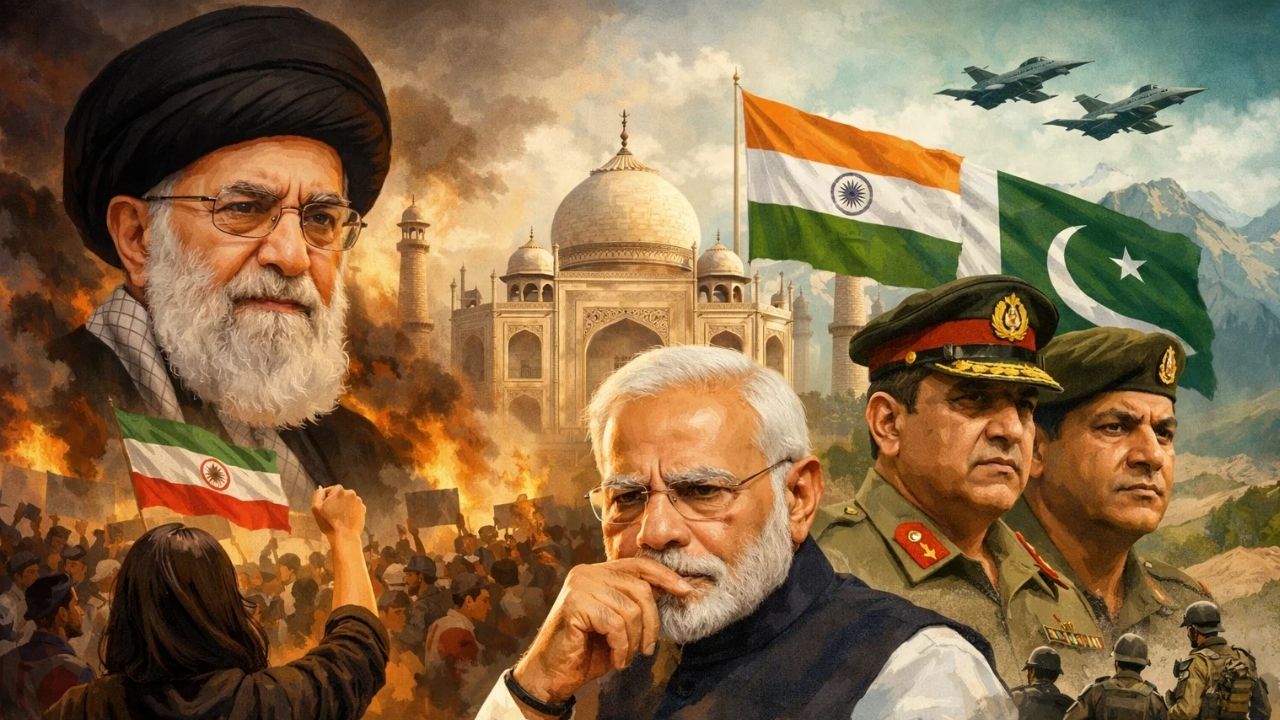
What is India afraid of amidst the smoldering Iran? If Khamenei’s government goes, will Pakistan gain or lose?

The protests in Iran’s cities stemming from economic distress and political fatigue are no longer just an internal crisis. Amidst the crowds taking to the streets, increasing violence and slogans echoing against the government, India is keeping a very alert eye on these developments. The question for New Delhi is not whether Iran’s current religious leadership will be able to overcome this crisis, but rather what impact it will have on India’s already limited strategic options if the Iranian state weakens or disintegrates.
According to the report published in Times of India, relations between India and Iran have never been driven by ideology. These relations are formed due to the constraints of geography, reach and regional balance. Iran has been India’s only viable corridor to the west after Pakistan closed land routes to Afghanistan and Central Asia. Additionally, Iran has long been a balancing force against Pakistan’s regional influence and a key pillar of India’s West Asia policy.
Weak Iran, increasing uncertainty
If Iran suddenly weakens or the power structure collapses, it will not result in a clean transition. Rather, this will start a period of uncertainty when India is already facing pressure on many fronts. News of instability in Bangladesh and attacks on minorities, Pakistan’s past actions, China’s increasing interference and America’s unpredictable global policy under the leadership of Donald Trump. Any major shock in Iran can affect India’s trade routes, diplomatic equations and security calculations established over the years.
India’s gateway to Central Asia
For decades, Iran has been India’s most important land bridge to reach Afghanistan and Central Asia. Due to Pakistan’s refusal, Tehran became the backbone of India’s western connectivity strategy. The center of this strategy is Chabahar Port, which was developed with Indian cooperation. Its objective was to bypass Pakistan and directly reach the Iranian coast and proceed from there through road-rail network. For India, Chabahar was not just a port, but a message that geography alone does not decide destiny.
JNU Professor Rajan Kumar said while talking to Times of India that ‘Iran remains the most important land corridor for India to reach Central Asia, because Pakistan does not allow India access through overland routes.’ Despite the withdrawal of Taliban and interruption in projects due to sanctions, the strategic importance of Chabahar has not diminished. If there is prolonged instability in Iran, these projects may be in danger. Kumar warns, ‘In the event of a possible power struggle after Khamenei, Chabahar may risk becoming a hostage to instability rather than a strategic asset.’
balancing role against pakistan
The importance of Iran was not limited to geography alone. Despite being a Muslim majority country, Tehran never openly supported Pakistan’s anti-India narrative. On the contrary, Iran has always opposed those Sunni extremist organizations which are a threat to the Shia community and Indian interests. In the 1990s and 2000s, when Pakistan was supporting the Taliban, India and Iran were standing on the same side. This coordination prevented Pakistan from completely dominating the region. Pro. Kumar says in clear words that ‘If Iran weakens internally or disintegrates, then Pakistan will get indirect benefit from it.’
Shia Factor and India’s West Asia Policy
Iran is the world’s largest Shia power and this gives it a different role from Sunni-majority countries like Saudi Arabia. If Iran’s current Shia leadership weakens or is replaced by a Sunni-leaning government, the entire West Asian balance could change. India has maintained relations with Tehran, Riyadh, Abu Dhabi, Tel Aviv and Washington over the years. This multi-alignment has been India’s diplomatic strength. Kumar says that ‘being the major Shia power in West Asia, India has been silently getting strategic benefits from Iran.’
Will the change of power change everything?
Some experts believe that change of power does not mean a liberal government. Dr. Ashok Sharma says that ‘even if there is a change of power, it does not mean that the next government will automatically be liberal or fundamentally different.’ For India, dealing with a familiar but rigid system has been easier than the completely uncertain alternative.
Trade, Investment and Bets of Chabahar
India-Iran trade may be limited, but it is important. In the past years it has been between 1.3 to 1.7 billion dollars. India has invested more than $1 billion in Chabahar and its related projects. Any change in power can have a direct impact on these investments. After 25 years of Iran-China strategic agreement, Beijing’s influence has increased rapidly. Due to Western sanctions, Iran has become more dependent on China. If instability increases in Iran, China can establish a stronger hold there, which will further limit India’s role.

Comments are closed.