
Air Defenses That Never Fired: How The US Paralysed Venezuela’s Military And Captured Maduro | world news

Washington: The world watched in surprise as Venezuela’s sophisticated air defense systems were inactive during the recent US operation that led to President Nicolás Maduro’s arrest. How could a system designed to detect and intercept enemy aircraft fail to act, even when fully operational?
Analysts argue that the answer lies not in technical malfunction, but in the evolution of modern warfare, where the focus has moved from destroying enemy forces to neutralizing their ability to make decisions.
Decision-Centric Warfare In Action
Add Zee News as a Preferred Source
The absence of any visible engagement by Venezuelan air defenses cannot be dismissed as a simple operational mistake. Instead, it shows a structural transformation in contemporary conflict. Today, military superiority is increasingly defined not by the destruction of enemy platforms, but by the ability to disrupt an adversary’s decision-making, coordination and escalation management.
This evolution represents a fundamental doctrinal change. Modern warfare now integrates C4ISR (Command, Control, Communications, Computers, Intelligence, Surveillance and Reconnaissance), multi-domain operations and cognitive warfare into cohesive strategies. Victory is decided not by the destruction of missiles or aircraft, but by controlling the environment so that any adversary decision becomes impossible, irrational or strategically prohibitive.
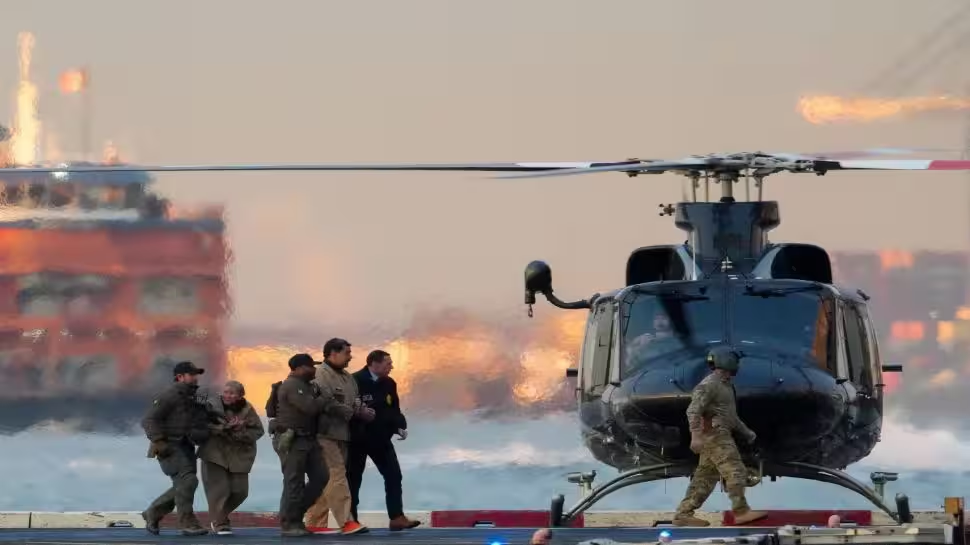
Operation Absolute Resolve, the US operation that resulted in Maduro’s arrest on January 3, illustrates this principle. Justified publicly as a revival of the Monroe Doctrine through what analysts call the “Trump corollary”, the operation was aimed at strengthening US control in the Western Hemisphere and countering Russian and Chinese influence.
The operation used intense intelligence, secret coordinated actions and teamwork between agencies, including the Drug Enforcement Administration (DEA). It focused on stopping the Venezuelan government from acting, rather than attacking its defenses.
This operation aligns closely with the National Security Strategy 2025, which emphasizes decision primacy, left-of-bang interventions (actions taken before an adversary can complete their decision cycle) and information dominance as central levers of modern conflict. In this structure, Operation Absolute Resolve was not simply a regime-change operation. It was a systemic attempt to strip the adversary of decision sovereignty.
From Info Power To Total Paralysis
Modern conflicts no longer follow a linear detect-engage-destroy pattern. Instead, integrated intelligence architectures determine the flow of action. Superiority is now measured by the ability to control information, synchronize effects and impose a strategic tempo the adversary cannot respond to.
Past operations in Kosovo, Iraq and Libya illustrate that systemic disorientation and command collapse often precede physical destruction.
The decisive points of today’s battles are informational and decisive, rather than geographical or purely military. Multi-domain operations connect air, land, maritime, cyber, space and electromagnetic assets to maintain continuity of effects.
Cognitive warfare further amplifies this advantage by creating doubt, uncertainty and hesitation within enemy ranks. Jamming, cyber operations and information manipulation aim not to blind the adversary completely but to make decision-making prohibitively risky.
The result is a new mode of conflict known as Decision-Centric Warfare. Rather than seeking to destroy enemy forces, it focuses on creating persistent decision disadvantages, preventing the adversary from observing clearly, orienting effectively, deciding credibly or acting with confidence. This strategy puts Colonel John Boyd’s OODA loop into action, disrupting the enemy’s decision-making and fitting with modern systems like JADC2.
Why Venezuela’s Air Defenses Were Neutralized
Venezuela possessed a mix of long-range S-300VM/Antey-2500 systems, medium-range Buk-M2 platforms, Pechora-2M batteries and short-range Igla-S MANPADS. On paper, this inventory offered major air-denial capabilities. In practice, effectiveness relied heavily on centralized command and intact information flows.
The Venezuelan military required both operational sensors and clear and credible orders from the top.
Political instability at the highest level, along with Maduro’s contested legitimacy, created friction that slowed decision-making. Fear of internal betrayal, political repercussions or post-hoc scrutiny made military commanders hesitate.
As a result, engagement became a high‑risk political choice rather than a routine operational task. The inaction of Venezuela’s air defenses was therefore not a technical failure but an intentional effect of systemic decision-strangulation.
Rather than decapitating command nodes through strikes, the US operation created an environment in which decision-making was paralyzed. Intelligence, combining with human sources, electronic monitoring and clandestine coordination, saturated the command chain.
The military was technically capable, but politically immobilized. Air defense systems could detect threats and track aircraft, but could not act without risking catastrophic strategic consequences.
Decision Superiority Defines Modern Conflict
The Venezuelan case illustrates that contemporary military success is no longer about destroying enemy hardware. It is about controlling decisions and guiding how risks are seen. AI-enhanced C4ISR systems compress the decision cycle, exploit asymmetries and preempt actions that adversaries might otherwise take. Multi-domain operations disrupt timing and cognition, while cognitive warfare creates strategic hesitation.
Victory now belongs to those who dominate the operational environment before kinetic engagement is necessary. Decision-Centric Warfare transforms intact capabilities into inert instruments if the political and informational conditions are carefully manipulated.
As warfare evolves, analysts argue that controlling the adversary’s capacity to act will define power more than firepower or platforms. The arrest of Nicolás Maduro and the silence of Venezuela’s air defenses highlight that 21st-century conflict is increasingly about decision superiority. Those who can impose command by denial, influence perception and orchestrate information-driven paralysis effectively win before a shot is ever fired.

Comments are closed.