
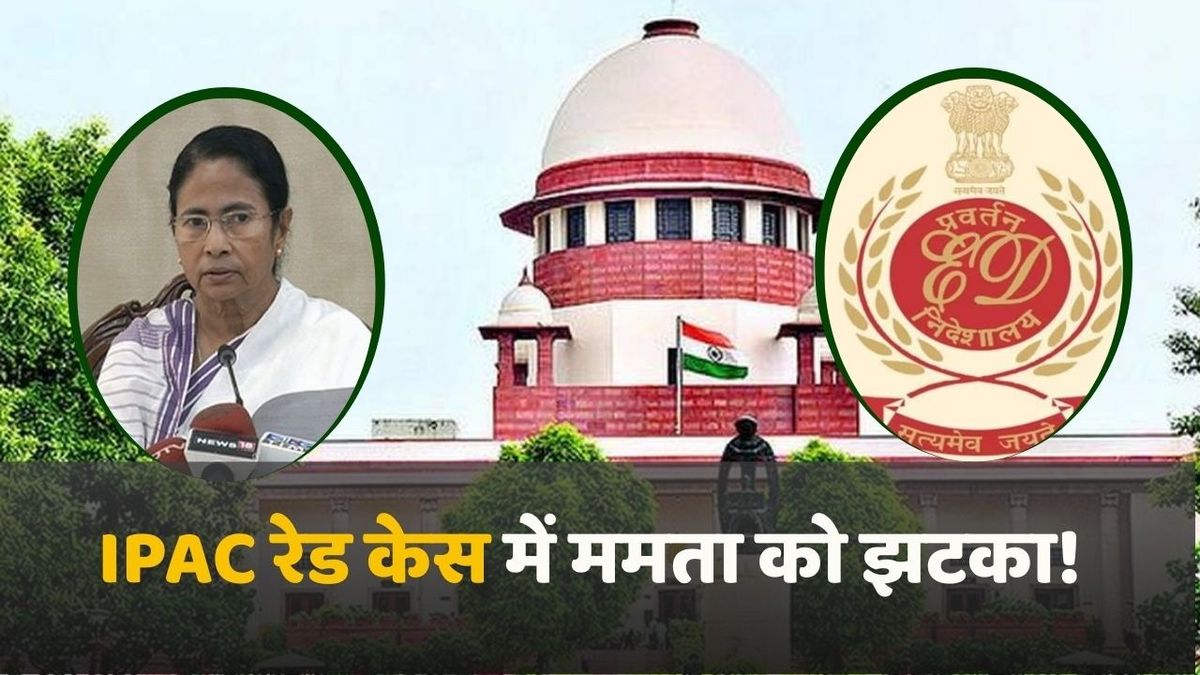
Mamta’s arguments did not work in IPAC raid case, Supreme Court said it is a serious matter

IPAC Raid Case: The controversy over the Enforcement Directorate (ED) raid on the office of political consultancy firm I-PAC and its associated persons in Kolkata has now taken the form of a constitutional debate at the national level. On Thursday, this case was heard in the Supreme Court, where the court called it serious and decided to issue a notice.
What comment did the Supreme Court make?
The bench of Justice Prashant Kumar Mishra and Justice Vipul Pancholi said during the hearing that they were deeply distressed that the Calcutta High Court was not allowed to hear the case. The court clearly said that this is not just a dispute between an investigating agency and the state government, but has become a matter of institutional conflict, which needs an in-depth review.
The Enforcement Directorate (ED) has approached the Supreme Court with a fresh application ahead of the hearing in the IPAC raids matter, seeking the suspension of West Bengal Director General of Police (DGP) Rajiv Kumar.
In its plea, the ED has also called for disciplinary action…
— ANI (@ANI) January 15, 2026
ED’s big demand: CBI investigation and action against top officers
The Enforcement Directorate has filed a petition in the Supreme Court demanding a CBI inquiry against Chief Minister Mamata Banerjee, state DGP Rajeev Kumar, Kolkata Police Commissioner Manoj Verma and South Kolkata DCP Priyabatra Roy.
ED alleges that during the raid the investigation was deliberately obstructed, documents were removed and evidence was tampered.
Demand to suspend DGP, request for departmental inquiry
Before the hearing, the ED filed an additional application demanding suspension of DGP Rajeev Kumar and disciplinary action against other senior police officers. ED also urged the court to direct the DoPT and the Home Ministry to initiate a departmental inquiry against the officials concerned.
Solicitor General’s sharp arguments
Solicitor General Tushar Mehta, appearing for the ED, said in the court that mobocracy, not democracy, has become dominant in West Bengal. He alleged that whenever central agencies exercise their statutory powers, the Chief Minister herself reaches the spot and police officers are seen standing with the political leadership.
Complete sequence of the raid
On January 8, ED had conducted a search operation at the I-PAC office in Salt Lake and Prateek Jain’s residence in South Kolkata. The agency claims that during that time the Chief Minister reached the spot, important documents and electronic devices were removed and ED officials were threatened. In its petition, ED has mentioned a total of 17 serious crimes including robbery, destruction of evidence, obstruction in government work.
State government’s stance and way forward
Senior advocates Kapil Sibal and Kalyan Banerjee appeared on behalf of the West Bengal government. However, the state side could not make detailed arguments in Thursday’s hearing. Now after the notice of the Supreme Court, this matter can take a more serious legal turn. In the next hearing, it will be decided whether any historical guidelines will emerge on the conflict between the investigating agencies and the state government.
This matter is not limited to just I-PAC or ED, but has become a test of the federal structure, independence of agencies and the rule of law.
Also read – Mamata government did not get relief in Kolkata IPAC raid case, Supreme Court expressed serious concern

Comments are closed.