
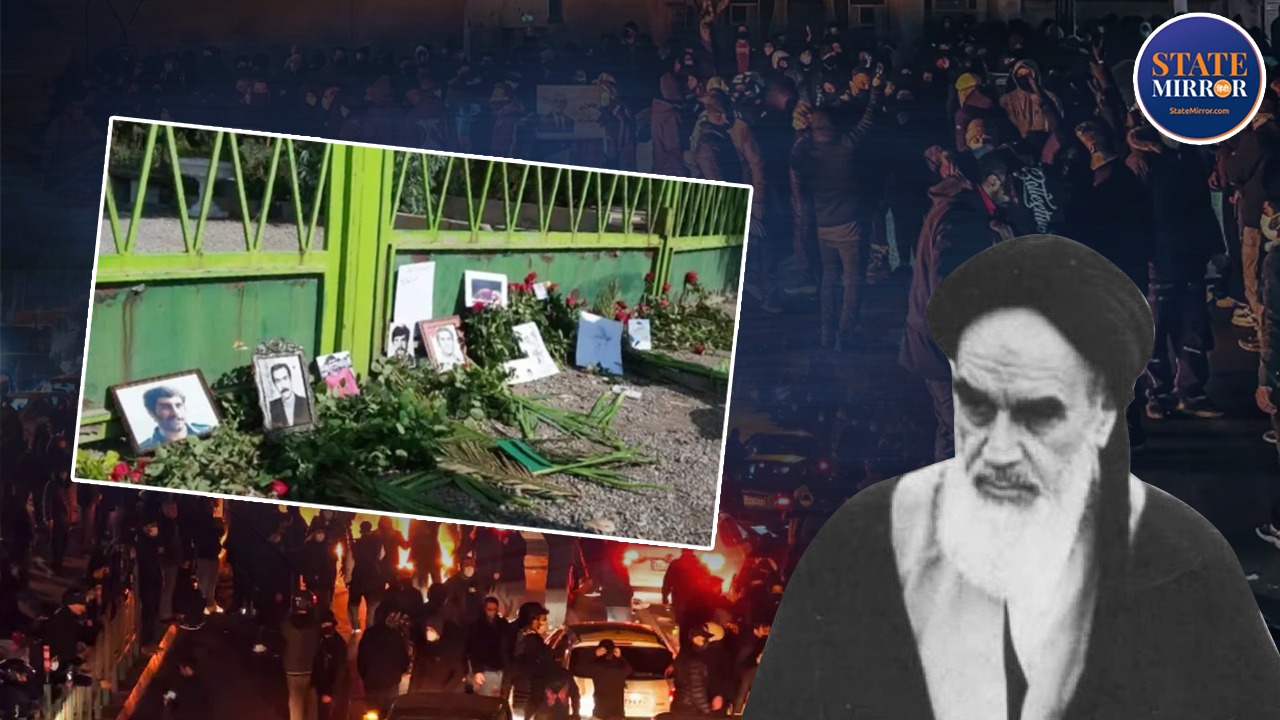
Most people were killed in Iran after the Islamic Revolution? Will tremble remembering that bloody scene of 47 years ago

The people’s movement going on in Iran from December 2025 till now has started the discussion about the Islamic Revolution of 1979. Khomeini definitely established a new regime on the basis of this revolution, but what happened nine years later put humanity to shame. In the summer of 1988, Iran’s prisons suddenly started turning into cemeteries. There was no riot, no mass movement, no open war, yet thousands of people were killed silently. The prisoners were taken out of the cells overnight, interrogated for two-three minutes and then the ropes were tightened. The families were neither allowed to meet for the last time, nor were the bodies handed over, nor was the address of the grave told. All this happened under a secret fatwa, which made ideology a crime. This incident is considered the most horrifying massacre after the Islamic Revolution. Know, what is the story of the biggest massacre that took place in 1988 amidst the ongoing fight for change of power in Iran.
In fact, in Iran, after the end of the monarchy in the Islamic Revolution in 1979, the power of the supreme religious leader was established, but the then government was struggling with the problem of stability and public trust. This is because Shah, a supporter of Pahlavi, kept raising his voice. To overcome this and establish the power created by the Islamic Revolution, the then Iranian government took a decision which is considered to be the biggest massacre there after the Islamic Revolution. However, the government did not accept this either.
At the same time, strong evidence shows that thousands of political prisoners were mass hanged by Iranian authorities in 1988. This incident was considered a crime against humanity throughout the world. According to Human Rights Watch, in 1988, acting on orders from then-Supreme Leader Ayatollah Ruhollah Khomeini, Iranian authorities executed thousands of political prisoners across the country immediately without due process of law.
The special thing is that the exact number of people killed is not known. According to estimates by former Iranian officials and lists compiled by human rights and opposition groups, Iranian authorities have executed more than 5,000 prisoners in at least 32 cities, including President Abraham Raisi. The 1988 massacre is often described as the most systematic mass murder of dissidents in the country’s history. Minimum estimates by groups such as Amnesty International put the death toll at 5,000. However, opposition groups such as the MEK claim that 30,000 people were hanged.
What is the full story of the massacre?
Human Rights Watch quoted senior Iran researcher Tara Sepehri Farr as saying, “For decades, the families of the victims of the 1988 massacre have been fighting tirelessly for truth and justice for their loved ones, but without success. Now that a trial in Sweden has again focused attention on one of the darkest chapters in Iran’s modern history, prosecutors in other countries are increasingly seeking justice for these heinous crimes.” Started demanding.”
In response, the Iranian government neither acknowledged the mass killings nor provided any information about the number of prisoners killed. Instead, authorities sought to silence those demanding truth and justice for these alleged crimes.
In 2016, Ahmed Montazeri, the son of Ayatollah Hussein Ali Montazeri, who was deputy supreme leader at the time of the execution, released an audio tape discussing a plan for the mass execution of senior officials. Following the release of the audio file, the Special Religious Court convicted Montazeri on a number of charges, including ‘spreading propaganda against the system’ and ‘disclosing plans, secrets or decisions related to the domestic or foreign policies of the State… which amounts to espionage’. In November 2016, he was sentenced to 21 years in prison, which was later suspended.
According to Human Rights Watch, between July and September 1988, Iranian authorities executed thousands of prisoners in violation of the fundamental right to an impartial judicial process. Under international law these were considered extrajudicial killings and inhumane crimes. This was a crime against humanity. The mass massacres carried out in Iran were well planned.
Responsibility for serious crimes under international law is not limited to those who commit them, but also applies to those who order them to be committed. Or play the role of assistant in such murders.
Major events that took place in Iran in the last 5 decades
February 1979: Ayatollah Ruhollah Khomeini returned after 14 years of exile in Iraq and France. Following a referendum in April, Iran was declared an Islamic Republic. In November the United States imposed its first sanctions on Iran. The American hostages kept in the US Embassy in Tehran were vindicated by capturing them. The US supported the ousted Shah, or King, Mohammad Reza Pahlavi. Earlier, it had helped remove the democratically elected Prime Minister, Mohammad Mosaddegh, in a 1953 coup, which was also supported by US and UK intelligence agencies.
September 1980: Iraq attacked Iran. According to an estimate, the death toll in this battle was around 5,00,000. Iran suffered the most loss. In this battle, like in the First World War, trenches, machine guns and bayonets were used on a large scale. However, Iraq also used chemical weapons against Iranians and Iraqi Kurds.
January 1981: This year, the Iranian government released all the US hostages, ending the Iranian hostage crisis. In June, a bomb blast at the headquarters of the Islamic Republican Party in Tehran killed dozens of senior officials, including Judiciary head Mohammad Beheshti, who was considered the second most important man in Iran after Khomeini. In August of the same year, President Mohammad-Ali Rajai and Prime Minister Mohammad Javad Bahonar were assassinated in a bomb blast at a meeting in Tehran. Officials blame the leftist revolutionary-minded opposition Mojahedin-e-Khalq (MEK) group, which was cracked down on last year.
June 1982: Israel attacked Lebanon. Iran started funding the Lebanese protest movement Hezbollah.
June 1989: Supreme Leader Ayatollah Ruhollah Khomeini died on June 3. Ayatollah Ali Khamenei, who succeeded him, was elected by the Assembly of Experts the next day.
June 1990: A big earthquake occurred in Iran. About 40,000 people died.
March and May 1995: US imposed oil and trade related sanctions on Iran. He accused Iran of sponsoring terrorism and making nuclear weapons.
September 1998: The Taliban admitted that eight Iranian diplomats and a journalist were killed in Afghanistan. When the group captured the northern city of Mazar-e-Sharif. In response, Iran deployed thousands of soldiers on its border with Afghanistan.
Student movement 1999: At least 4 people were killed during the student movement of 1999. Approximately 1,200 to 1,400 students were injured. Thousands of students were arrested.
January 2002: US President George W Bush described Iran as part of the axis of evil along with North Korea and Iraq and said that these countries are supporters of terrorism.
March 2003: US attacked Iraq. Iran started financing and supporting Shia militias and political groups on the ground. Its impact on such groups continues even today. In November, Iran announced it would halt its uranium enrichment program and allow the UN to conduct more thorough inspections of its nuclear sites. The International Atomic Energy Agency (IAEA) says there is no evidence of a nuclear weapons program. This openness is a change since Iranian officials had blocked or obstructed previous inspections. 40,000 people died in floods and earthquakes in southern Iran.
December 2006: The UN Security Council (UNSC) banned the trade of Iran’s sensitive nuclear material and technology. Because Iran failed to stop its nuclear program in exchange for diplomatic and economic incentives from Germany and the United States.
Green Movement 2009: According to independent and human rights groups, more than 100 people were killed during the Green Movement in 2009. More than 4,000 people were arrested. Hundreds of people were injured.
Economic protests 2017–2018: At least 22 people were reportedly killed during the 2017-18 economic protests. 3,700 people were detained. A large number of people were injured.
Bloody November 2019: The 2019 protests were considered one of the deadliest actions since the revolution. In the official government figures, the number of dead is said to be 230. According to human rights organizations, about 1,500 people were killed. During that time also internet service was stopped in Iran. The movement, which started as protests against the sudden increase in fuel prices, soon turned into a demand for the removal of the supreme leader.
Mahsa Amini Movement 2022–2023 : In the year 2022, hundreds of people were killed during the Mahsa Amini movement regarding women, life, freedom or human rights. In this movement, women were brutally tortured by the Iranian regime. Human rights groups confirmed at least 551 deaths. Dozens of women and children were included in these. This movement started after the death of Mahsa Amini in police custody. This movement spread to all 31 provinces.
Iranian protests 2025-2026: The current wave of nationwide unrest, which began on 28 December 2025, is being described as the biggest and most lethal challenge to the Islamic Republic since 1979. This movement started due to economic crisis and high inflation. This movement has turned into a broader political challenge. The protesters are demanding regime change. Internet service is halted due to the movement in Iran. The protesters are being stopped using bullets. The government also says that there is foreign interference behind the protests. It is the latest round of protests against Iran’s governing system since the 1979 revolution, which ousted the shah and ushered in an Islamic republic.

Comments are closed.