
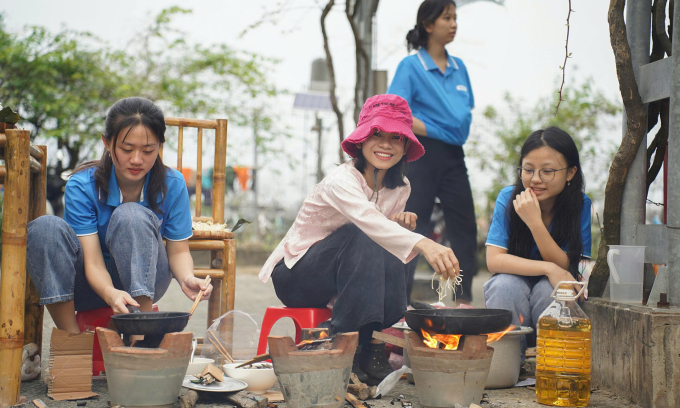
Children are quietly nurturing us, with their resilience, their innocence, their love: a nurse’s epiphany

The boarding school inside FPT City in Ngu Hanh Son Ward, Da Nang, welcomed its first 34 students in February 2022.
Children arrived in small groups accompanied by neighborhood leaders, Youth Union officials or local residents. The parents who would normally have walked them to school had been taken by the pandemic.
Phuong was among the school’s first staff members, assuming the role of nurse from the outset.
She quit her previous job working with children with disabilities at Hoa Binh Village in Quang Nam Province to care for students who were physically healthy but burdened by profound loss.
One child, a sixth-grader from Ho Chi Minh City, was the youngest in a close-knit family who had lost her mother to Covid-19.
For an entire month Phuong was unable to get the girl to speak. Every question was met with silence. The girl communicated through short handwritten notes such as “Are you tired today?” and “Go to bed early so you don’t get dark circles.”
Unsure whether pressing for conversation would help or harm, Phuong chose patience.
She learned that simply staying close mattered. “Not leaving them became a kind of medicine,” she later reflected.
Gradually, the girl began to talk, engage and open up to those around her.
Nurse Nguyen Ngoc Lan Phuong (3rd from L) and students at Hope School in Da Nang. Photo courtesy of Hope School |
As communication increased, daily life at Hope School has settled into a steady rhythm.
A bell rings at 5 a.m., calling students of all ages to the yard for morning exercise. Days unfold with study, meals, rest, play, and hands-on activities.
On weekends music fills the campus — singing, guitar, drums.
There are various clubs where students bake, make soap or build robotic models together.
Teachers increasingly take on roles beyond instruction, becoming parental figures and trusted companions.
From its original intake of 34 students, the school has grown steadily, and now there are 363 children, all orphaned by Covid-19.
Phuong’s responsibilities extend far beyond healthcare.
She is often the first adult to notice a loose baby tooth or hear whispered anxieties of adolescence.
She manages everything from minor fevers to outbreaks of flu and chickenpox that periodically sweep through the school.
In 2024 Hope School faced its most serious medical challenge: A routine health check detected a 10th-grade student having a pancreatic tumor.
Six months earlier her health records had shown no abnormalities.
Phuong and the teaching staff rushed to prepare for surgery. The operation was successful, but it marked the beginning of a long and difficult course of chemotherapy. As pain and fear intensified, the girl began to panic and resist treatment.
During one attempt to administer medication, Phuong offered reassurance: “Just a little longer, and the pain will pass.”
The girl shouted at her, asking: “You’re not the one taking it. How do you know how much it hurts?”
The remark stunned Phuong; she realized that words alone were inadequate. She then sat down and held the girl’s trembling shoulders.
As her sobbing gradually subsided, the girl agreed to extend her arm to the doctor.
As her condition improved, her life slowly returned to normal.
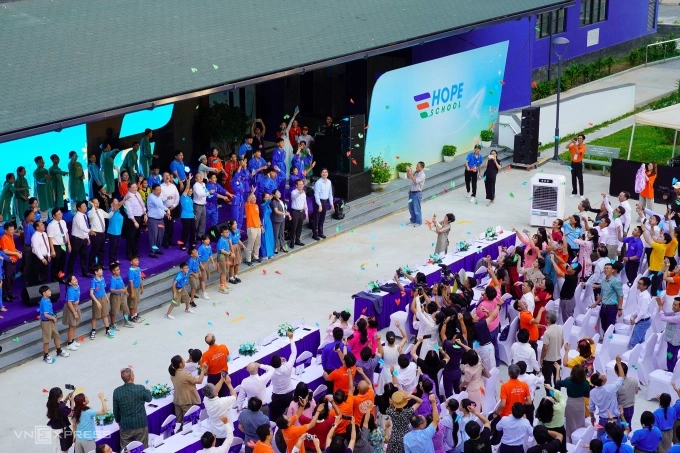 |
Hope School’s new campus inauguration in August 2025 at Ngu Hanh Son Ward, Da Nang. Photo by Read/Nguyen Dong |
Some of Phuong’s challenges require extraordinary patience.
One involved a female student struggling with severe depression and e-cigarette addiction. The girl experienced multiple relapses.
“At times I felt betrayed and helpless,” Phuong admits.
“I even thought about sending her back to her family.”
After consulting senior colleagues, Phuong has come to understand that emotional recovery for these children rarely follows a straight path, and setbacks are part of the process.
She has changed her approach, and, instead of confrontation, she focuses on companionship — waking early together, walking in the sunlight, tending vegetables.
Three years later the once-troubled student has graduated and is now studying at FPT University in Can Tho in the Mekong Delta.
In a recent photo she sent to the school, she is smiling on stage at a talent show.
After long and demanding workdays, Phuong finds balance in the school’s art club.
Painting, she says, has taught her lessons that medicine never did. When a stroke goes wrong, the artist does not erase it, but adapts, painting over it or transforming the mistake into a new detail.
“Hope School is like that painting. The pain of loss is a cruel, flawed stroke of fate. We cannot erase it, but we can paint new colors of joy, knowledge, and maturity over it.”
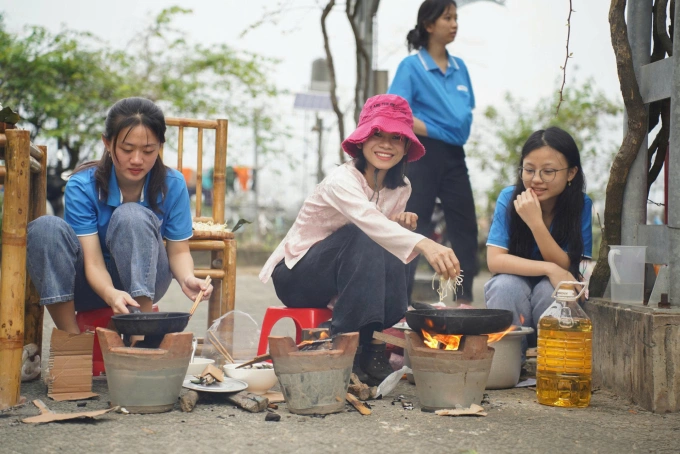 |
Nguyen Ngoc Lan Phuong (C) joins students in a school activity in 2025. Photo courtesy of Hope School |
Four years at Hope School have reshaped her outlook. Once impatient for quick results, Phuong has learned to let go of rigid methods, to work with the children’s uneven lines, and to allow growth to emerge gradually.
The rewards of that patience are often small but deeply moving: a misshapen bar of handmade soap, a piece of candy carefully saved from a festival, handwritten notes left on her desk.
One reads, “To Miss Phuong, the most beautiful in the world.” Another promises, “When you are old, I will take care of you.”
Recently fourth-grader Bui Yen Ngan ran up to Phuong with a mischievous smile.
“Hold out your hand,” she said, placing a small, tightly wrapped bundle in it.
When Phuong opened it, she laughed; inside were two freshly fallen baby teeth. Like many children at the school, Ngan entrusted her with keeping them, the way parents usually do at home.
“We come to the children thinking we are the protectors,” Phuong says.
“But the further we go, the more we realize these children are quietly nurturing us, with their resilience, their innocence, their love.”

Comments are closed.