
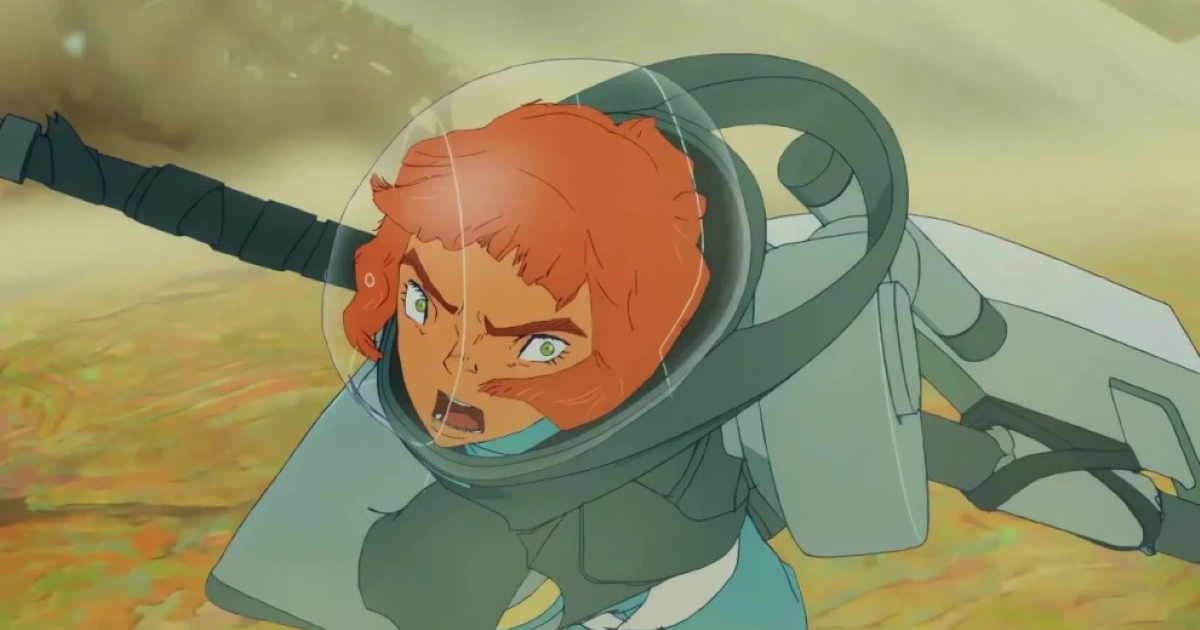

All You Need Is Kill director Kenichiro Akimoto spoke to News about his new anime movie, which is based on the same light novel that spawned the Tom Cruise movie Edge of Tomorrow. Akimoto discussed the film’s female perspective by focusing on Rita, its depiction of suicide, and more. GKIDS will release All You Need Is Kill in theaters starting January 16, 2026.
“Set in the year 20XX, All You Need Is Kill follows the story of Rita, a resourceful but isolated young woman volunteering to help rebuild Japan after the mysterious appearance of a massive alien flower known as ‘Darol.’ When Darol unexpectedly erupts in a deadly event, unleashing monstrous creatures that decimate the population, Rita is caught in the destruction—and killed. But then she wakes up again. And again. Caught in an endless time loop, Rita must navigate the trauma and repetition of death until she crosses paths with Keiji, a shy young man trapped in the same cycle. Together, they fight to break free from the loop and find meaning in the chaos around them,” says the official synopsis.
Tyler Treese: I particularly liked seeing All You Need Is Kill’s story being told through the eyes of a protagonist who struggles to connect with others. What was most interesting to you about featuring this version of Rita as the main character?
Kenichiro Akimoto: I do like Rita as a character who can’t become friends with people easily. With the character design, I had [Izumi] Murakami-san come up with her concept. I do like strong women, but the one thing that I wanted to make sure that Rita was, is that she doesn’t smile easily. She doesn’t try to be liked by others. So, when she does smile, instead of smiling with her teeth showing and looking straightforward at the person, she actually kind of looks down and away, then smiles. That’s something that we incorporated into her character. And then that’s how you know how Rita is.
After the first few deaths, Rita is ready for it to end. She says, “If I kill myself, this might end.” Depicting suicide always has to be done thoughtfully. Can you speak to crafting the drowning scene? I thought it was very powerful.
So, I had two reasons for creating that sequence. One was to show that no matter what she tries to do, Rita is unable to escape from the loop. It was a way to showcase that the rule of the loop is that no matter what, even if she kills herself, she’s gonna be stuck in the loop. Then the other part is that in the past, her mother had tried to kill both of them. She had dropped Rita into the ocean, and then she herself jumped in. But both of them couldn’t die. So, that kind of ended up with Rita having a very bad relationship with her mother.
She has a very big trauma towards the ocean and to the sea. It’s something that’s very scary to her. So, she had to go through two pains, basically. She had to jump into the water that she’s scared of, but then, at the same time, she also wanted to kill herself to just get out of the loop. So, when she wakes up in the next scene, I made it so that the color changes, and it’s a much more muted color. There’s less color. It kind of shows her emotional state. She is devastated. She is depressed.
Tyler Treese: There’s been a lot of influential time loop movies and novels coming out of Japan, going back to 1965’s The Girl Who Leapt Through Time and up to today with this film and games like Steins;Gate. Why do you think this idea is still as captivating today as it was 60 years ago?
Kenichiro Akimoto: Even in foreign films, there are a lot of movies that have a time loop, and I think there’s a very fun element to time loop stories. In a time loop, you’re the only one who knows what’s going to happen in the future. So, the main character has an advantage, and then you end up being kind of godlike, and you kind of feel above everybody else, but then it’s kind of fun for the viewers to have that extra knowledge. But then, at the same time, it’s a very lonely place for the character.
You eventually do find a way to try to escape the loop. There are some movies where you never get to escape the loop, but that’s where the characters kind of come up with ideas and it shows character growth in trying to find ways to escape from the time loop. In making this film, I actually watched a lot of time loop movies, and they took a lot of different approaches, so I had a lot of fun watching them as well.

Comments are closed.