

If Indiana beats Miami on Monday night to win the College Football Playoff National Championship, the school will have completed one of the most shockingly fast turnarounds in sports. Just two seasons ago, the Hoosiers were an also-ran in the Big Ten, to put it politely. Now, under Curt Cignetti, they’re a national powerhouse.
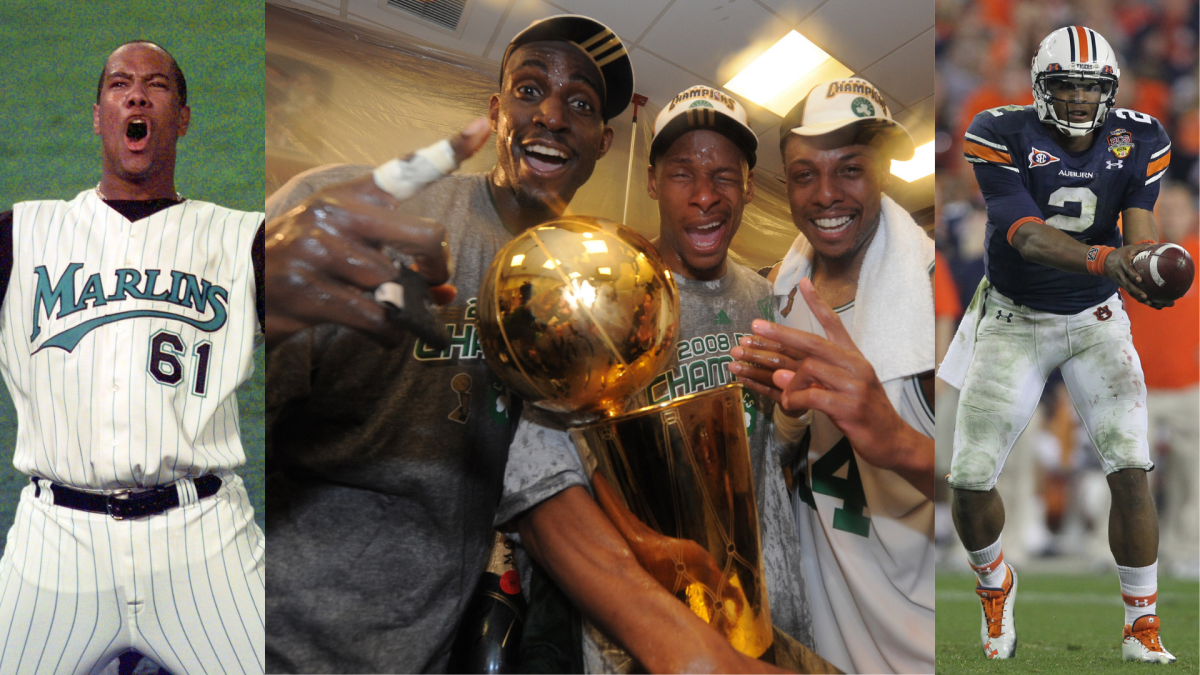
That got us thinking about some of the quickest turnarounds in modern sports history. Which teams came from nowhere only to reach the pinnacle of their sport in just a few short years later after a dramatic turnaround? Some may have forgotten how bad a legacy team like the Boston Celtics were prior to their 2007-08 championship run. And then there was an expansion team like the 1997 Florida Marlins, who won it all in just their fifth year of existence.
Sometimes, all it takes is one key player to make all the difference. Just ask the 1999 St. Louis Rams or the 2010 Auburn Tigers. Those squads got major shots in the arm from the right spot at the right time, and then just rode that to championships.
Before Indiana tries to complete its dizzying ascent to the college football throne, let’s look back on some of the fastest turnarounds ever in the sports world.
New York Rangers (1992-94)
Despite boasting a wealth of talent, the 1992-93 Rangers just couldn’t put it all together and finished last in the Patrick Division at 34-39-11. Perhaps the biggest issue was that star defenseman Brian Leetch was limited to just 36 games due to injury. On top of that, Mike Richter had one of his worst seasons between the pipes with a 3.82 GAA and a .886 save percentage.
The very next season, Leetch was fully healthy, and he tallied 79 points from the blue line. Forward Adam Graves exploded for 52 goals, and Richter bounced back with 42 wins, a 2.57 GAA and a .910 save percentage. After a year in which nothing went right, the puck bounced the Rangers’ way constantly in 1993-94, and the team rolled to a first-place finish.
The Rangers made quick work of their first two playoff opponents, going 8-1 against the New York Islanders and Washington Capitals. Then, with the Rangers down in the three games to two to the Devils in conference final, Mark Messier guaranteed a road Game 6 (at New Jersey) before advancing and taking out the Vancouver Canucks in seven games in the Stanley Cup Final. Leetch took home the Conn Smythe Trophy.
Florida Marlins (1993-97)
Let’s first all agree that time is relative. The Florida Marlins lost 98 games in their 1993 debut, and then — along with the rest of Major League Baseball — lost games in its second and third seasons due to the 1994 strike. Fans in South Florida would have been downright giddy at the prospect of going 80-82 in 1996, but then came the unthinkable: Winning a World Series championship the following season, in only the team’s fifth year of existence.
Seeking a win-now strategy, team owner Wayne Huizenga busted out the checkbook heading into that 1997 season, signing veterans everywhere, including left fielder Moises Alou, third baseman Bobby Bonilla and pitcher Alex Fernandez. Jim Leyland, a manager with World Series experience, was also brought on board, and those acquisitions joined a roster that already had a young Gary Sheffield and rookie shortstop Édgar Rentería. Darren Daulton and Craig Counsell were picked up at the trade deadline, and in the playoffs, Cuban rookie pitching sensation Liván Hernández sparkled, winning NLCS and World Series MVP honors.
A five-year turnaround might not seem fast-fast, but when you consider the team Florida beat in that 1997 Fall Classic was a Cleveland franchise that — to that point — had gone five decades without a World Series title, yeah, we’d say what the Marlins did was relatively quick.
St. Louis Rams (1998-99)
The Rams went 4-12 in 1998, and they did so with a Hall of Fame quarterback sitting on the bench. Instead, Tony Banks led an offense that scored just 17.8 points per game.
Going into the 1999 season, Kurt Warner wasn’t even supposed to be the starter. The Rams brought in Trent Green, but he tore his ACL in the preseason. That gave Warner his shot, and he didn’t miss. He threw for 4,353 yards and 41 touchdowns while Isaac Bruce, Torry Holt and Az-Zahir Hakim formed a three-headed monster at receiver.
Joining Warner in the backfield was running back Marshall Faulk, acquired from the Indianapolis Colts via trade after the 1998 season. Faulk totaled 2,429 yards from scrimmage and 12 touchdowns and he finished second in MVP voting. The Rams went on to win Super Bowl XXXIV in early 2000 in a 23-16 thriller against the Tennessee Titans.
Detroit Shock (2002-03)
The Shock won just nine games in 2002, and they were the only team to finish the year with single-digit victories. Detroit was especially dreadful on defense, allowing 70.8 points per game, which was one of the worst marks in the WNBA. Of course, that overall record disguises a positive upward trend that occurred after Bill Laimbeer took over for Greg Williams, who led the team to an 0-10 record. The Shock went 9-13 under Laimbeer, and they carried that momentum into the 2003 season.
The defense didn’t improve much in 2003, but the offense took off with 75.1 points per game. Swin Cash led the way with 16.6 points and 5.8 rebounds per game. The biggest addition was No. 3 overall pick Cheryl Ford, who won Rookie of the Year with 10.8 points and 10.4 rebounds per game.
The Shock took down the Cleveland Rockers and Connecticut Sun in the first two rounds of the postseason before beating the Los Angeles Sparks in the WNBA Finals.
Boston Celtics (2006-08)
The 2006-07 Celtics were about as far away from an NBA title as you can be. Their 24-58 record was the worst in the East, and only the Memphis Grizzlies had a worst record overall. An injury limited Paul Pierce to 47 games, and the team around him collapsed. The following offseason, general manager Danny Ainge got to work.
Boston swung blockbuster deals, landing both Ray Allen and Kevin Garnett, to assemble a Big Three. That trio — combined with ascending players like Rajon Rondo and Glen Davis — proved to be lethal. The Celtics had the best record in the NBA in 2007-08, and they fought their way through an arduous postseason.
Two series went seven games and the other two ended after Game 6, one of which being an NBA Finals championship over the Kobe Bryant and Boston’s arch-rival Los Angeles Lakers.
Auburn Tigers (2008-10)
In 2008, the Tommy Tuberville era on The Plains came to an unceremonious end with a 5-7 season. The Tigers were 2-6 in SEC play, and they scored just 17.3 points per game, which ranked 111th in the country.
The following season was the start of Gene Chizik’s tenure as coach, and while there were some improvements, Auburn still had its fair share of flaws. With Chris Todd and Ben Tate leading the way on offense, Auburn’s offense rebounded to 33.3 points per game. Unfortunately, the defense didn’t hold up its end of the bargain, and the Tigers finished with a respectable 8-5 record, although they were 3-5 in league play.
In 2010, Auburn found lightning in a bottle thanks to one of the greatest seasons from any college football player ever. Cam Newton came in to play quarterback, and he was a one-man wrecking crew. Newton totaled 4,327 yards and accounted for 51 touchdowns, and those gaudy numbers earned him the Heisman Trophy. Thanks to Newton, the Tigers ran the table and beat Oregon to win the BCS National Championship.
Leicester City FC (2014-16)
There are long shots, and there are LONG SHOTS. Leicester City’s drive to the 2015-16 Premier League title doesn’t only fall in the all caps category it practically screams in 48-point font that there won’t be anything like it ever again. Claudio Ranieri’s men were an unfathomable 5,000-1 shots before the season began, but there was, indeed, a chance.
After losing half of their game in their first Premier League season of 2014-25, For magic to happen that season, the club needed a few things to go right. First was that the traditional powerhouses in England all struggled to some degree or another with Chelsea, Manchester City, Manchester United and Liverpool all falling apart while Arsenal and Tottenham narrowly failed to catch the unlikely winners. From there it was the magical alchemy of a trio of yet to be appreciated stars in N’Golo Kante, Riyad Mahrez and Jamie Vardy surrounded by a consistent, workman like set of role players that danced between the raindrops to become the unlikeliest story in Premier League history.

Comments are closed.