
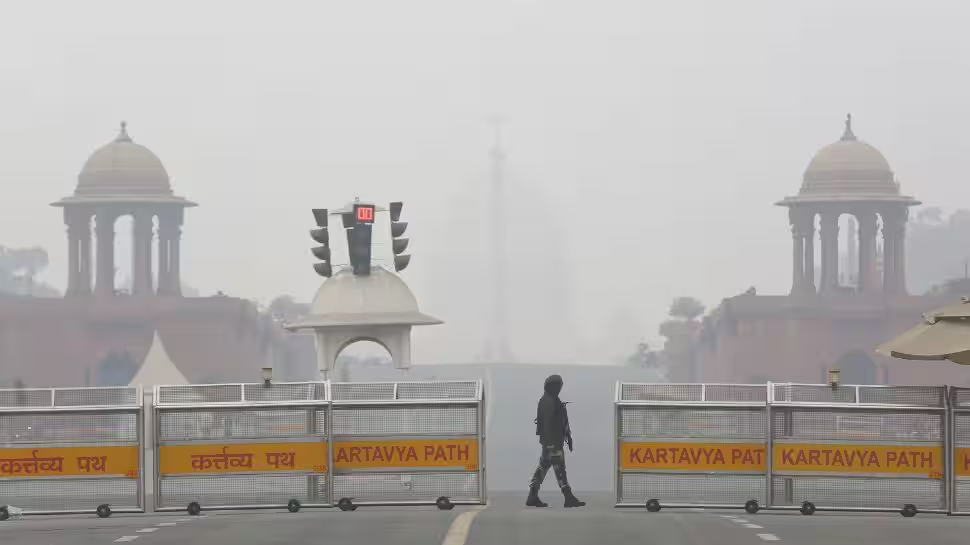
Weather Alert: Delhi Continues To Shiver, AQI Remains ‘Severe’ | Check Flight Advisory | India News

Weather Alert: As North India continued to shiver, Delhi and the National Capital Region (NCR) experienced a cold Tuesday morning. Cold wave conditions persisted in the national capital, prompting Delhi Airport to issue an advisory stating that low-visibility procedures were in effect.
The visuals from the area near the Swaminarayan Akshardham temple in Pandav Nagar showed a layer of smog. The AQI in the area, as reported by the Central Pollution Control Board (CPCB), is 445, falling within the ‘severe’ category.
#WATCH | A layer of smog covers parts of Delhi NCR. Visuals from the area near the Swaminarayan Akshardham temple in Pandav Nagar.
AQI in the area, as claimed by CPCB, is 445, falling in the ‘severe’ category. pic.twitter.com/W3CPVTZPaX— ANI (@ANI) January 20, 2026
Add Zee News as a Preferred Source
Visibility in Noida was affected as a layer of smog engulfed the city.
Check Visuals from Noida Sector 150
#WATCH | Uttar Pradesh | Visibility in Noida is affected as a layer of smog engulfs the city. Visuals from Noida Sector 150 pic.twitter.com/0GxssMYKkA— ANI (@ANI) January 20, 2026
ANI reported that as the cold wave continued in several parts of the national capital, homeless individuals took refuge in rain shelters to escape the winter chill.
Meanwhile, in response to the deteriorating air quality, the Commission for Air Quality Management (CAQM) reinvoked Stage-IV measures under the Graded Response Action Plan (GRAP) on Saturday across Delhi and the NCR.
Delhi Flight Operations
Delhi Airport, in a post on
Passenger Advisory issued at 06:30 hrs.
Please click on this link for real-time winter travel updates: https://t.co/KkKldKUlLQ#DelhiAirport #PassengerAdvisory #DELAdvisory pic.twitter.com/NYgLoX1lmn— Delhi Airport (@DelhiAirport) January 20, 2026
Tamil Nadu Weather Forecast
According to an IANS report, the India Meteorological Department (IMD) has announced the formal withdrawal of the Northeast Monsoon from Tamil Nadu, Puducherry, Karaikal, and adjoining parts of South India, marking the end of the primary rainy season for the region.
Dry weather conditions are likely to prevail across Tamil Nadu, Puducherry, and Karaikal until January 21 (Wednesday).
During this period, early morning fog or mist may occur at one or two isolated places, particularly during the pre-dawn hours, potentially affecting visibility in low-lying and inland areas.
The Weather Department has indicated that there will be little to no significant change in minimum temperatures across the region during this phase.
However, night temperatures are expected to remain near normal or slightly below normal levels, bringing relatively cooler conditions during the early mornings and late evenings.
(with agencies’ inputs)

Comments are closed.