

Highlights
- OpenAI plans to test ads in ChatGPT for Free and Go tier users in the U.S. in the coming weeks.
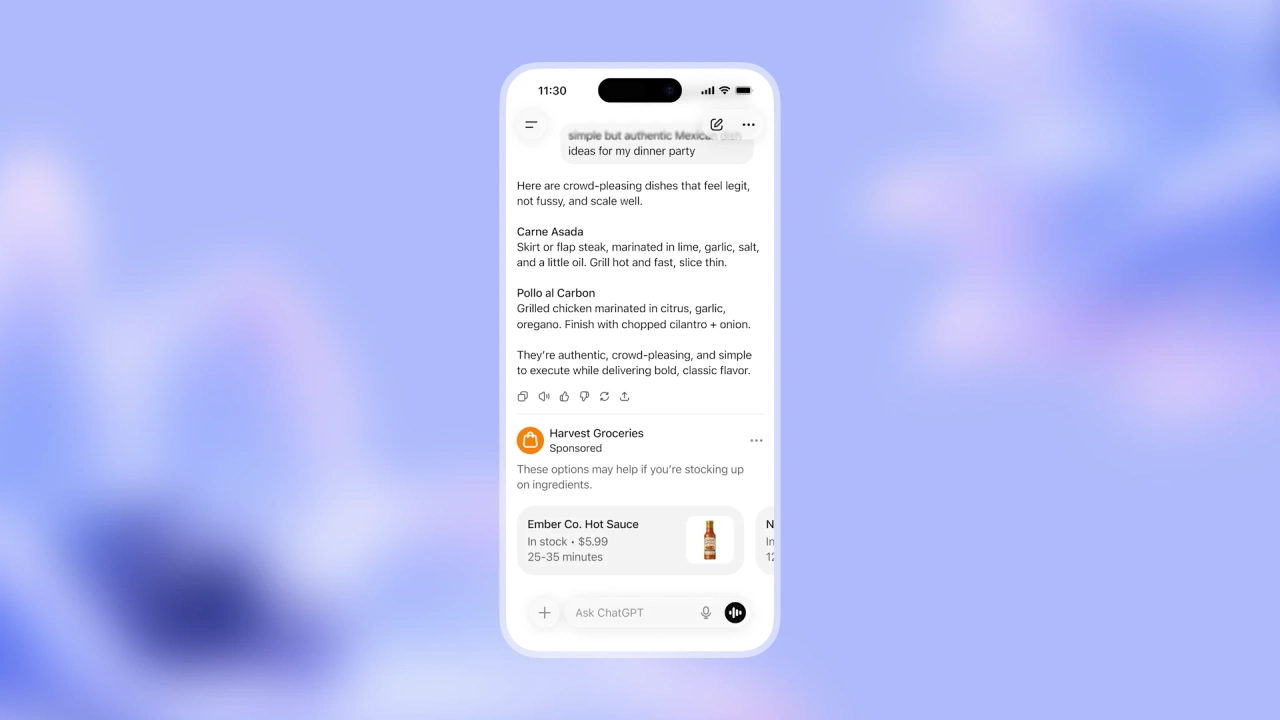
- Ads will be clearly labeled and separate from AI responses without influencing ChatGPT’s answers.
- Users can control ad personalization or disable it, with privacy protections in place.
- Paid Plus, Pro, Business, and Enterprise subscriptions remain ad-free.
OpenAI, the developer of ChatGPT, has announced plans to introduce advertisements in ChatGPT adswhich would be a considerable change in the company’s revenue model and AI service access affordability strategies.
In the post that outlines their plan, OpenAI mentions that in the US, soon advertising will be tried out on users who have the free plan and the newly enlarged ChatGPT Go plan, whereas higher subscribers will be free of ads. The action has resulted in both the tech sector and the public discussing the issues of privacy, user experience, and the trade-off between accessibility and commercialization.
Why OpenAI Is Adding Ads to ChatGPT
OpenAI has introduced one more monetization scheme besides its subscription-based revenue streams in order to maintain and enhance the quality of its platform. The company has around 400 million users for its main product, ChatGPT, which is the most popular AI-based assistant worldwide.
Though OpenAI’s revenue had primarily come from ChatGPT subscription plans -Plus, Pro, Business, and Enterprise – the major plan consists of rapid responses and premium features for users, and the millions of dollars gone are now expected to flow in through ads and partnerships.
Reuters reports that OpenAI has already started creating a user-friendly and pleasant advertising experience with the ads for… Children and adult users in the U.S. would be clearly indicated, and their running in a separate area from the generating AI’s response would be the only marketing influence on the bot’s answer. Although the company’s new advertisement strategy hasn’t been activated yet, OpenAI plans to place ads at the bottom of replies when a relevant marketed product or service is in line with the user’s context of the conversation.
Advertising is intended to supplement – not replace – subscriptions, allowing OpenAI to continue investing in model improvements, safety, and performance
How ChatGPT Ads Will Work
According to at least three sources, OpenAI’s roadmap for advertising and its connected reports will govern the rollout of the following defining features:
Clear Separation From AI Answers
- The ads will be different from the other outputs of ChatGPT, for they will be marked as “Sponsored” so that no one gets confused.
- Such relevancy will be one of the criteria for placing the ads; thus, the ads will show up only when the previous conversation topic is related to shopping or the recommendations of a certain service, etc.
Contextual, Limited Placement
- Privacy protections: OpenAI has made a firm statement that the data gathered from conversations will not be transferred to advertisers, and users’ privacy is going to be a priority. Discussions on topics like health, wellness, and politics will not have ads related to them, as these are considered sensitive areas.
User Controls and Opt-Out Options
- Opt-out options: Users will have settings that allow them to switch off personalization for ads and will be able to control or erase the information that is used for targeting ads.
Strong Privacy Protections
- Adult-only and tier-restricted display: Certain age restrictions will apply to the displaying of ads, which means that they will be targeted to adults on specific tiers, the free and Go plans in particular. The paid membership will still be ad-free in the Plus, Pro, Business, and Enterprise plans.

This delicate framing highlights OpenAI’s ultimate goal of trust building with users and the assurance that ChatGPT’s commercial interest will not affect its application. OpenAI insists that the AI outputs will be guided by the usefulness and not the marketing placement.
The Reason Behind the Change
The choice to run ads for a trial period is primarily due to the increasing operational costs, along with the company’s aim to make access to powerful AI possible for less. According to OpenAI, a large part of the users are still on the free plans, and the revenue from ads could be used to provide access to all without charging high subscription fees.
Moreover, OpenAI has globally rolled out its ChatGPT Go plan recently, which is a less expensive subscription plan that offers more usage than the free version. The start of ads is part of a larger effort to make the revenue stream more diverse while keeping AI tools accessible to a large audience.
Reaction and Potential Concerns
The change in approach is not welcomed by all users and critics, who think that if ads are placed and users are not able to personalize them, it could ruin the image of ChatGPT as a neutral and trustworthy assistant.

The integration of advertising into chat interactions prompts issues regarding the privacy of users and the extent to which a potential commercial influence -perhaps even in the form of subtlety – could affect the public’s view of the recommendations, provided that the answers are still officially independent.
One of the criticisms is that the situation is compared with the case of social networks, where advertising has often posed the problem of trust and has been one of the causes of data-use concerns.
AP News
According to some industry analysts, the decision represents a realistic next stage of the generative AI platforms’ development. Advertising has been one of the areas explored by Google and Microsoft as a possible common ground where monetization could happen, which is why new revenue streams might be unlocked, at least to some extent, by integrating ads into AI experiences and allowing free access to remain active.
What Happens Next
OpenAI will soon begin advertising tests in the U.S., and user reaction will most probably affect the speed and extent of future expansion. Among other things, the company is considering feedback from these early tests in order to perfect the placement, the relevance, and the controls available to users.
For the time being, the advertising key takeaway is that its presence in ChatGPT is planned and systematic, whose purpose is to uphold the limited access of open without compromising the main trust that users put into the AI’s answers.
The future will tell how effective this balance is, as it will be scrutinized by users, advertisers, and competitors alike, with AI becoming increasingly versatile as both a tool and a platform.

Comments are closed.