
India-UAE Trade: India-UAE set target to increase bilateral trade to $200 billion by 2032

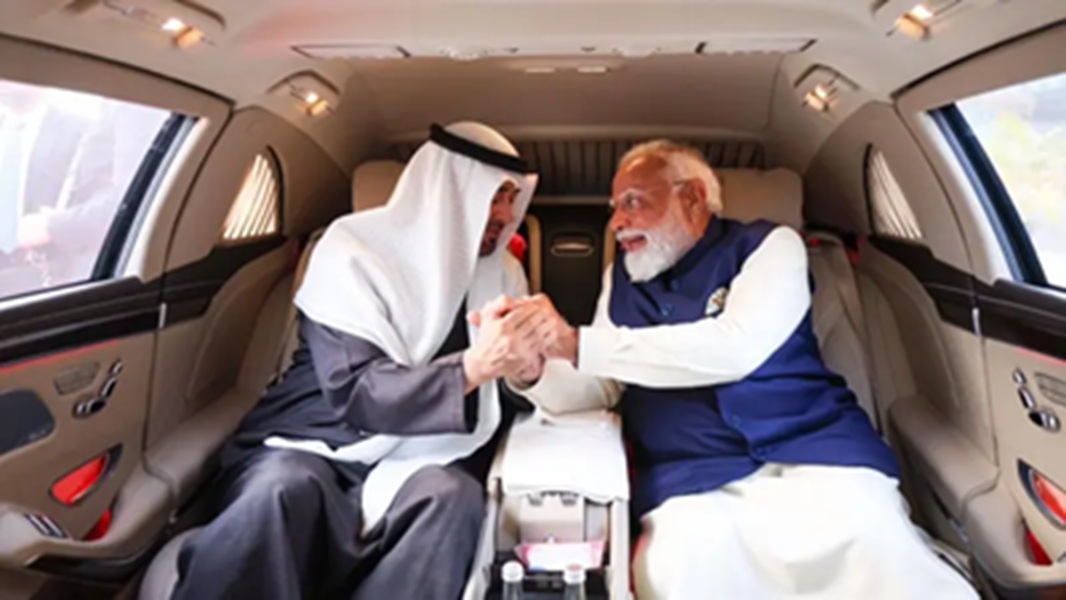
New Delhi, 20 January. Prime Minister Narendra Modi and United Arab Emirates (UAE) President Sheikh Mohammed bin Zayed Al Nahyan on Monday set a target of doubling India-UAE bilateral trade to $200 billion by 2032. This information was given in the joint statement issued after the meeting held here. The two leaders welcomed the strong growth in trade and economic cooperation since the signing of the Comprehensive Economic Partnership Agreement (CEPA) in 2022. The statement said that India-UAE bilateral trade has reached $100 billion in the financial year 2024-25.
The leaders endorsed the outcomes of the 13th High-level Investment Task Force held in September 2025 and the 16th India-UAE Joint Commission Meeting and 5th Strategic Dialogue held in December 2025. He gave directions to his teams to connect the Micro, Small and Medium Enterprises (MSME) units of both the countries. In this context, a call was made for early implementation of key initiatives like ‘Bharat Mart’, ‘Virtual Trade Corridor’ and ‘India-Africa Bridge’ to promote MSME products in the Middle East, West Asia, Africa and Eurasia region. The leaders expressed satisfaction that the bilateral investment treaty signed in 2024 will strengthen investment flows in various sectors in both the countries. He also welcomed the discussions on a possible UAE partnership for the development of a special investment zone in Dholera, Gujarat.
Under this proposed partnership, strategic infrastructure such as international airports, pilot training schools, maintenance-repair-overhaul (MRO) facilities, greenfield ports, smart urban townships, railway connectivity and energy infrastructure is envisaged to be developed. Noting the success of the first National Investment and Infrastructure Fund (NIIF) infrastructure fund, Prime Minister Modi invited the UAE’s sovereign wealth funds to consider participation in the second infrastructure fund proposed in 2026.
The two leaders welcomed the establishment of branches of DP World and First Abu Dhabi Bank (FAB) in Gujarat International Finance Tech-City (GIFT City), thereby enhancing GIFT City’s emergence as a leading international financial hub. FAB’s GIFT City branch will play an important role in connecting Indian companies and investors to the Gulf Cooperation Council (GCC) and Middle East and North Africa markets. Both sides reiterated their commitment to further strengthen India-UAE cooperation in the field of food security, describing it as strategically important for sustainable supply chains and long-term stability. He stressed the role of public-private partnerships, innovation and knowledge exchange in promoting sustainable agriculture and strengthening national food security.
Expressing satisfaction at the strength of the bilateral partnership in the energy sector, the leaders underlined the UAE’s contribution to India’s energy security. He welcomed the signing of the 10-year LNG supply agreement between Hindustan Petroleum Corporation Limited (HPCL) and ADNOC Gas, which will see the supply of 0.5 million tonnes of LNG per year from 2028. The joint statement said the two sides agreed to explore collaboration in advanced nuclear technologies, including the development and deployment of large nuclear reactors and Small Modular Reactors (SMRs), advanced reactor systems, nuclear plant operation and maintenance and cooperation in nuclear safety. The leaders also appreciated the deepening cooperation in the financial sector and directed to work on interconnecting national payment platforms to make cross-border payments faster, cheaper and more effective.
It was also agreed to deepen cooperation in the space sector. In this context, the understanding reached on a joint initiative to promote commercialization through space science and technology was appreciated. The initiative aims to develop an integrated space ecosystem, enable joint India-UAE missions, expand global commercial services, strengthen bilateral investment through high-skilled employment and startup creation and sustainable business models. The two leaders also decided to enhance cooperation in science and technology and innovation, especially in artificial intelligence (AI) and emerging technologies. Welcoming the decision to cooperate in setting up supercomputing clusters in India, they also agreed to the possibility of setting up data centers in the country.

Comments are closed.