
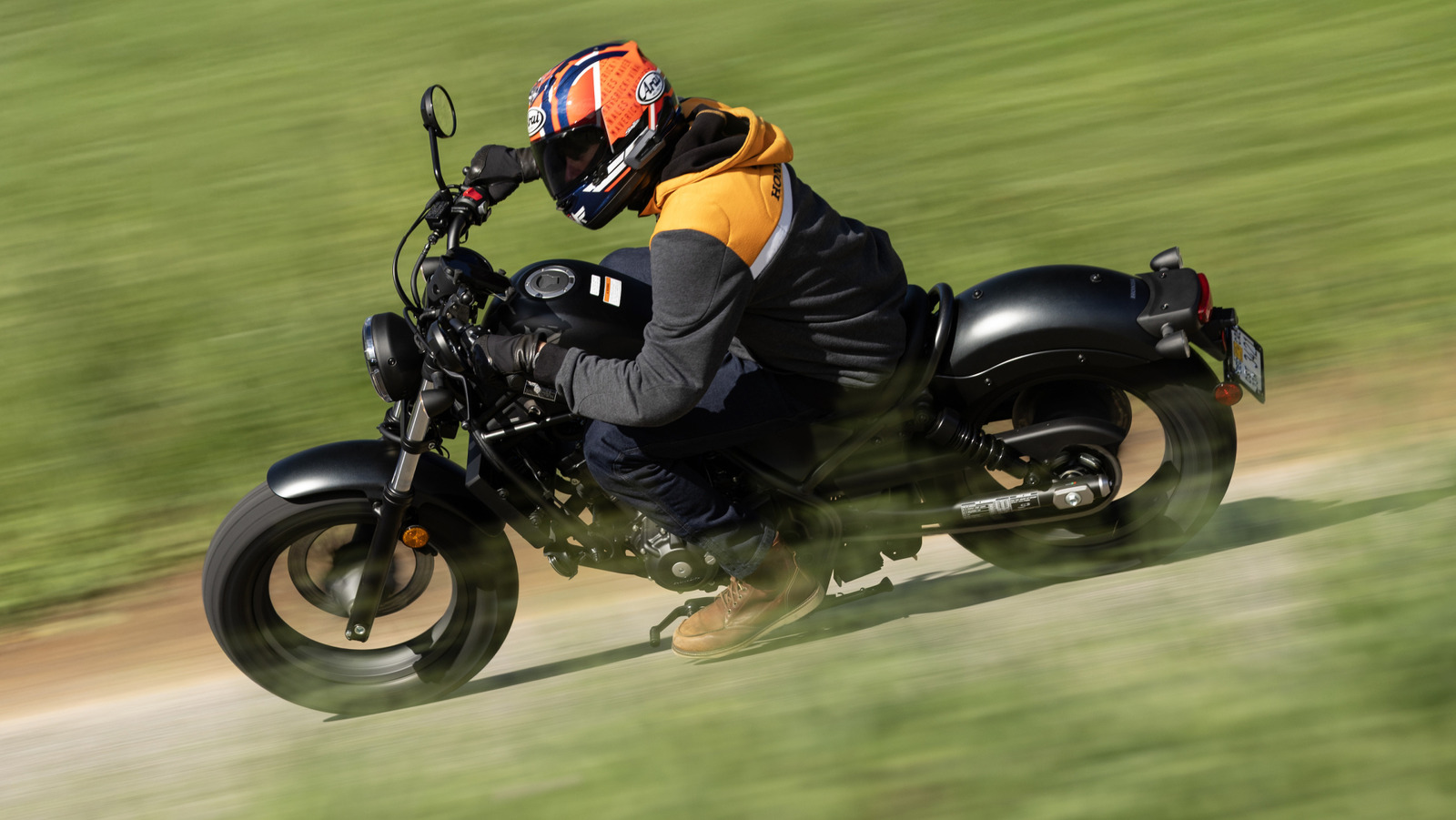

The Honda Rebel 300 is meant to appeal to new riders on a budget. It’s simple, two-wheeled transportation that’s styled like a classic cruiser and built by a brand with a reputation for reliability. For 2026, the Honda Rebel 300 gets a big update that could add to that appeal and, in theory, make it even easier for new riders to hop on and learn the basics.
The 2026 Rebel 300 now comes standard with Honda’s E-Clutch. Already available on bikes like the CB750 and CB650R, E-Clutch is a shifter system that allows the rider to change gears without ever using the hand-operated clutch lever. For some new riders, the thought of learning how to operate a manual transmission, potentially for the first time, is an intimidating hurdle too tall to jump for motorcycle ownership.
This move to the exclusive use of E-Clutch on the Rebel 300 could assuage those concerns for newbies. More than that, it could make the Rebel easier to ride in stop-and-go traffic. Even for seasoned riders, shifting constantly is a tiring chore that wears out your hands and wrists on long rides, so it has some potential appeal for all rider sets. E-Clutch does, however, have some potential drawbacks: The system adds weight, cost, and potential complication to a bike that’s otherwise attractive because of its simplicity.
Riding the newest Rebel 300
Honda launched the new Rebel E-Clutch with a test ride in Los Angeles, just a few miles from my front door. Naturally, I accepted their invite to the event and rode over to check the bike out. Immediately, I was impressed with the look and feel of the bike. I hadn’t seen the small Rebel 300 in person in a while, but I was reminded straight away why so many new riders like it: It looks simple, but upscale. Classic body lines, beefy tires, and LED lights are all part of the impressive vibe, but so are the black components that dominate the aesthetic.
Honda gave a brief presentation about the E-Clutch system before the ride, then we set out for a day of riding in Los Angeles traffic. The route took us to some iconic landmarks and tourist destinations, but it also had us riding in brutal traffic, over some of the worst road surfaces you could find in the city. It was a torture test for the Rebel, but it performed admirably.
Okay, but what the heck is an E-Clutch?
Technically, the Rebel 300 still has a six-speed manual transmission. It still requires that the rider shift gears using their left foot and the foot lever, but there’s no need to use the hand clutch. That’s where the “E” part of the E-Clutch comes in. A motor control unit is governed by some parameters like RPM, throttle position, and wheel speed, controlling the three-part clutch lever shaft and doing the work the rider would normally need to do with their clutch-lever hand.
Like any other bike with a manual transmission, the Rebel still needs the rider to select the proper gear. It can bog if you try to accelerate in the wrong gear, but animated arrows on the LCD display do their best to remind you to shift. If you forget to pop down into first gear at a stop sign, though, coming to a stop in second gear won’t stall the bike. Second gear will get you going, but third or fourth will struggle to provide power. And yes, you can technically stall the Rebel 300 E-Clutch, though it’s much harder than it would be with a traditional transmission/clutch combo.
How does the E-Clutch work in practice?
If you want to operate the E-Clutch like a traditional manual, you can, at least for a while. I started the bike in neutral, pulled the clutch lever, and shifted into first. That meant I was in manual mode, and the small LCD display let me know via a tiny light. The CB650R offers the ability to turn off E-Clutch functionality completely, turning the bike into a traditional manual, but the Rebel 300 doesn’t have that option. The E-Clutch system takes over even if you’ve started your ride using the hand lever.
According to Honda, the switch over from standard manual to E-Clutch control happens after “less than a second at higher engine speeds and after five seconds at lower engine speeds.” While testing the Rebel 300, that translated to a few “whoopsie” moments for me with free-ranging revs and missed gears, but no real damage was done, aside from the damage to my ego.
Where the system caused me the most trouble was at slow speeds, attempting u-turns. Normally, I’d feather the throttle, drag the rear brake a bit, and modulate the clutch for stability. But if the Rebel had the E-Clutch engaged, this wasn’t possible. So, before making any tight u-turns, I’d have to make sure the bike was in the proper manual mode, then engage the hand lever. Or, I had to abandon the hand-lever modulation and trust the Rebel to keep applying power to the rear wheel while placing a foot out for fear of tipping the bike over — not a natural approach for any experienced rider.
Low power, low weight, impressive comfort
E-Clutch operation aside, Honda gave me and the other riders a day full of riding to focus on the rest of the Rebel’s characteristics. The Rebel 300 is powered by a 286cc single-cylinder engine. Honda doesn’t release official power numbers for the Rebel 300 here in the United States, but most reports have it around 25 horsepower and 17 lb-ft of torque. It won’t win any races against four-cylinder sport bikes, but the small single is robust enough to help the Rebel 300 leave the line ahead of sleepy cagers.
Honda’s test route was limited mostly to city streets, but we did get a short stint at highway speeds, and the Rebel will do 75-80 mph comfortably provided you have the patience. The Rebel weighs 379 lbs (15 lbs more than the 2025 model), which is light enough to make it easy to push around in parking lots and its incredibly-narrow tank makes it feel ultra nimble maneuvering through traffic. Don’t go for any hasty passing moves, though — it’s just not fast enough.
With dual rear shocks, a meaty 150/80-16 rear tire, and 3.7 inches of rear suspension travel, the Rebel 300 has a good ride quality for an entry-level bike, but large potholes will definitely get your butt out of the seat. The single-rider seat that comes standard is well padded but small. The seat height of just 27.2 inches is low enough that even adults of limited stature can easily swing a leg over for a ride.
Layout and usability on display
The Rebel’s handlebars were moved for better positioning a few years back and they should be easy to reach for most small and average-sized riders. There were a few taller riders in our group, though, and they admitted to being a bit scrunched up throughout the day. Working against the Rebel in the comfort department are the poorly-damped engine vibrations. Lots of engine movement makes its way to the handlebars so, after a day of riding, I had some forearm soreness to contend with. On anything shy of a six hour commute, however, it should be fine.
There aren’t any high-tech rider aids with an entry-level bike like the Rebel 300, which means the handlebars are uncluttered with the lack of cruise control buttons, rider modes, or directional pads. It’s just lights, a horn, a kill switch, turn signals, and blinkers. In 2025, when the Rebel 300 got a series of updates, the LCD gauge cluster was updated to reduce reflection, and it seems to have worked. The small, digital display is easy to read, with only a few basic stats on display.
Pricing is a tough nut to crack
Scooters and miniMOTO models aside, the Rebel 300 is one of the least-expensive new, full-size motorcycles you can buy from Honda in 2026, but it’s a bit more expensive than last year’s model. In 2025, the Rebel 300 started at $5,449 (including a $600 destination fee). The 2026 model, with its standard E-Clutch, goes up to $5,949. Problematically, that $500 increase doesn’t include any additional standard equipment, aside from the E-Clutch, of course. And for a beginner bike, nearly $6,000 is a pretty hefty price tag.
When it comes to new entry-level bikes, there are several different versions of Royal Enfield’s 350 platform available to take on the Rebel, including the Hunter, Classic, and Meteor – all of which undercut the Rebel significantly (though they are a bit more cafe-styled). The Triumph Speed 400 offers more power and displacement than the Rebel at a similar price. Yamaha’s V Star 250 is significantly smaller than the Rebel, but priced a few hundred dollars lower, which should reel in bargain shoppers. It’s nowhere near as modern as the Honda, though.
Then, of course, there is a bevy of available entry-level sport and sport-naked bikes like the formidable Yamaha MT-03, the excellent Kawasaki Ninja 500, and even Honda’s own CB300R, which is $850 cheaper than the Rebel.
2026 Honda Rebel 300 E-Clutch verdict
For experienced riders, the Rebel 300’s new E-Clutch system will take some learning, and it may feel eternally unnatural to some. But even as a rider with years of experience, I think there are benefits to the E-Clutch system. It makes the bike easier to ride in stop-and-go traffic, reducing fatigue and potentially increasing the amount of time you’ll spend riding. And, if its existence brings any additional riders into the fold who wouldn’t otherwise ride, it’s a net positive.
There are, however, two things I’d do to refine or improve the system: First, I’d give it a lighter gear shift lever movement. Honda positions the E-Clutch as offering the performance of a quick shifter, but the shifting action isn’t quite light enough for that praise. Second, I’d provide a button that allowed riders to turn the system on or off manually. It would make for a more engaging ride on a bike that already has a lot going for it.

Comments are closed.