
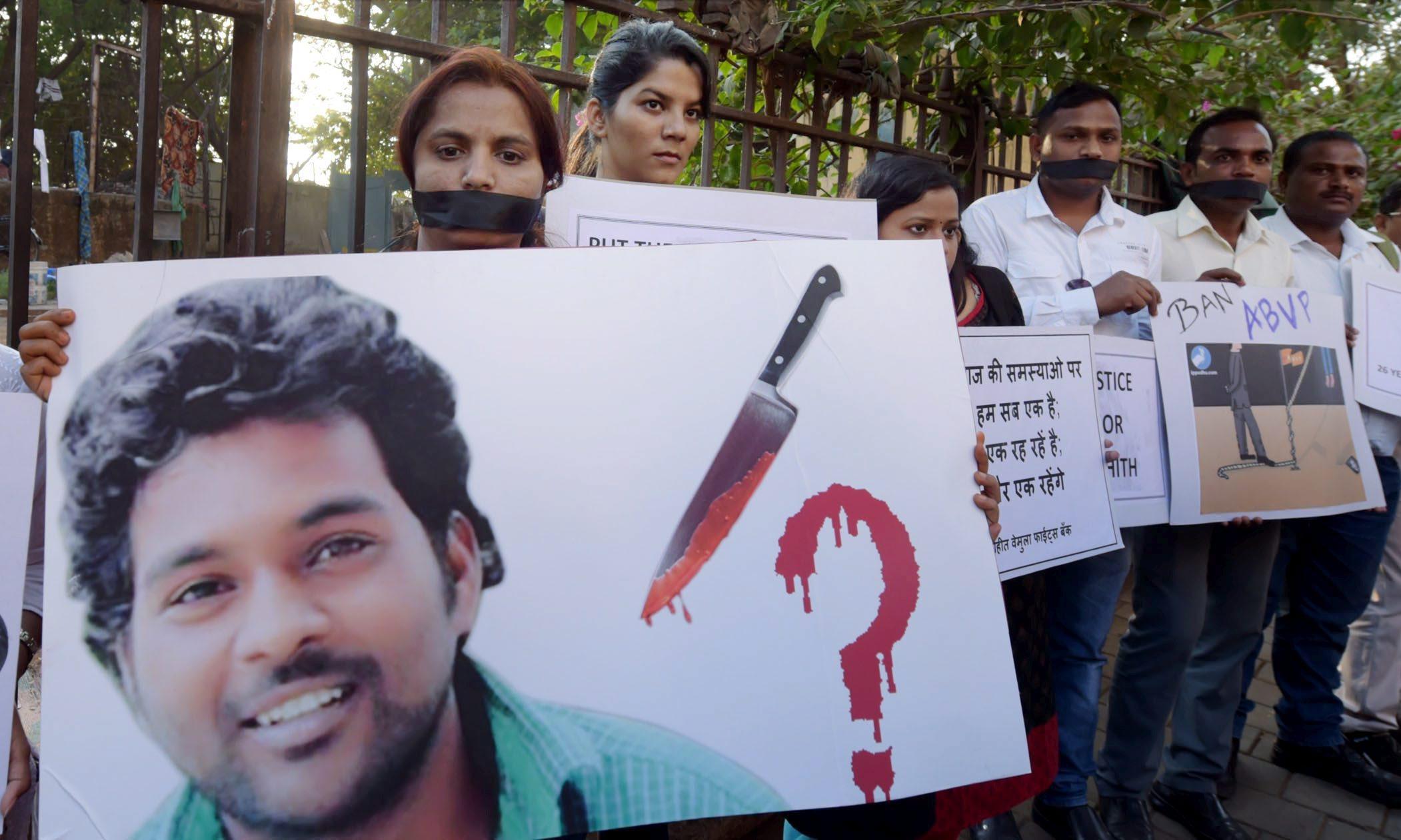

Ten years after institutional discrimination drove Hyderabad Central University (HCU) research scholar Rohith Vemula to death, Indian universities continue to struggle with the same structural failures that his case laid bare.
While regulatory frameworks have expanded and courts have intervened repeatedly, students and teachers say discrimination has not disappeared; it has merely become more systemic, harder to prove, and easier for institutions to deny.
In January 2016, Rohith Vemula, a Dalit PhD scholar at the University of Hyderabad, died by suicide after months of institutional hostility, suspension from his hostel, and withdrawal of his fellowship. His death triggered nationwide protests and renewed scrutiny of caste discrimination on campuses.
Unfulfilled promises
In the years since, there have been promises of reform, including demands for a Rohith Vemula Act and stronger safeguards for students from the Scheduled Caste (SC) and Scheduled Tribe (ST) communities. Yet, a decade on, students and teachers argue that these promises remain largely unfulfilled.
“I feel now the discrimination seems to be more systemic. It’s not so blatantly open,” said Satish Chennur, Assistant Professor at the Centre for Studies in Social Sciences and a contemporary of Rohith Vemula at HCU.
Also Read: On Rohith Vemula’s death anniversary, Rahul seeks anti-bias law on campuses
Reflecting on the past decade, Chennur said that while new laws and policies were discussed, implementation remained weak.
“There are certain laws which have come, but none of them have effectively been implemented. Institutions keep finding loopholes. The Rohith Vemula Act was discussed so much last year, but nothing has actually been fruitful,” he said.
‘Dilution of protections’, defunct SC/ST Cells
According to Chennur, the dilution of protections under the Scheduled Castes and Scheduled Tribes (Prevention of Atrocities) Act has further weakened accountability.
“In many cases, complaints are not taken at all, or people are asked to ‘negotiate’ even before approaching the police or the institution,” he said.
Also Read: Rohith Act demand persists 10 years after Rohith Vemula’s death
Concerns about institutional neglect are also reflected in recent regulatory developments. Following Supreme Court intervention last year, the University Grants Commission once again directed higher educational institutions to ensure that Equal Opportunity Cells and SC/ST Cells are properly constituted and functional. The renewed directive itself underscored the poor enforcement of earlier mandates, despite these mechanisms being projected as key safeguards after Rohith’s death.
In 2023, an RTI response to an application filed by the Ambedkar Periyar Study Circle at IIT Bombay exposed how hollow these assurances can be. The data showed that 16 of the 19 SC/ST Cells across the Indian Institutes of Technology were defunct, lacking designated officers, grievance records, or even basic contact details.
Sharp rise in reported discrimination
This institutional failure exists alongside a sharp rise in reported discrimination. As per reports, UGC data shows that complaints of caste-based discrimination in universities rose by 118.4 per cent, increasing from 173 in 2019-20 to 378 in 2023-24. Students argue that in the absence of functioning institutional forums, discrimination is routinely reframed as individual conflict.
This pattern is echoed across central universities, said Thunga Ramesh, president of the Dalit Students’ Union at HCU.
“If any student writes their concern regarding discrimination before SC/ST committees, grievance committees, or any other committee, most cases are dismissed as a personal issue. They don’t look at it from a caste perspective,” he said.
Also Read: Kerala PhD scholar’s plight rekindles memories of Rohith Vemula
According to Ramesh, institutions often avoid acknowledging caste discrimination because it would trigger legal obligations.
“If the university accepts that there is caste discrimination, they will have to follow the legal process. That is why they deny it and say it is a personal issue between a student and a faculty member,” he said.
‘Recurring site of harassment’
Students say discrimination frequently appears in everyday academic procedures. Ramesh pointed to fellowship disbursement as a recurring site of harassment.
“Every month, we need signatures from supervisors and heads of department to upload continuation certificates. Many students don’t get these signatures on time. If you miss the first week, you lose the fellowship for that month… If the student is a Dalit woman, especially a first-generation learner, the discrimination is worse. No one files complaints against supervisors because they need those signatures,” he said.
Sharp decline in SC/ST student enrolment
At Jawaharlal Nehru University (JNU), data from the JNU Teachers’ Association (JNUTA) shows a sharp decline in SC and ST student enrolment in recent years.
“More recently, the proportion of students from SC and ST categories is also showing trends that should be of great concern,” the JNUTA noted in its October report.
Also Read: Karnataka’s Rohith Vemula bill proposes jail, fines for caste discrimination in higher education
Citing the university’s annual reports, the JNUTA said that between 2021–22 and 2024–25, SC enrolment fell from 1,500 to 1,143, while ST numbers dropped from 741 to 545, pushing representation below mandated reservation levels.
The teachers’ body linked this decline to structural changes in admissions, including the shift away from JNU’s own entrance exam and the removal of the “deprivation points” model, whereby those belonging to disadvantaged sections were given extra points in admission.
CUET – another detrimental factor
Academics say similar trends are visible elsewhere, particularly after the introduction of the Common University Entrance Test (CUET).
“CUET is another detrimental factor… Rural students and students from marginalised backgrounds are forced to compete with urban, English-educated students,” said Chennur.
Also Read: Asked team to draft Rohith Vemula law, Siddaramaiah writes to Rahul Gandhi
Now that he has progressed from being a student to a teacher and having served on interview panels and academic committees, Chennur said he has witnessed discrimination from within the system.
“Now I am on the other side of the table. I am part of the system, and I can see how effectively institutions derail ideas like emancipation and empowerment. Reservations are not implemented. Students from marginalised or tier-two and tier-three backgrounds are denied by saying they don’t speak English or can’t write proper sentences,” he said.
Failure of Equal Opportunity Cells
Student leaders argue that Equal Opportunity Cells often fail precisely when students need them the most.
“We have an Equal Opportunity Cell, but it is not always functional,” said K Gopika Babu, vice-president of the JNU Students’ Union (JNUSU).
“Sometimes students keep mailing for intervention, but they end up going to the Human Rights Commission just to get a response from the administration,” she added.
Also Read: Telangana: Rohith Vemula’s mother meets Revanth Reddy, seeks ‘justice’
Similar experiences have been reported at the Tata Institute of Social Sciences (TISS). A student associated with TISS for over a decade said procedural safeguards were ignored during disciplinary action against him.
“As per guidelines, the inquiry committee should include a student union representative and a representative from the SC/ST Cell or Equal Opportunity Cell. In my case, none of these was present. That is a clear procedural error. To date, no one from the SC/ST Cell has even spoken to me. Do they actually have autonomy?” he said.
Teachers also discriminated against
The discrimination is not limited to students alone. Last year, Delhi University (DU) found itself in the dock after teachers from various groups raised the issue that the university was using “Not Found Suitable (NFS)” to deny teachers recruitment and promotion on reserved posts.
In August 2025, the Parliamentary Committee on the Welfare of SCs and STs also took note and “vehemently condemned” the use of the term NFS to block appointments and promotions.
Also Read: Radhika Vemula: The journey from a victim to leader
“The Committee opines that declaring Scheduled Castes/Scheduled Tribes candidates as NFS is not only inappropriate but also hurts the sentiments of the deserving, eligible, and well-qualified SC/ST candidates. The Committee is of the firm view that in the present era there is no dearth of eligible Scheduled Castes/Scheduled Tribes candidates holding impressive credentials in teaching fields,” the Committee said in its report tabled in Parliament on August 8.
SC ruling on student suicides
More recently, in a January 15, 2026 order on the issue of student suicides in higher educational institutions (HEIs), the Supreme Court stressed that affirmative action must go beyond access.
“The lived realities of students belonging to marginalised groups (SC/ST/OBC), persons with disabilities (for short, “PwDs”), transgender persons, women, students from rural backgrounds, non-English-speaking students, etc. remain different even within the college atmosphere. Affirmative action cannot stop at merely ensuring their entry into higher education. It must also reflect in the creation of adequate support systems which ameliorate instead of exacerbate existing inequities,” a Bench of Justices JB Pardiwala and R Mahadevan said.
Sadly, it is these support systems that seem lacking even a decade later.

Comments are closed.