
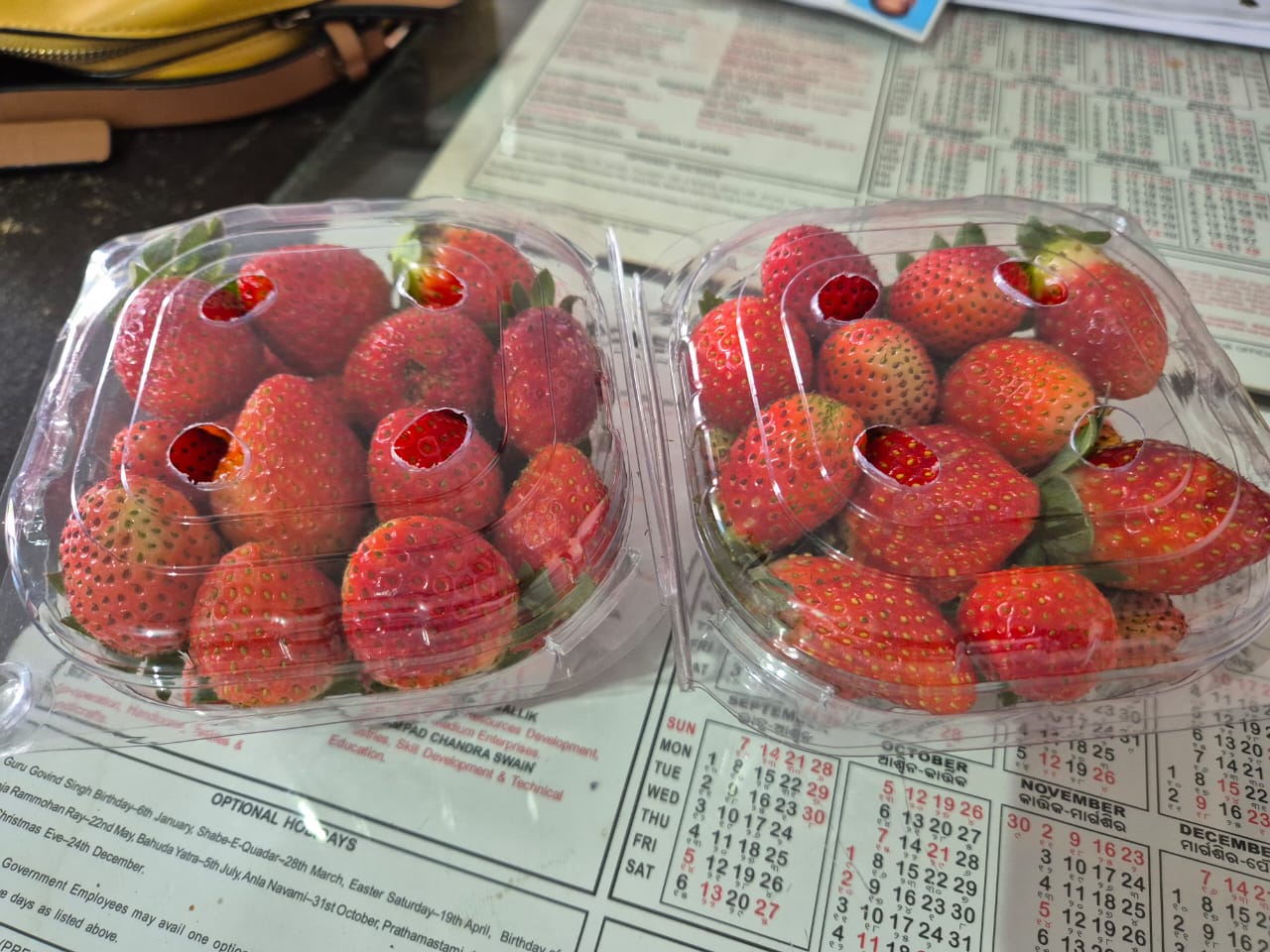


The successful cultivation of strawberries in Banki, Cuttack districtmarks a quiet but significant shift in India’s agricultural landscape. Traditionally confined to cooler hill regions, strawberries are now thriving in Odisha’s plains—challenging climatic assumptions and offering important lessons for agricultural policy, rural enterprise, and high-value horticulture.
At a time when farm incomes and climate resilience are top policy priorities, Banki’s strawberry success presents a compelling case for crop diversification backed by targeted state support.
First strawberries from Banki soil!
Cuttack farmers break new ground with strawberry cultivation – debut harvest is here! @CuttackDM @krushibibhag— CMO Odisha (@CMO_Odisha) January 21, 2026
Rethinking Crop Geography in a Warming Climate
Strawberries have historically been grown in temperate zones such as Mahabaleshwar, Himachal Pradesh, and Jammu & Kashmirwhere cooler temperatures naturally support fruiting. However, climate change and rising input costs are forcing a re-evaluation of rigid crop–climate boundaries.
Banki’s experience demonstrates that technology and agronomic innovation can substitute for climatic advantages. Raised-bed cultivation, mulching, drip irrigation, and adaptive planting schedules have enabled strawberries to perform well even in warmer, more humid conditions.
For policymakers, this raises an important question: should agricultural planning continue to rely on traditional agro-climatic zoning, or evolve toward technology-enabled adaptability?
Policy Push Behind the Transition
Odisha’s shift toward strawberries is not accidental. The state government has actively promoted high-value horticulture as a strategy to:
Under state-supported schemes, farmers receive assistance of up to ₹12.27 lakh for hectarecovering planting material, infrastructure, and technical guidance. This risk-sharing approach has been crucial in convincing farmers—particularly smallholders and women-led self-help groups—to experiment with a non-traditional crop.
From a policy perspective, this model highlights the importance of front-loaded investment in horticulture rather than post-facto subsidies.
Agribusiness Opportunities Emerging from Banki
The strawberry experiment is creating multiple opportunities across the agribusiness value chain:
1. Input and Technology Providers
Demand is rising for:
Localised agri-tech solutions tailored to warm climates could become a new market segment.
2. Market Linkages and Direct Sales
Farmers in Banki are supplying strawberries to urban centres such as Cuttack, Bhubaneswar, Balasore, Bhadrak, and Jajpur. Advance orders and direct farmgate sales have helped stabilise prices and reduce post-harvest losses.
This opens space for aggregators, cold-chain startups, and farm-to-consumer platforms to integrate strawberries into their supply networks.
3. Value Addition and Processing
Strawberries lend themselves well to processing into:
Policy incentives for small-scale food processing units could multiply income potential while reducing wastage.
Women, SHGs, and Inclusive Growth
A notable feature of Odisha’s strawberry cultivation drive is the participation of women-led self-help groups. With relatively small land requirements and quick harvest cycles, strawberries are well-suited to collective farming models.
From an inclusion standpoint, this aligns with broader policy goals of:
Enhancing women’s participation in agriculture
Supporting micro-entrepreneurship
Strengthening rural institutions
Tourism and Rural Branding Potential
Strawberry farms in Banki have begun attracting visitors, creating informal agri-tourism hubs. While still nascent, this trend points to an opportunity for rural branding—positioning districts as centres for specialty produce.
With modest policy support, this could evolve into structured agri-tourism, offering farmers additional income streams while promoting local economies.
Risks and Policy Gaps
Despite its promise, strawberry cultivation in non-traditional regions carries risks:
To sustain growth, policymakers will need to focus on:
Climate-resilient varieties
Extension services and farmer training
Cold-chain infrastructure
Crop insurance tailored to horticulture
Lessons for India’s Agricultural Future
Banki’s strawberry success underscores a broader truth: India’s agricultural transformation will depend not on expanding land, but on expanding value. High-value horticulture, supported by smart policy and market integration, can deliver income growth without increasing environmental stress.
For agribusiness leaders and policymakers alike, the message is clear—the future of farming lies in adaptability, diversification, and collaboration.
As strawberries take root in Odisha’s plains, they offer a blueprint for how India can reimagine agriculture in a changing climate.

Comments are closed.