
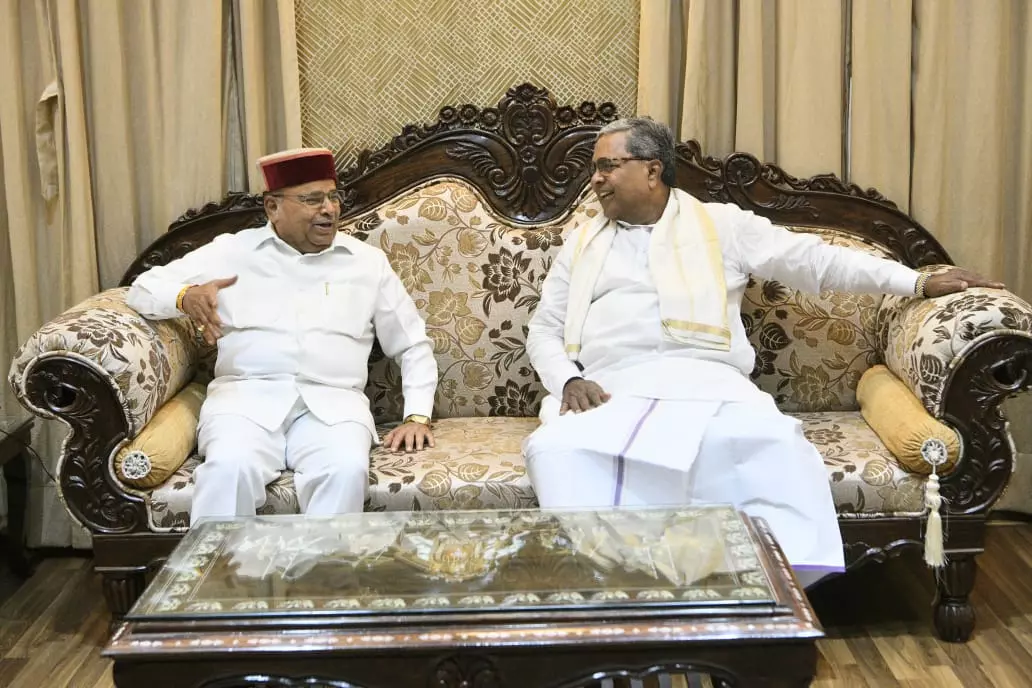

It’s late-night political drama in Bengaluru. (This story is developing)
The standoff between the Karnataka government and the Governor has escalated ahead of the joint session scheduled for Thursday (January 22), after Chief Minister Siddaramaiah refused to delete references critical of the Centre from the Governor’s address. The Governor had earlier agreed to deliver the speech after the Congress-led government consented to remove those portions from the draft. However, while Law Minister H K Patil reportedly agreed to the deletions, but Siddaramaiah later stood firm on retaining them.
Chief Minister’s legal adviser A S Ponnanna is now meeting the Governor to resolve the impasse. Siddaramaiah has said the government is willing to correct technical errors in the speech, but not alter its policy positions.
MGNREGS row hits state politics
One of the major contentious points remained the Centre’s decision to replace the Mahatma Gandhi National Rural Employment Guarantee Scheme (MGNREGS) with the Viksit Bharat Guarantee for Rozgar and Ajeevika Mission Act. However, the government backtracked and agreed to remove 11 paragraphs that contained points against the Centre from the speech.
Also read: Bengaluru hop-on hop-off double-decker bus service launched; check route, price, timings
The refusal by the state’s constitutional head, a former minister in the Narendra Modi government at the Centre, prompted the government to swing into damage-control mode. A high-level delegation of ministers led by the state Law Minister H K Patil visited the Lok Bhavan, the governor’s official residence, on Wednesday (January 21) evening to persuade him. The team included A S Ponnanna, legal advisor to Chief Minister Siddaramaiah, and state Advocate General Shashi Kiran Shetty, among others.
State representatives recall Article 176
“Under Article 176 of the Indian Constitution, the governor has to come to the House and deliver a speech. We have made a request in this regard. He has suggested dropping 11 paragraphs against the Centre, and the state government has agreed to it,” Ponnanna said.
Speaking on the issue, Patil also mentioned Article 176, saying the governor has to read the government’s speech. He mentioned issues that the state government finds controversial, including those related to the 15th Finance Commission, saying the government included points in Gehlot’s speech script from the perspective of Karnataka’s welfare.
Also read: Karnataka obscene video row adds to Ramachandra Rao’s trail of controversies
While the law minister said that the government would pay attention to the governor’s suggestions on making some modifications in the content of the speech, he was not entirely convinced about such a practice.
“He (Gehlot) has suggested dropping some paragraphs. That is not very reasonable. The Centre has taken away the rights of farmers and agricultural workers. They don’t want any voice raised against these. The Centre is planning to centralise power. How can this not be informed in the Joint House?” Patil asked.
The minister confirmed that a copy of the revised speech will be submitted to the governor on Wednesday night.
Karnataka follows TN, Kerala
The latest incident shows Karnataka has walked the path of its neighbours, Tamil Nadu and Kerala, which have also witnessed conflicts between the governor and the respective governments.
On Tuesday (January 20), Kerala Assembly witnessed extraordinary scenes after Chief Minister Pinarayi Vijayan made corrections to the policy address made by Governor Rajendra Vishwanath Arlekar after the latter departed. He was accused of omitting those parts of the speech that criticised the Centre.
Also read: Bengaluru civic body elections after May 25 via ballot papers, confirms state poll body chief
Similar scenes unfolded the same day in Tamil Nadu where Governor R N Ravi alleged insult to the National Anthem, declined to read the customary state government-prepared speech, and walked out of the Assembly. Clashes between Ravi and the state’s Dravida Munnetra Kazhagam government have been widely reported.
Earlier, in Karnataka, the government huddled together under Siddaramaiah after Gehlot expressed his intent not to deliver the government’s speech.
A delegation led by Patil went to the CM’s residence and informed him about the governor’s non-attendance in the legislature. It was then that Siddaramaiah had instructed the law minister and legal advisor to immediately go to the Lok Bhavan and talk to the governor.
The governor’s U-turn saved the state government from a major embarrassment since his refusal to give the speech would have given the opposition parties in the state, the Bharatiya Janata Party, and Janata Dal (Secular), a weapon to portray the government’s administrative failure and disrespect for the office of the governor.
What Article 176 says?
Article 176 of the Indian Constitution mandates a state governor’s special address to the state legislature at the start of the first session after general elections and the first session of each year, informing them of the government’s agenda and ensuring executive accountability. It also sets the legislative tone.
The governor must address the Assembly (or both Houses in case the legislature is a bicameral one) to outline reasons for summoning the legislature.
The governor, as the state’s constitutional head, delivers the speech, but the text of which is prepared by the elected government.
In the Shamsher Singh v. State of Punjab case of 1974, the Supreme Court observed that the governor, like the President of India, is bound by the aid and advice of the Council of Ministers. It also reaffirmed that the governor’s address must be prepared based on the state government’s policy agenda.
(This article was originally published in The Federal Kannada)

Comments are closed.