
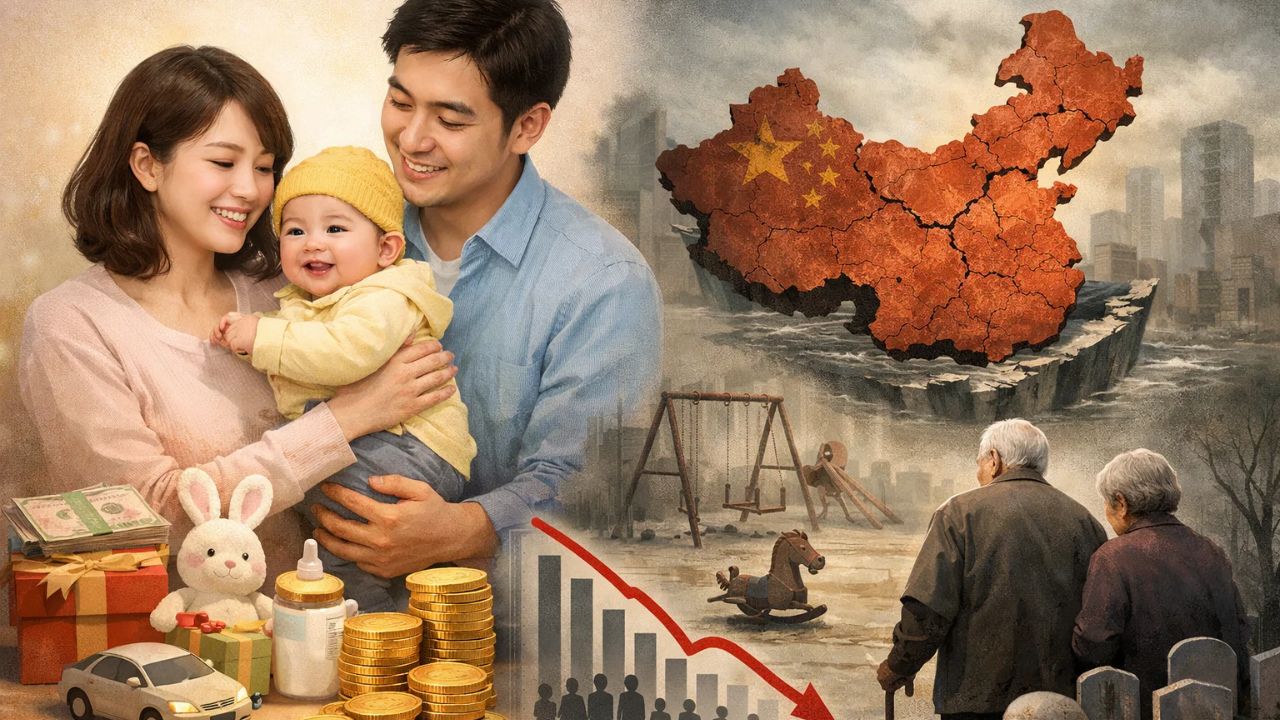
You can’t do it, Xi Jinping! Even heavy taxes on condoms aren’t working. How will the Dragon King persuade people to have more children?

China, which once considered its vast population the greatest pillar of national strength, is now taking unusual and shocking measures to protect that very population. Taxing condoms, offering dating courses in schools, offering cash subsidies for children—these are the policies of a country that for decades “controlled” births and is now struggling to “encourage” them.
According to a new government population report, China’s population decline is not just a statistic, but a deep and structural decline – a decline that experts are now calling a “population collapse,” reports the Times of India.
The lowest birth rate since 1949, the population is declining for the fourth year in a row.
According to government data, China’s total population will decline to 1.404 billion in 2025. This is about 3 million fewer than last year. This is the fourth consecutive year that China’s population has declined. Most shockingly, China’s birth rate has reached its lowest level since the Communist Revolution of 1949—the same year Mao Zedong founded the People’s Republic of China.
In 2025, the birth rate was 5.63 per 1,000 population, and a total of 7.92 million births were born, a 17% decline compared to 2024. Although there was a slight increase in the birth rate in 2024, it was so short-lived that the figures fell again before policymakers could take credit for it.
Fertility rates: the root of the crisis
China’s last official fertility rate was released in 2020, at 1.3. However, independent demographers estimate the actual rate to be 1 or even lower. A fertility rate of 2.1 is considered essential for a country’s population to remain stable. For comparison:
- South Korea: ~0.7
- Japan: ~1.26
- America: ~1.6
The result is clear – the number of elderly people in China is increasing rapidly and the young population is shrinking.
When population was a strategic weapon
In 1957, Mao Zedong declared, “China’s 600 million people are its greatest strength.” But by the 1970s, the situation had changed. Hunger, famine, and economic instability forced the Chinese leadership to recognize that uncontrolled population could become the biggest obstacle to the country’s modernization.
One Child Policy: Which shook the foundation of the future
In 1980, four years after Mao’s death, China implemented the infamous one-child policy. Most families in urban areas were allowed only one child. This policy remained in effect for nearly 35 years and had profound consequences:
Gender imbalance in the preference for sons
- The “only child” generation – no brothers, no sisters
- rapidly aging population
- Shrinking workforce in urban areas
Two children were allowed in 2015 and three children in 2021, but by then it was too late.
Why are Chinese families not wanting children?
Despite the end of the one-child policy, China hasn’t experienced a baby boom. The reasons are deep and complex.
- Financial pressure: Raising children in urban China has become incredibly expensive – housing, schooling, tuition, healthcare, and extracurricular activities. The slowing economy and youth unemployment have exacerbated the situation.
- Changing social values: Marriage rates are falling. Young women, in particular, are postponing marriage and motherhood or opting out altogether. Long working hours, career pressures, and a competitive education system militate against large families.
- The policy’s psychological impact: For the generation raised under the one-child policy, small families have become the “normal.” The culture of over-investing in one child—known as the “Little Emperor Syndrome”—persists.
- Cultural reasons: 2025 was the Year of the Snake according to the Chinese calendar, which is considered inauspicious for childbirth. This also affected the birth rate.
- It is worth noting that since 2022, the number of deaths in China has exceeded births.
Beijing’s strange measures
When social change failed, the government resorted to economic and behavioral engineering. Recent measures include the following:
- Cash subsidy: 3,600 yuan (about $500) per child in some areas
- 13% tax on condoms (VAT exemption removed)
- Tax exemptions for kindergartens, daycares, and even matchmakers
- Promotional campaigns promoting marriage and childbearing
- Five-year plans aim to reduce childcare costs
However, experts say that these subsidies are inadequate compared to the actual cost and do not address the underlying structural problems.
Aging China: Before It Gets Rich
- By 2025, China will have 323 million people over the age of 60, representing 23% of the total population. This proportion is rising rapidly. This has serious economic consequences:
- Slow economic growth: China’s growth was 5% in 2025, but due to decreasing labor force, it may slow down further in the future.
- Pressure on pensions and health: The growing number of retirees will increase government expenditure. Pension reforms and expanding the tax base will become essential.
- The challenge of industrial transition: High-tech and automation cannot replace all jobs, especially in a consumer economy.
Experts sum up this fear in one sentence – “China is getting old before it gets rich.”
Global impact and the India factor
Population has always been a strategic strength for China. President Xi Jinping called it a “wall of steel made of 1.4 billion people.” But in 2023, India will surpass China to become the country with the world’s largest population. Now, population is not just a matter of numbers, but also of markets, diplomacy, military planning, and leadership in the Global South.
What next?
There are no easy solutions for China. Countries like Japan and South Korea are also grappling with the same crisis, but the scale of China’s situation is unprecedented.
To stop population decline, China should:
- Making family life cheaper
- Pension and welfare systems need to be reformed.
- The pressure on working parents needs to be reduced.
- Economic stability must be maintained
But demographers warn that once fertility rates fall below a certain threshold, they’re extremely difficult to recover. A country that once tried to prevent births at all costs is now grappling with a new and unexpected question: how to persuade people to have children in a society accustomed to having fewer children?

Comments are closed.