
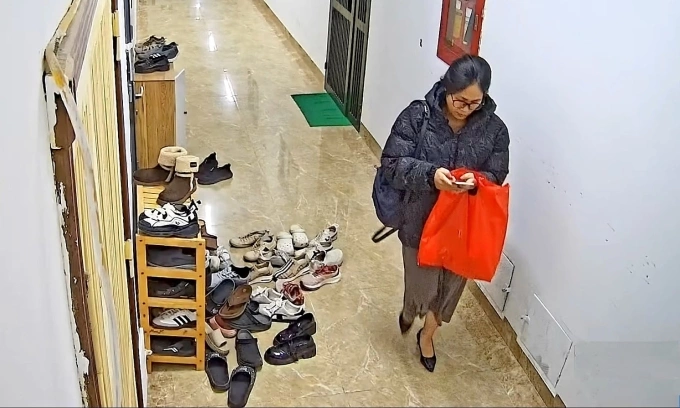

In 2017 she had moved into an apartment on Tran Huu Duc Street in Tu Liem Ward. Right on the first day she noticed the corridor outside her home was littered with the neighbor’s belongings, including more than 20 pairs of shoes that occupied over half the place, a bicycle, a shopping cart, and a treadmill.
“On several occasions, my door hit the pile of shoes and knocked them out of place. The neighbor’s family immediately rushed to the door to scold and warn me ‘not to make the same mistake again,’” she says.
On the evening of Jan. 8, while returning home from work, she was blocked and assaulted by the neighbor’s family, who accused her of voicing her opinion in the residents’ group chat.
“One slapped me, another pulled my hair, and they kept punching me in the head,” she says.
The altercation left her hospitalized and prompted her to leave her apartment over safety concerns. Hang’s might be an extreme case, but represents a wider problem in high-density urban areas, where disputes over shared spaces are common.
Shoes from a neighboring household take up more than half of a shared corridor at an apartment building on Tran Huu Duc Street, Tu Liem Ward, Hanoi. Photo courtesy of Hang |
Endless disputes
Le Hoang, 42, who lives in Long Bien Ward, says he has been in a two-year standoff with a neighbor over shoes in the hallway.
After his neighbor moved in, they gradually moved their shoe rack closer to the area in front of his door, and, during warm weather, odors from unwashed socks would drift into his living room, he says.
“I tried reminding them politely but was ignored. I eventually had to throw some of the shoes down the stairwell or into the trash before they finally moved the shoes back inside.”
In Tu Liem Ward, Bui Thi Ngoc, 46, says her gentle suggestion about shoes blocking the corridor drew a curt response from her neighbor: “I don’t need you to teach me.”
That neighbor later retaliated by sweeping debris toward her door, dumping trash and making noise late into the night to disrupt her family’s life, she says.
She says there were even scuffles and loud arguments across the building, but nothing changed because the apartment management did not hand out fines.
“For the last two years I have never been fully comfortable in my own home. I want to sell the apartment and move but with a young child and limited finances, I have no choice but to endure it.”
The ‘every man for himself’ mindset
Nguyen Duy Thanh, a building operations expert with 11 years of experience, says conflicts in mid- and lower-priced apartments often stem from an “every man for himself” mindset.
Some occupants, particularly those living at the end of a corridor, treat the shared area outside their doors as private space, he points out.
“They want their homes to be clean and spacious and so move dirty, smelly and bulky items outside.”
In the event of a fire, corridors are often the only escape route, and smoke and power outages can turn shoe cabinets or bicycles into obstacles that block evacuation or further the spread of fire, he says.
Cluttered corridors also reduce property value, he says.
“An apartment building is not valued only by the interior of each unit but also by the order and civility of its shared spaces. When corridors are cluttered, homeowners are reducing the value of their own property.”
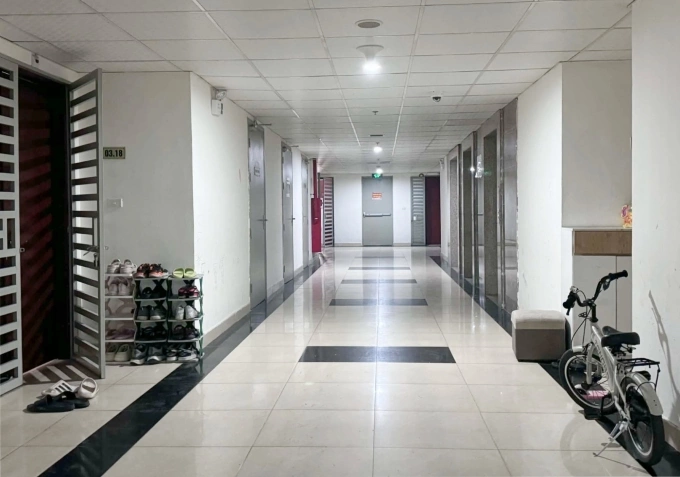 |
Shelves of slippers and bicycles are placed in the hallway at an apartment building in Cau Giay, Hanoi. Image: Pham Nga |
Shoe racks and bicycles in a corridor at an apartment building in Cau Giay Ward, Hanoi. Photo by Read/Pham Nga
In many countries, corridor regulations are strictly enforced.
After the 2017 Grenfell Tower fire in the U.K., a “zero tolerance” policy has been adopted at many buildings, treating items such as doormats and shoes as fire hazards, and apartment managements are allowed to seize and dispose them of.
In the U.S., homeowners can face lawsuits for compensation of hundreds of thousands of dollars if someone is injured after tripping over items left in corridors.
In Vietnam too, the law sets out penalties for violation of shared living spaces. Decree 16/2022 slaps fines of VND30-40 million (US$1,000-1,500) for encroaching on a shared area along with the requirement to restore the space to its original condition.
But enforcement is largely limited to reminders from building managements.
Tran Tu, 43, of Ha Dong Ward, says he once treated the corridor in front of his home as his “yard” until the management confiscated his shoe rack without prior notice.
“I had to go to the storage area, sign a written commitment, and pay a fine to get my belongings back. The most embarrassing was carrying the rack and bags of shoes into the elevator during rush hour while security told me to move quickly.”
His family then returned the corridor to its original state.
But others are less lucky.
After the violent altercation, Hang and her daughter live in a rented house, and she laments: “I have a house that I cannot go back to just because of misplaced shoes.”

Comments are closed.