
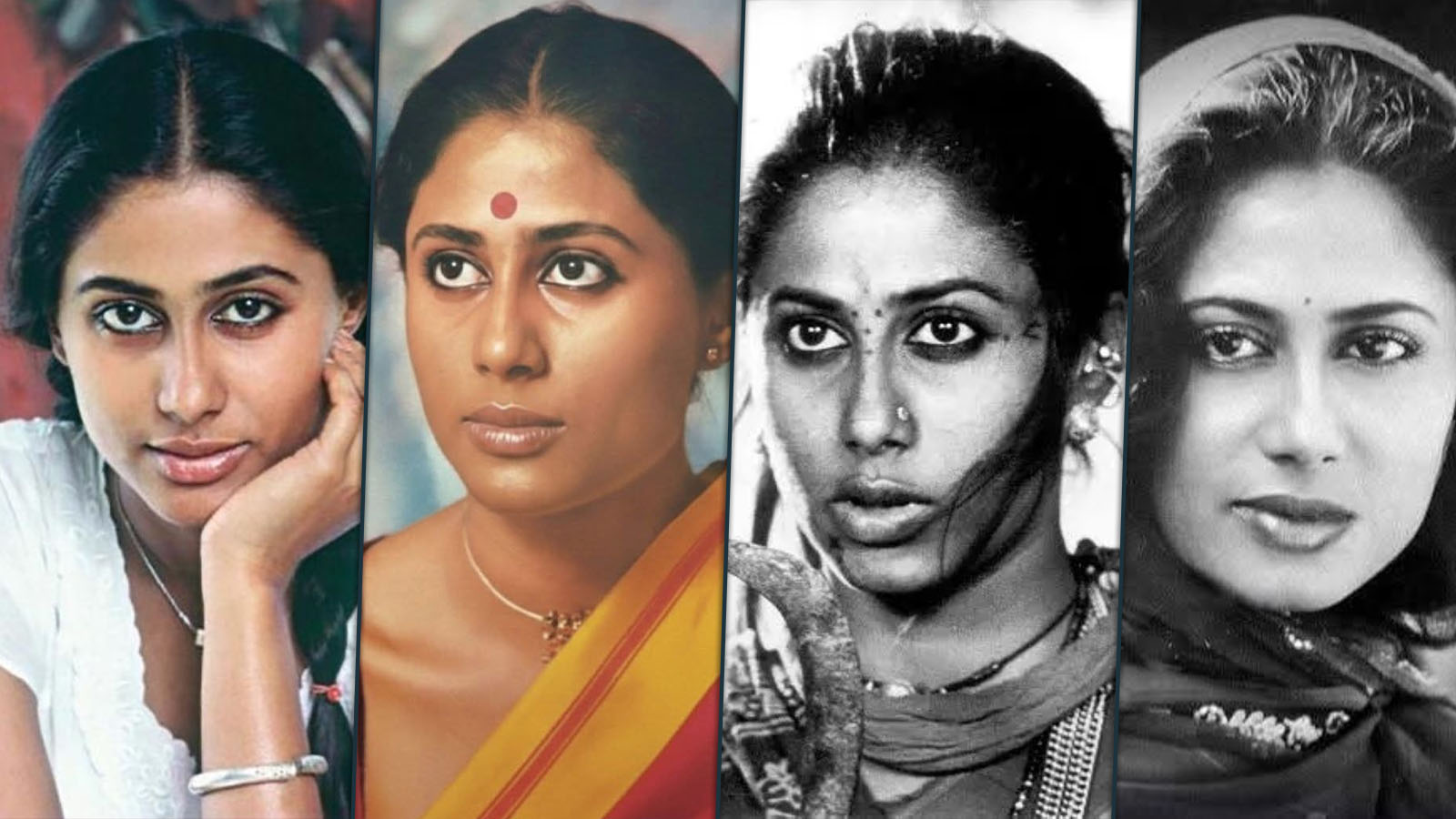

Smita Patil (1955-1986) was like a meteor. Even 40 years after her untimely demise on December 13, 1986, she continues to live on through her body of work, breathing quietly in the cultural memory. As an actor, she left an indelible impression on the minds of cine lovers, like an unending poem that faded into the timeless dusk of memory, but never quite disappeared.
Indian cinema, now over 125 years old, marks the 40th anniversary of her death this year. Smita, who died at the age of 31, acted in over 80 films in a single decade across Hindi, Marathi, Bengali, Gujarati, Malayalam, and Kannada cinema. She worked with doyens of the parallel cinema movement, including Satyajit Ray, Shyam Benegal, Govind Nihalani, Jabbar Patel, Ketan Mehta, Girish Karnad, TS Nagabharana, and G. Aravindan, among others.
Though her journey was brief, Smita’s impact remains enduring. Across her roles, she showed society in its raw colours and through a gaze that could at once wound and heal. Her face carried stories older than words: the ache of the earth, the strength of women, and the quiet dignity of struggle.
Her retrospective at BIFFes
Smita made her film debut with Shyam Benegal’s Charandas Chor in 1975. “The 17th edition of Bengaluru International Film Festival (BIFFes), which will be held between January 29 and February 6, is set to mark the 50th year of Smita entering cinema and 40 years of her demise by making it a moment to recall a body of work that continues to unsettle, question and inspire. Screening her films under the retrospective section will be in tune with the ambitious agenda of BIFFes — Stree Endare Ashte Saake (Is a woman just that much or is that enough) — dedicated to women,” P.B. Murali, Artistic Director of the festival, told The Federal.
“We have scheduled to screen Ketan Mehta’s Bhavni Bhavai and Mirch Masala, and G. Aravindan’s Chidambaram. And hoping to add another three-four films to the lineup,” he added. “In Mirch Masala, Smita delivered an enigmatically feisty performance of a faithful, determined woman. In her eyes, you could see the revolution of Manthan, the anguish of Arth, the haunting solitude of Bhoomika. While essaying these roles with raw grace, Smita lived those characters, dissolving the boundary between screen and soul. Each frame she inhabited felt alive, painted with realism lit by empathy”, said Murali.
Also read: What Polish filmmaker Andrzej Wajda’s cinema teaches India about censorship
He added that Smita was a true trailblazer in Indian cinema, known for her fearless choice of roles, dedication to craft and ability to portray women in a deeply human and authentic manner: “She will always be remembered as a cinematic legend whose performances continue to resonate with audiences across generations”.
Art and mainstream cinema
An arts graduate from Bombay University, Smita first entered visual media through Arun Khopkar’s Film and Television Institute Diploma film Teevra Medium (1974), when she was barely 19 years old. But the credit for introducing her to the Hindi screen goes to Shyam Benegal, who got impressed with her eloquent eyes as a Marathi news anchor on the small screen. Shyam first cast her in a small role in Charandas Chor (1974) and then in Nishant (1975) and Churning (1976) in quick succession. She did not look back afterwards, and the rest is history.
Smita got the National Award for her performance in Benegal’s Bhumika (1977) in which she essayed the role of a Marathi stage actress, Hansa Wadkar, portraying unconventional life, search for identity and struggles as a woman in patriarchal society. Smita, who traversed the delicate line between art and mainstream cinema with ease, was also honoured with Padma Shri in 1985. Mandi, Umbarta, Bazar, Bhavni Bhavai, Chakra, and Mrinal Sen’s Akaler Sandhane (In Search of Famine) are Smita’s landmark films.
Smita’s performance in Akaler Sandhane remains unforgettable for its poignant exploration of human suffering against the backdrop of Bengal famine. This film exemplifies the way she could embody complex emotions. B S Basavaraj, veteran cinematographer of Kannada films, recalled what K K Mahajan (1944-2007), who canned Akaler Sandhane, shared with him that Smita was confused about a certain shot in the film. “She was not confident about her response to a particular emotion. Then, Mrinal and asked her to shed her method-acting mould and react naturally. Smita obeyed her Master’s direction and delivered an expression that could not be matched,” Basavaraj told Mahajan.
How Benegal discovered Smita
Smita began her career in the early 1970s as a television newsreader on Mumbai Doordarshan. In an interaction with this writer, Benegal, during his visit to Bengaluru in 2014, recalled how he discovered Smita’s acting prowess. “When I was casting for NishantI failed to find a suitable actress to essay Rukmini’s character. I needed a perfect Marathi face. While watching the news on television, I noticed Smita. Hiten Ghosh, my sound recordist, knew her and contacted her family,” he said.
Also read: Shaji N. Karun: Cinematographer-auteur who introduced a new visual poetics to Indian Cinema
Smita, however, was not interested in working in films. “I met her twice, once with her father, who was then minister in the Maharashtra cabinet. I did my best to persuade her to act in Nishant. As she was not a trained actress then, I made her act in Charandas Chora children’s film. She proved her mettle. That gave me confidence as she seemed to be tailor-made for the characters I wrote,” said Benegal, admiring her artistic calibre.
Anveshane and the razor incident
Smita’a most significant engagement with Kannada cinema was in Anveshane (1983), a film directed by National Award recipient filmmaker T S Nagabharana that stands at the intersection of realism, moral inquiry and narrative restraint. Speaking to The FederalNagabharana said, “Co-starring Girish Karnad, Ananth Nag and Sundar Raj, the film exemplifies the parallel efforts with Kannada cinema to explore truth, conscience, and the fragile ethics of individuals caught with larger social structure.”
“In AnveshaneSmita’s performance is marked by quiet intensity and moral gravity rather than dramatic flourish,” he added. Nagabharana disclosed that, during the shooting of AnveshaneSmita was diagnosed with haemophilia, a genetic condition where essential clotting factors are missing. Finally, Smita breathed her last due to prolonged bleeding during her delivery.
Crediting Girish Karnad, Nachiket, Jayoo Patwardhan, and his Pune connections for preferring Smita Patil for AnveshaneNabhanana recalled: AnveshaneI was searching for a suitable Kannada actor to essay the character of Revathi. Since it was a role with emotional depth, no one quite matched our expectations. Finally, Girish suggested that I contact Smita.”
“I used to visit Nachiket and Jayoo Patwardhan’s home, where Smita would often come. One day, I narrated the story to her. She was thrilled and asked me to go ahead with the project. I then asked her, ‘Will you play Revathi?’ She immediately replied, ‘Why not?’ Girish was surprised and asked me whether Smita had discussed remuneration. I said no. Girish just smiled.” he added.
Recalling the first signs of Smita’s haemophilia during the shooting of AnveshaneNagabharana recounted a disturbing incident from the Mysore schedule: “In a scene where Anant Nag was shaving his beard and Smita brought him coffee, the razor in his hand accidentally touched Smita’s index finger. Blood began to ooze, and all our initial attempts at first aid failed to stop the bleeding. ”
“We immediately rushed her to a nearby hospital. Even the doctor struggled, but somehow managed to stop the bleeding temporarily. We were all shocked and deeply worried. Despite this, Smita continued shooting, assuring us that she would have it checked once she returned to Bombay. Later, we learnt about the haemophilia she was suffering from. I was completely disturbed and shattered when I heard of Smita’s death due to haemophilia,” he added.
Her discipline and seriousness
At the time of filling AnveshaneSmita’s health condition was not publicly known nor did it visibly affect the integrity of her performance. “On screen, she appears composed, inward, and morally anchored, qualities that had already become her artistic signature. What is striking is that Smita continued to work with the same discipline and seriousness. There was no trace of self-pity or physical concession in her performance. Instead, her presence in Anveshane is marked by an almost heightened artistry,” he added.
Also read: Why the backlash against AR Rahman is unfair and an act of cultural illiteracy
“When I suggested rescheduling her scenes, Smita protested and asked me to complete the schedule, assuring me there would be no problem until the shoot was over. She was homely and never asked about remuneration. Nor did she ever claim flight charges for her personal visits. Once, she even travelled by night bus to Pune for urgent work,” Nagabharana recalled.
He added that Smita represented a philosophy rooted in truth rather than performance. Her cinema believed that reality, however uncomfortable, deserved to be seen without embellishment. Her strength lay in not romanticising pain, she allowed it to exist, breathe, and speak for itself.
During a recent conversation with this writer, Govind Nihalani, who worked closely with Smita, admired her immense talent while also expressing deep frustration at her untimely passing and the loss of a great artist. “She acted in my landmark films Akrosh and Ardh Satya. Smita is not a nostalgic memory for me. She is a critical presence, urging cinema to reclaim seriousness, empathy, and courage,” he said.
Nihalani also disclosed that he, along with Ketan Mehta, had hoped to create a definitive biopic on Smita’s life, recognising both her extraordinary career and tragic end. “But we could not accomplish that dream due to family guardianship over her story,” he said.
The retrospective at the 17th edition of BIFFes is both a tribute to an irreplaceable talent and a remembrance of a rare ‘star’ that vanished from the cinematic galaxy too soon, like a massive star collapsing directly into a black hole rather than fading gradually from view.

Comments are closed.