
Trump–Putin ‘secret deal’ speculation fuels global geopolitical churn. DNA Explains | world news

Speculation around a possible backchannel understanding between US President Donald Trump and Russian President Vladimir Putin has intensified ahead of their expected meeting, the first in nearly 160 days. While the location of the meeting has not been disclosed, diplomatic circles believe discussions could revolve around two critical flashpoints: the ongoing Ukraine war and the strategic future of Greenland. The emerging narrative suggests a recalibration of great-power politics at a time when the global order already appears under strain.
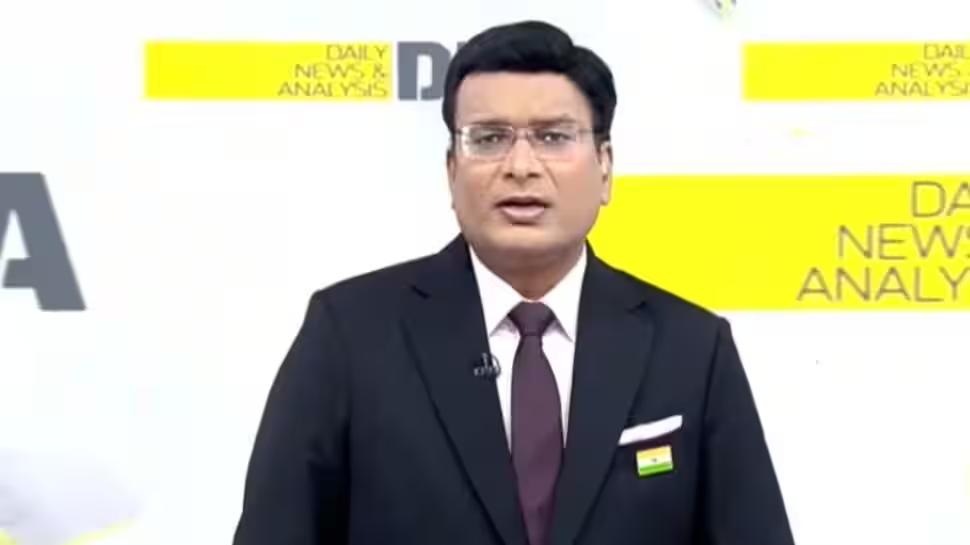
In today’s episode of DNA, Rahul Sinha, Managing Editor of Zee News, conducted a detailed analysis of these developments, questioning long-held assumptions in West Asia and beyond. The analysis challenges the belief within Iran’s leadership that Russia would automatically come to Tehran’s aid in the event of a US strike, arguing that shifting geopolitical interests may no longer align Moscow with Tehran in the same way as before.
Trump’s ‘Gaza Plan’…how did Pakistan get trapped?
Analysis of the ‘deal’ between Trump and Putin
Analysis of the latest ‘Dharmayuddha’ on ShankaracharyaSee #DNA LIVE with Rahul Sinha#DNAFriends #ZeeLive #ZeeNews #DNAWithRahulSinha@RahulSinhaTV
https://t.co/rmGvtzIsUm— Zee News (@ZeeNews) January 22, 2026
Add Zee News as a Preferred Source
At the center of the debate is Greenland. As much of Europe resists Trump’s renewed interest in the Arctic territory, Putin has made remarks that appear to indirectly support Washington’s position, even drawing historical parallels with Denmark’s 1917 sale of the Virgin Islands to the United States. Analysts interpret this as a signal that Moscow may be open to facilitating pressure on Denmark, potentially in exchange for American concessions elsewhere.
Ukraine remains the other key pillar of the speculation. Trump’s recent statements, including those made at Davos, indicate a softer tone toward Russia and a sharper criticism of Ukrainian President Volodymyr Zelensky. Trump has repeatedly suggested that a deal to end the war is close, while implying that Kyiv has been a hurdle in past negotiations. These remarks closely mirror Moscow’s narrative, further fueling talk of a possible understanding between the two leaders.
Three broad scenarios are being discussed by observers. One suggests that Washington could allow Russia to retain control over parts of eastern Ukraine, including Donbas, while Moscow assists the US in advancing its Greenland strategy. Another point to a reduction in US military support for Ukraine under the banner of a ceasefire, alongside increased Russian military activity in the Arctic to pressure Denmark. A third scenario involves easing sanctions on Russia and keeping Ukraine out of NATO in return for Russia limiting China’s role in Arctic geopolitics.
Adding to the intrigue are reports that Trump’s special envoy Steve Witkoff and the former president’s son-in-law are scheduled to meet Putin in Moscow. Officially framed as efforts to halt the Ukraine conflict, these meetings are also being viewed as potential groundwork for a broader geopolitical bargain.
Experts warn that if such an arrangement materialises, it could mark a return to a “sphere of influence” world order reminiscent of the post–Second World War era shaped at the 1945 Yalta Conference. In such a scenario, powerful nations would dominate regions at the expense of smaller states, potentially triggering fresh conflicts—from East Asia to the Middle East.
While Trump and Putin have both spoken of peace initiatives, including support for a Gaza peace plan, analysts caution that transactional diplomacy between major powers may ultimately deepen global instability rather than resolve it. In an era of shifting alliances, the coming days could prove pivotal for the future balance of power.

Comments are closed.