

Highlights
- Neural network chips are bringing on-device AI from data centres into home desktop PCs.
- Local AI improves speed, privacy, and reliability without relying on cloud services.
- AI desktops suit creators and developers most, with upgrades driven by workload needs.
Introduction: AI Moves Out of the Cloud and Into Your Home
For over the major part of the last 10 years, artificial intelligence was living a remote life. Whenever users interacted with a digital voice assistant with a query, or applied AI improvements to their photos, or produced text, more than the computer’s access point to cloud intelligence was involved – the real work was happening in far away data centres.
However, this model is gradually changing.
By the year 2026, AI will not be restricted to server and subscription-based access. Neural network chips – the hardware designed especially for accelerating AI tasks – are going to be widely used in desktops as well as in laptops. What was only possible with enterprise-grade hardware and top-tier smartphones is now transforming desktop computing.
This change signifies a complete shift: AI is now where the user is, it is personal and increasingly less dependent on cloud services.
Are Neural Network Chips Just Another Name for Some Chips?
Neural network chips can be thought of as machine-learning-optimised processors. These chips, in contrast to general-use CPUs that are good at a variety of tasks and also the GPUs that parallelly process graphics, are meant solely for AI inference and, in some cases, training.
They come in various shapes and sizes. Some are exclusive Neural Processing Units (NPUs). Others, like AI accelerators, are embedded with CPUs or GPUs. The matter of their performing matrix operations, which is the mathematical support of neural networks, is carried out very quickly and with very little power consumption.
With these chips in the desktop PCs, it is possible for the AI tasks to be performed locally rather than being transferred to the cloud. The difference is more profound than it seems.
Why On-Device AI Matters for Home Users
AI running locally leads to a change in three major areas of computing: speed, privacy, and reliability.
A huge reduction in latency is the consequence of processing performed on the device. Tasks such as image enhancement, voice recognition, and real-time translation become instantaneous as they are no longer dependent on the network speed.
The privacy aspect becomes better since the data in question never leaves the device. So, your personal photos, documents, voice recordings, and even patterns of behavior are kept local and thus have lower chances of being accessed by third-party servers.
Likewise, the reliability aspect is positively affected. The AI functions will still be there even if internet access is slow, unreliable, or totally cut off. For users living in areas where the connectivity is intermittent, this alone is a real boon.
From Smartphones to Desktops: A Natural Progression
Smartphones were the first consumer products to incorporate a processing unit on a large scale. Limited battery power, together with always-on connectivity, left mobile AI no choice but to be on-device.

Desktops had a slower adoption as they did not share the same limitations. Being plugged in was always the assumption, and they were not so power-conscious.
The previously made assumption is no longer true. Nevertheless, this has been the case for quite a while now as the AI has gone to the extent of being indispensable in everyday tasks such as writing, editing, and generating code, which has also increased the demand for local processing.
The hardware aspects of the desktop PCs are already giving them the upper hand in terms of space, cooling, and power, making them the best for AI processing to the most advanced levels.
AI Desktop Builds of Today
The initial AI-centric desktop builds introduced a mixture of traditional components and AI-optimized ones. Now the CPUs have AI-specific cores, and not only are GPUs supporting AI tasks beyond graphics, but even some setups have evolved add-on cards that are exclusively for neural workloads.
The systems are similar to normal desktops in terms of their appearance but different in terms of their functionality. The intelligent offloading of AI tasks to the most efficient processor shrinks CPU load and increases overall system responsiveness.
For the users who work frequently with AI-powered software, the difference is instantly perceptible.
The Home Practical Use Cases
The most interesting question is not what the neural network chips *can* do but what they actually do for home users today.

Content creators get the help of real-time video upscaling, background removal, noise reduction, and intelligent editing tools, all working in a cloudless way.
On the other hand, developers can run and test AI models on their machines, which will consequently speed up the experiments and reduce the need for using the paid cloud resources.
All these things lead to the average user getting smarter search, more responsive voice commands, and personalized system behavior that changes with time.
These are small improvements however, combined, they are redefining the experience of a personal computer.
Gaming, AI, and the Desktop Experience
Gaming is one of the common reasons for the purchase of high-performance PCs; AI chips are, however, gradually influencing gaming in a less obvious way.
Neural processors are supporting GPUs rather than taking their place. They permit the use of players’ smarter avatars, the processing of voices in real-time, the implementation of systems with adjustable difficulty, and the provision of various good features for users with difficulties.
What is more, AI acceleration enhances the performance of the entire system that runs games side by side, like streaming, recording and applying real-time effects, without compromising the quality of gaming.
Thus, it results in the creation of games that are more fluid and tightly knit.
Costs vs Benefits: Is It Worth Upgrading?
The AI-optimised desktop hardware is still more expensive than a traditional desktop, both in terms of the performance it offers and the price it carries. The use of dedicated AI chips and high-end CPUs automatically implies a higher price tag, and still, not all software is capable of utilizing them to their fullest extent.
For casual users, the advantages might seem somewhat theoretical. Cloud-based AI continues to be sufficiently good for doing most people’s everyday tasks.
For heavy users, artists, and AI workflow experimenters, the picture of the value proposition is much clearer. Offline processing minimizes the cost of subscriptions in the long run, gives one more control and enhances performance reliability.
Upgrading should be a decision based on workload rather than being influenced by marketing.
Software Readiness: The Missing Piece
The introduction of AI hardware is only half of the story. A new generation of software must be the one that makes the best use of the neural processors.
Operating systems are slowly but surely integrating AI scheduling to ensure the routing of tasks to the best-suited processor. Devises are offering more and more on-device AI modes that rely entirely on local processing, thus bypassing cloud processing altogether.
The downside, however, is that the support is not uniform across the board. While some applications are completely welcoming of the local AI acceleration, others do hardly recognize its existence.
The ongoing transition phase is very much like the past transitions in computing where the initially strong hardware went before the software slowly catching up completely.
Privacy, Ownership, and Control
One of the most overlooked components of local AI technology is the issue of ownership. When the AI is processed in the cloud, the users are actually renting it. While the user is on the local system, the user owns it.
This difference has ethical and practical aspects. People get back the control of their data, their process and their dependence on the outside service.
If AI is going to be the main factor in job and creativity then the shift to ownership may become as significant as performance improvements.
Who Should Build an AI-Focused PC Today?
Neural network chips for home PCs are the ones that are mainly directed towards early adopters, creation and development, and professionals who are making active use of AI tools.
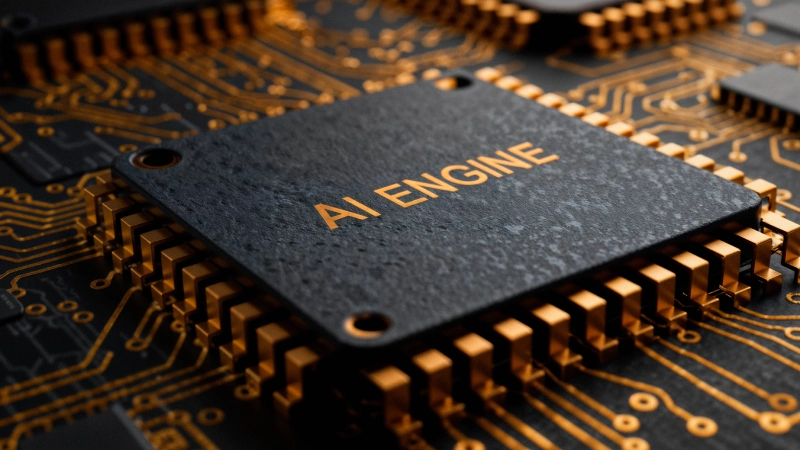
On the other hand, these chips are not that attractive for the people who are using the computer only for browsing, streaming or performing light office work.
Knowing one’s needs is very important. AI desktops are tools and not status symbols.
The Bigger Picture: A New Phase of Personal Computing
Neural network chips are introducing a new category of components but they are also causing a change in the way we think about computers.
Previously, personal computing devices were becoming thinner and lighter while the computers’ intelligence was moving to the cloud. Now the intelligence is coming back and it will be directly embedded in the machines that people use every day.
The move of AI to the periphery of the users has very far-reaching consequences for privacy, creativity, and digital independence.
Conclusion: The AI PC Era Has Started Quietly
The chips for neural networks are coming in with no loud and dramatic ceremonies. There is no definite point in time when AI desktops will entirely take over conventional PCs.
On the contrary, the shift is taking place silently and gradually, in terms of workloads. Jobs that used to need cloud access are now processed on computers. AI functions are felt to be quicker, more personal, and more intertwined.
By the year 2026, the building of AI desktop machines is still not a widespread practice, but they are accepted to be less trial and more research.
The domain of personal computing is not only powerful anymore but also smart, local, and gradually becoming more and more user-controlled.

Comments are closed.