
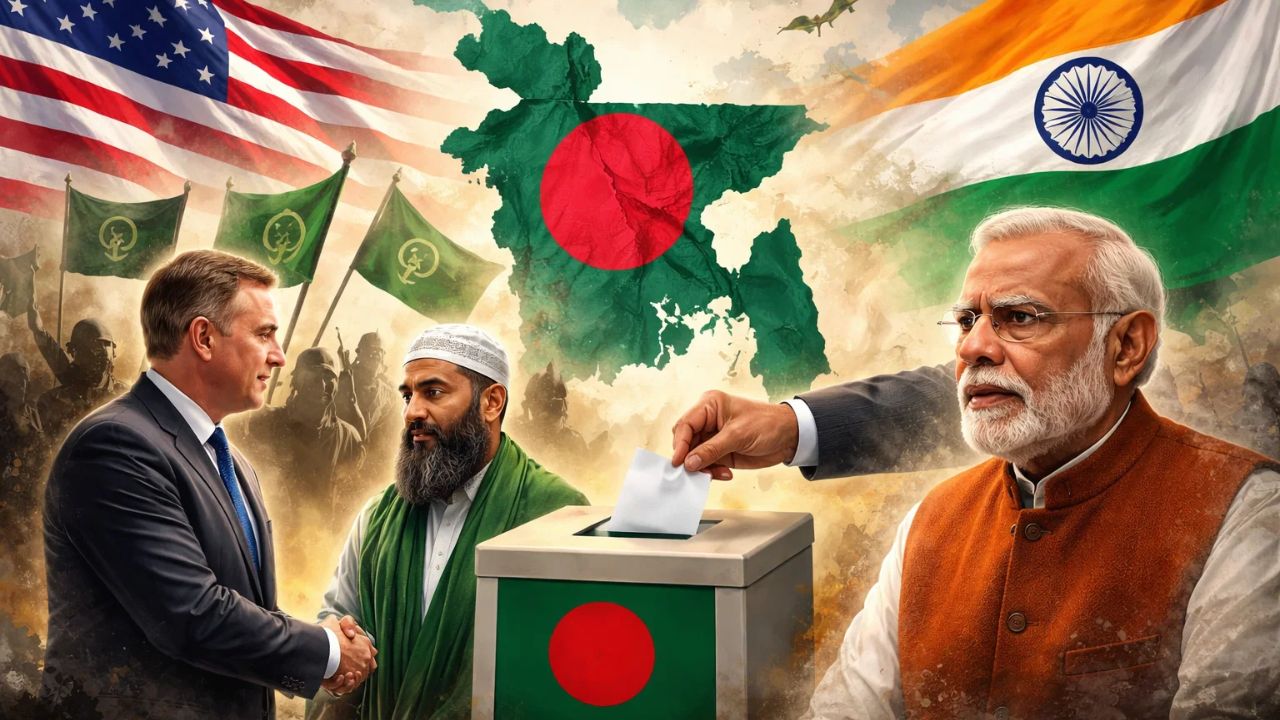
What is going on in Bangladesh? Is America making Islamists ‘friends’ before elections? Why is this a big threat to India?

Elections are going to be held in Bangladesh in February 2026. But even before the elections the situation there has worsened. Meanwhile, a news has come which has increased India’s concern. The news is that America now seems to be getting closer to Bangladesh’s radical Islamist party Jamaat-e-Islami. The same Jamaat, which had opposed the independence of Bangladesh in 1971 and which is considered an anti-India party.
The Washington Post report, highlighting this entire incident, has claimed that officials of the US Embassy in Bangladesh recently met party leaders at the regional office of Jamaat-e-Islami in Sylhet. According to the report, an American diplomat while talking to local journalists even said – “We want them to be our friends.” That is, we want to make them our friends. This statement has come at a time when Bangladesh’s politics is going through turmoil, Awami League is banned and former Prime Minister Sheikh Hasina is taking refuge in India.
US Embassy clarified, but questions remain
According to the report of Times of India, the US Embassy has rejected the allegation that America is supporting any particular party. Monica Shea, a spokeswoman for the US Embassy in Dhaka, was quoted as saying that the December conversation was a “routine, off-the-record” discussion in which several political parties were mentioned. He said that America will work with whichever government the people elect in Bangladesh. But the question is that if it was just a general conversation, then why the repeated and continuous contact only with Jamaat-e-Islami?
How American ‘engagement’ with Jamaat increased
The real story starts from 2023. That year, when violent protests were taking place against Sheikh Hasina’s government, an American diplomat met a senior Jamaat leader in Dhaka. After this, this contact increased rapidly in 2025.
- March 2025: Two former US ambassadors reach Jamaat headquarters
- June 2025: Jamaat will be called to the US Embassy to discuss internal governance, women and minority rights.
- July 2025: Chargé d’Affaires Tracy Ann Jacobson formally meets Jamaat chief Shafiqur Rehman
- The most surprising thing is that in November 2025, America also gave a visa to Shafiqur Rahman – even though his record has been very controversial.
Hardcore statements, Hamas support and still US visa
Serious allegations have been made against Shafikur Rahman earlier also. He has publicly praised Hamas leader Yahya Sinwar and has made anti-Semitic statements on several occasions. Despite this, America granting them visas indicates that Washington is considering Islamist forces as ‘stakeholders’ instead of ignoring them ahead of Bangladesh elections. This is where India’s worries begin.
Why alarm bells for India?
Currently, the Awami League – which has been India’s most reliable ally till now – is completely marginalized in Bangladeshi politics. Sheikh Hasina is in India and her party is banned. In such a situation, three forces are seen emerging in the 2026 elections – Bangladesh Nationalist Party (BNP), Jamaat-e-Islami (JI) and National Citizen Party (NCP) – the new party that emerged from the student movement of 2024. The attitude of all three towards India is either cold or openly hostile.
If Jamaat wins, what does it mean for India?
Jamaat-e-Islami coming to power is being considered the worst scenario for India. The party has been opposed to the liberation war of 1971. Its ideology is staunch Islamist and anti-India. Jamaat can increase defense and infrastructure partnership with China and Pakistan. The party’s student organization has won the Dhaka University elections in 2025, which shows its grassroots strength. Additionally, with Jamaat coming to power, there is a possibility of increased atrocities on minorities, especially Hindus, in Bangladesh – indications of which have been visible in recent months.
BNP victory: Cold relations, but practicality?
BNP’s victory will be a little less dangerous for India but will not be easy either. The party is using slogans like “Bangladeshi Nationalism” and “India Out”. Nevertheless, BNP has maintained practical relations with India in the past. Recently, positive response was also given to PM Modi’s message regarding Khaleda Zia’s health. This means that if BNP comes to power, relations will remain cold, but will not break completely.
NCP: Young face, but distance from India
The National Citizen Party emerged from the 2024 student movement and its leaders are young faces like Naheed Islam, who was at the forefront of the anti-Sheikh Hasina movement. Although NCP is called ‘reformist’, its relations with India have deteriorated further. The party’s stance is strict against nationalism and foreign interference—which also targets India.
Sheikh Hasina Factor: More poison in relationships
Bangladesh is continuously demanding to send Sheikh Hasina back from India. Relations between the two countries have deteriorated further on this issue. The situation reached such a level that recently both countries temporarily stopped visa services due to security reasons. Meanwhile, Sheikh Hasina is continuously making sharp attacks on the interim government and Mohammad Yunus from India. They allege that the interim government encouraged radicals and failed to protect minorities. Also weakened India-Bangladesh relations. Hasina claims that relations cannot become normal without the return of a legitimate government.
Human rights, deaths and international pressure
The situation became more complicated when a court in Dhaka convicted Sheikh Hasina of “crimes against humanity” and sentenced her to death. According to the report of the United Nations Human Rights Office, about 1,400 people died in the “July Uprising” that took place between July-August 2025, when Hasina government ordered security forces to take strict action.
Politics vs Diplomacy, and India’s Challenge
America’s increasing contact with Islamist parties in Bangladesh is not just a political issue there, but an issue related to the strategic stability of South Asia. The challenge for India is clear – without the Awami League, relations will not be easy, irrespective of the government in Dhaka. If Jamaat or anti-India forces become stronger, it will impact every front – security, border, minority rights and regional balance.
Now the big question is: Is America putting the stability of South Asia at stake for electoral mathematics, and is India ready for it?

Comments are closed.