
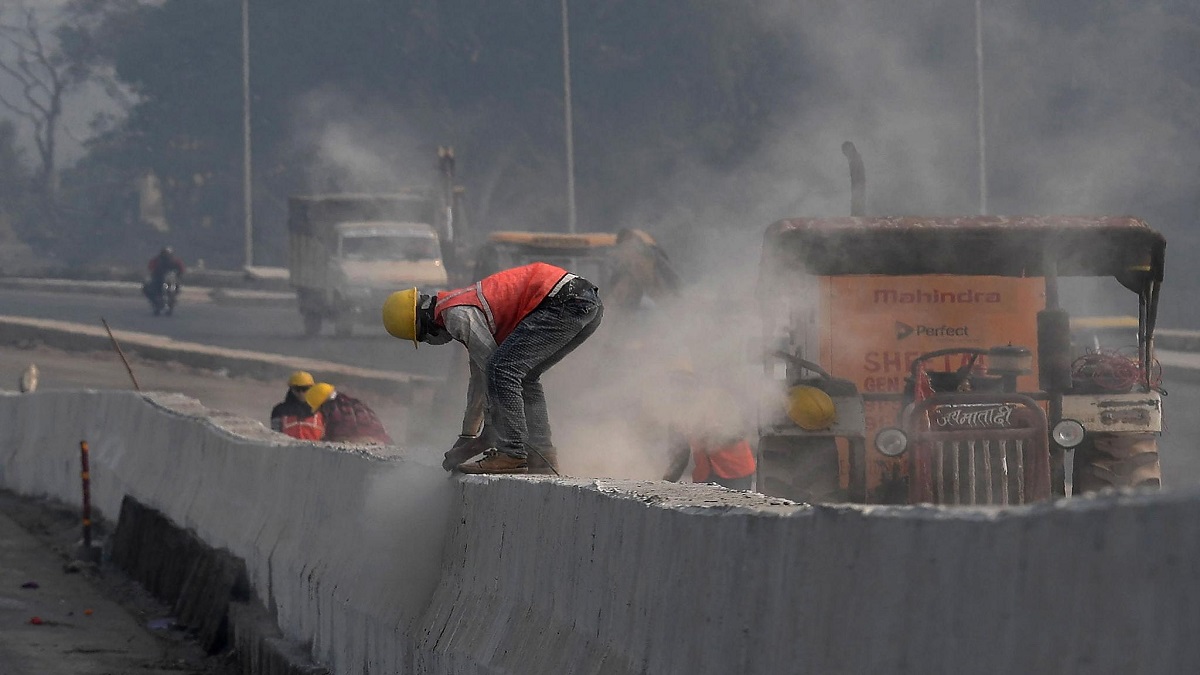

the country’s rapidly growing construction Projects are now not only changing the skyline, but are also having a deep impact on the air of cities and the health of people (CEEW Report Construction Dust). The latest report of the Council on Energy, Environment and Water (CEEW) has clearly exposed this danger. According to the report, construction dust is contributing about 18 to 20 percent of the total PM2.5 pollution in big urban areas like Delhi, Amritsar and Chandigarh.
The report shows that this pollution is not limited to statistics only, but it has a direct impact on the health of workers working at construction sites and common people living in cities. Breathing chronically dusty environments could become a major public health challenge in the coming years.
Which diseases are increasing due to construction dust?
According to a CEEW study, workers working on construction sites are most at risk (CEEW Report Construction Dust). They come in direct contact with fine dust during operations such as finishing, cutting, drilling, painting, casting and seasoning. due to this
The risk of COPD, silicosis, chronic bronchitis, lung cancer and kidney related diseases increases manifold. Experts say that prolonged exposure to PM2.5 gradually weakens the body from within.
Construction sector in India: strength as well as challenge
India’s construction sector is considered the backbone of economic development, but its environmental impact cannot be ignored.
Investment: There is a possibility of investment of about Rs 36.58 lakh crore in this sector by the year 2028.
Employment: The livelihood of about 4 crore people is directly linked to this sector.
GDP Contribution: At present its contribution to the country’s GDP is about 8 percent.
That means, the bigger this sector is, the bigger is its responsibility.
What is necessary to reduce pollution?
The report gives several practical suggestions to deal with construction dust.
Regular water sprinkling should be made mandatory at construction sites.
Appropriate quality masks and safety equipment should be provided to the workers.
Real-time sensors should be installed to monitor PM2.5.
Tools such as ‘Control of Substance Hazards to Health’ should be used to assess risk.
The new construction and demolition waste rules and guidelines issued by the Pollution Control Board should be strictly followed.
The CEEW report clearly indicates that if construction activities are not made environment friendly in time, then the health of the people will have to pay the price of urban development (CEEW Report Construction Dust). Now there is a need to strike a balance between development and clean air.

Comments are closed.