
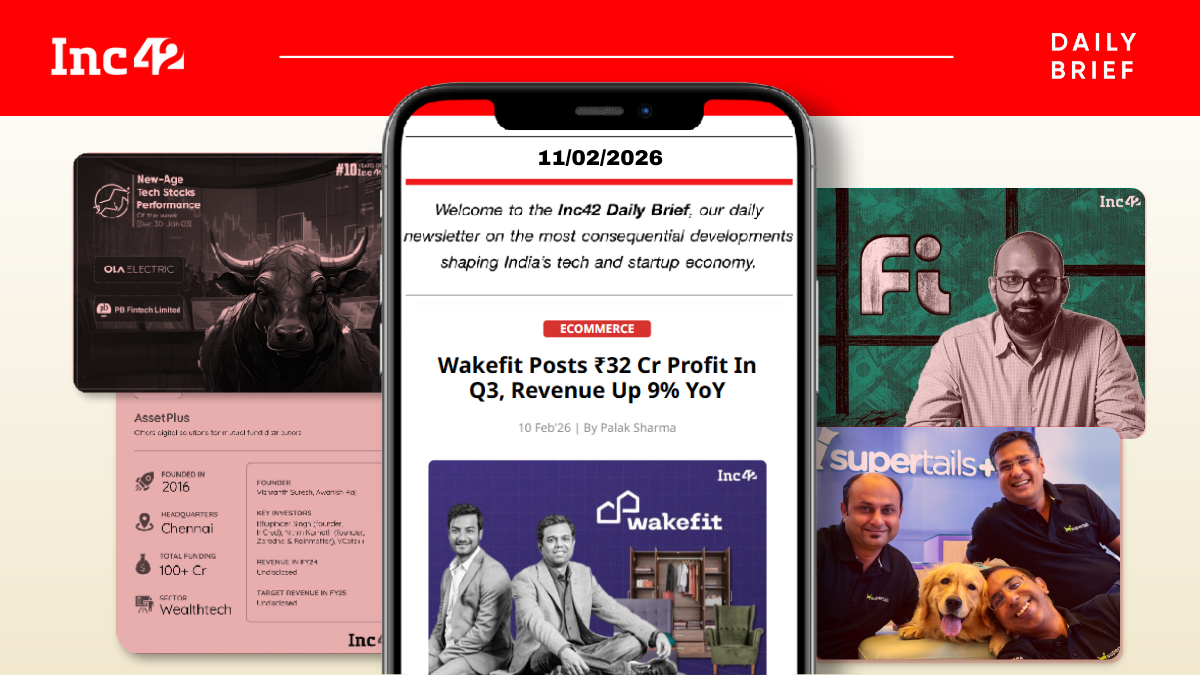

Margins Cushion Wakefit’s Profitability
Fresh from its IPO, Wakefit reported a profitable Q3 FY26. Despite seasonal discounts and a CFO transition, the D2C furniture and mattress brand clocked record quarterly revenues, alongside a sharp improvement in its margins.
Here is a snapshot of Wakefit’s Q3 numbers:
- Profits stood at ₹31.9 Cr compared to a loss of ₹2.4 Cr in Q3 FY25
- Revenue from operations rose 9.4% YoY to ₹421.3 Cr
- EBITDA improved 158% YoY to ₹70.3 Cr, while margins expanded to 53.8%
- Total expenses rose a marginal 0.4% YoY to ₹396.7 Cr
The Margin Play: The D2C brand flipped to profitability in Q3 on the back of gross margin expansion that offset modest top-line growth and a one-off labour code expense. What also helped was operating leverage kicking in across its core categories, even as management flagged temporary demand shifts tied to GST changes that favour other consumption baskets.
The Omnichannel Drift: Wakefit also continued to diversify beyond pure ecommerce in Q3. Own channels drove the majority of sales, giving Wakefit pricing control and customer data depth. Similarly, marketplace presence and new company-owned stores brought incremental reach.
On the product front, mattresses remained Wakefit’s undisputed cash cow, while furniture and furnishings steadily began clawing revenue share.
Post-IPO Posture: Even as many of its recently listed peers face market jitters, Wakefit shows no signs of post-IPO wobbles. This has largely been attributed to the ongoing offline store rollout and a structured public issue that balanced fresh capital with OFS.
With markets closely watching whether the D2C major will continue its profit spree in the coming quarters, here is how Wakefit fared on the financial front in Q3.
From The Editor’s Desk
🏦 Fi Hits Pause On B2C Dreams
- The neobank is restructuring its operations to shed a part of its consumer-facing neobank. The company now plans to pivot to AI-driven systems for startups and large enterprises.
- Fi Money has framed the move as a structural reset, signalling role cuts and product sunsets across teams. Meanwhile, the startup will continue to search for a path to sustainable unit economics after years of weak monetisation.
- Founded in 2019, Fi has raised about $137 Mn from marquee backers to offer a ‘digital-first bank for young Indians’. Yet, core economics never clicked – FY23 saw just ₹38 Cr in operating revenue against a loss of ₹300 Cr.
💰 Supertails Bags $30 Mn
- The pet care marketplace has raised ₹271.7 Cr in its Series C round led by Venturi Partners to scale its pet clinics to 15 in Bengaluru and expand the footprint of its quick commerce dark stores.
- Founded in 2021, Supertails operates a comprehensive platform spanning online vet consultations, pharmacy, training, clinics and at-home services. Including the current round, it has raised $57 Mn to date.
- India’s fragmented pet care market is booming on the back of rising pet ownership, disposable incomes and demand for professional grooming services. The space is projected to become a $24.8 Bn opportunity by 2032.
🎧 GoBoult Eyes 2027 IPO
- The smart wearables brand plans to file its DRHP with SEBI by November for a listing on the bourses early next year. There appears to be no clarity on the size of its IPO.
- Cofounder Varun Gupta told Inc42 that the company has set multiple milestones before the IPO – premiumisation push, expanding offline footprint, turning profitable and steering clear of entering new categories.
- Founded in 2017, GoBoult is a consumer electronics brand that sells smart wearables and audio devices. On the financial front, the brand clocked a revenue of ₹762.9 Cr in FY25, up 9.4% YoY, against a profit of ₹24.2 Cr, up 10X YoY.
🤖 India’s Deepfake Crackdown
- MeitY has notified amendments to the IT Rules 202, directly targeting deepfakes and AI-generated synthetic context across social platforms. The rules will come into effect from February 20.
- The new rules also mandate platforms to prominently label such content, seek user declarations on AI origin and embed unique identifiers to trace the content.
- Under the new norms, content flagged by authorities will have to be taken down by social media platforms within 3 hours, compared to 36 hours earlier. Digital intermediaries will also be required to dispose of grievances within 7 days.
🔔 Fractal & Aye Finance’s IPO Day 2
- The SaaS unicorn’s public issue was subscribed 20% on the second day, receiving bids for 36.4 Lakh shares against 1.86 Cr shares on offer. Meanwhile, the NBFC’s IPO was subscribed 16% on Day 2receiving bids for 72.87 Lakh shares.
- For Fractal, the NII portion was subscribed 29%, while the retail quota saw 60% subscription rate. On the other hand, retail individual investors continued to drive demand for Aye Finance’s offer, subscribing to 42% of their quota of 82.78 Lakh shares.
- The NBFC’s IPO comprises a fresh issue of ₹710 Cr and an OFS component of 300 Cr, while the SaaS major’s public issue comprises a fresh issue worth up to ₹1,023.5 Cr and an OFS of up to ₹1,810.4 Cr.
Inc42 Markets

Inc42 Startup Spotlight
Can paperplane Challenge The OTA Dominance?
Planning a travel itinerary can be a cumbersome task. While OTAs offer the same generic packages, boutique platforms can charge a premium for basic bookings. paperplane is tackling this problem by offering subscription-led access to wholesale hotel rates.
Ex-Stoa Founders Go Offline: Founded in 2025 by the cofounders of now-shut edtech platform, paperplane targets global Indians seeking premium stays at affordable rates. The platform is building a community-driven platform that blends wholesale economics with concierge planning.
The Membership Magic: The startup charges INR 10,000 for a two-year subscription, which claims to offer cheaper hotel rates (10-50%) than big-ticket OTAs. Members also get early booking credits, offbeat experiences and hands-on travel planning.
Growing Hotel Network: paperplane claims to have partnered with 3,000+ hotel chains, including The Leela, ITC, JW Marriott, Novotel and The Postcard Hotel, spanning India and global destinations. The bootstrapped startup is eyeing a piece of the homegrown hotel market, which is racing toward $22.41 Bn by 2030.
So, can paperplane capitalise on the aspirations of the middle-class for cost-optimised leisure travel?

Infographic Of The Day
In an AI-first economy, enrolments don’t define success — outcomes do. So, this is how you build a recession-proof skilling startup.


Comments are closed.