
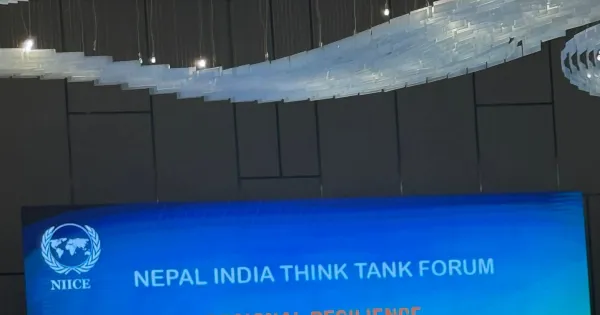

Kathmandu. Nepal-India security cooperation was discussed between representatives of think tanks and experts from both the countries. Experts from leading institutions of both the countries participated in the program organized by Nepal Institute of International Co-operation and Engagement on Tuesday.
“Nepali courage and valor have always been at the forefront of Indian military power and national security,” said Sanjay Jasjit Singh, director general of the United Service Institute of India, the oldest think tank of the Indian military.
Former National Security Advisor of India and convener of think tank Netstrat and former Ambassador Pankaj Sharan said that he was deeply impressed by the conversation he had with the youth of Nepal. He said that the youth of both Nepal and India should play an active role in building future Nepal-India relations.
Alok Bansal, executive vice president of India Foundation, said India has been a major victim of cross-border terrorism and it has serious implications for Nepal as well.
Professor Sangeeta Thapliya of Jawaharlal Nehru University said India-Nepal relations have benefited from the work of think tanks and academic centers and there is ample scope to strengthen cooperation.
Dr. Gaurav Saini, Co-Founder of the Council for Strategic and Defense Research, said that the India-Nepal border is unique due to deep commercial, cultural and people-to-people ties, but the common security challenges posed by the open nature of the border will have to be addressed together.
Binoj Basnyat, a retired Brigadier General of the Nepalese Army and a strategic affairs expert, said that Gen-G’s demonstrations in Nepal were not unexpected, but their nature was shocking. While acknowledging the importance of elections, he raised the question whether elections alone can ensure strategic stability. He interpreted the post-poll situation as more of a “strategic pause” than a strategic solution.

Comments are closed.