
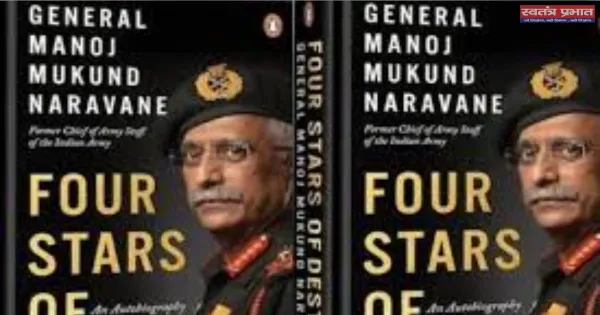
It is not just ‘do whatever you think is right’, there is much more in General Naravane’s book which will embarrass the government.

Bureau Prayagraj. Strategic affairs analyst Sushant Singh, who has written an article based on the book of former General MM Naravane, says that he has written this article on the basis of the manuscript of General Naravane’s book. He says that there is a lot in this book which may cause further embarrassment to the Modi government. In an interview to journalist Karan Thapar for The Wire, Sushant Singh said there are many more such references in the book which could embarrass the government.
As it is well known that Prime Minister Narendra Modi is fond of wearing army uniform on every occasion. It is also public in which he claimed that when the Balakot airstrike took place in 2019, he was in the war room and was keeping a close watch on the attack. In this connection, his interview became quite famous in which he advised the Air Force to take advantage of clouds. However, no one has ever officially denied this claim.
Similarly, before Operation Sindoor, the Prime Minister’s campaign team had shared pictures of Modi discussing the details of the operation with military officials. In such a situation, it was strange for the Prime Minister, who was so active, to tell the Army Chief, ‘Do whatever you feel is appropriate’, that too through the Defense Minister, two hours after General Naravane sought instructions. This is also shameful because it seemed like he was shirking his responsibilities.
However, in a conversation with Karan Thapar, Sushant Singh claimed that this is not the only shameful thing in the ‘unpublished’ book, which has not been approved for publication by the government. Sushant Singh points out that unlike 2019’s Operation Bandar (codename of the Balakot airstrike) and 2025’s Operation Sindoor (the name of the four-day standoff with Pakistan), little or no information has been shared about the Chinese intrusion in eastern Ladakh in 2020. Operational details of both cases were shared by the Indian Army and detailed accounts of these operations were given to retired military officers, who were encouraged by the government to write books.
But, the Indian government is hesitant in sharing details about the clashes with China along the Line of Actual Control (LAC). Sushant Singh explains that this is why the allegedly ‘unpublished’ memoirs of former Army Chief General MM Naravane (retd) become more important.
In a response to The Indian Express in September 2024, the Defense Ministry reported that it had the titles and manuscripts of 35 books submitted to it for approval since 2020. Except General Naravane’s book, all the other books were approved for publication and all of them were published. In fact, one of the books that got approved was by former Northern Command chief Lieutenant General Y. Joshi, who had written very good things about the Indian Army’s operations against the Chinese in 2020. General Naravane’s account is quite different from Lieutenant General Joshi’s account.
Sushant Singh told Karan Thapar that if General Naravane had also written a biography and praised political and military leadership, he feels his memoirs would also have been approved for publication. But it seems that this book has embarrassed both of them.
Sushant Singh says that one of the most shocking revelations in this book is that Chinese soldiers entered Indian territory in May, 2020 and not in June, 2020 as is generally believed. According to the former Army Chief, Chinese soldiers had set up their tent in Galwan Valley a month before the pitched battle in which 20 Indian soldiers were martyred. The commanders of Northern Command and 14th Corps were aware of the infiltration, but did not attach much importance to it. He said that when the snow melts and the water level at that place increases, the Chinese tents will be submerged in water.
But, on 15 June 2020, Indian soldiers were ordered to go and pitch their tents where the Chinese had already pitched tents. For this reason there was a clash in Galvan Valley. However, as per protocol, it is not known who ordered the unarmed Indian soldiers to set up tents. General Naravane also does not reveal in his memoirs who had given this order. However, the then army chief has strongly criticized the local commanders, writing that they were unprepared to deal with Chinese infiltration and underestimated the seriousness of the situation.
Singh argues that the Chinese intrusion in May 2020 was wrong and provocative, but the Indian decision to respond a month later without proper preparation, planning or coordination proved to be a big mistake. Obviously, no one’s accountability has been fixed yet.
General Naravane also tells in this book that the Indian Army was not allowed to record the minutes of the meetings held at the level of corps commanders on the border. The Ministry of External Affairs argued that it was its job to negotiate on the border and the Army should not keep minutes. As a result, on several occasions China suggested steps which the Indian side agreed to ‘consider’, but which China took as ‘consensus’. Singh claimed that recording of minutes started only in the 9th round of talks, when a Joint Secretary from the Ministry of External Affairs joined the talks.
Sushant Singh says we may never know how much land India lost to China in 2020, as those who negotiated the deal with China for the buffer zone in Ladakh made another embarrassing ‘mistake’. The Indian government does not call it a buffer zone, but calls this agreement a retreat from both sides. However, General Naravane calls it a buffer zone and says in his memoir that Indian negotiators had agreed to a retreat of five kilometers by both sides.
Singh underlines that although in 2020, Chinese troops retreated five kilometers from where they had come, Indian troops also retreated another five kilometers in their own areas. Therefore, it is entirely possible that the buffer zone agreed upon

Comments are closed.