
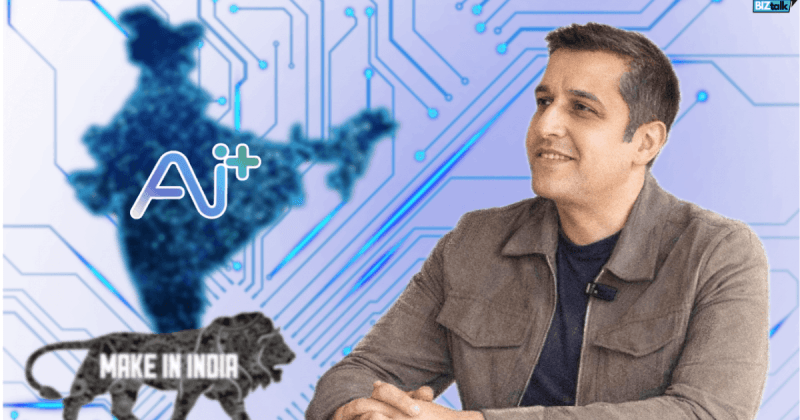
Madhav Sheth fixing gap in India’s smartphone story with long-term bet on Ai+ (Interview)

India is one of the world’s largest smartphone markets, worth more than Rs 4 lakh crore annually. Despite the scale, the country still lacks a globally dominant Indian smartphone brand. According to Madhav Sheth, CEO, Ai+ Smartphone and Founder, NxtQuantum Shift Technologies, that gap is not accidental; it is structural.
In a recent BizTalk interview with IBT’s News Editor Sami KhanSheth spoke at length about why he chose to walk away from helping build a billion-dollar smartphone brand, Realme, the deeper problems he sees in the industry, and why his new venture, AI+, is focused less on hype and more on long-term trust.
During Madhav Sheth’s tenure (2018-2023), Realme emerged as one of India’s fastest-growing smartphone brands, scaling rapidly across price segments and expanding into multiple international markets. Launched in 2018, the brand crossed over 50 million smartphone shipments globally within its first two years and later went on to surpass 100 million cumulative smartphone sales worldwide, according to industry estimates.
For Sheth, the decision to exit a successful global brand was not driven by ambition or burnout, but by misalignment.
“Supply chains always follow the country of origin. If a brand is born in China, Taiwan, or the U.S., that’s where long-term decisions will align. India is treated as a consumption market, not a place to build from.”
That distinction between selling to India and building from India became central to his thinking. While India has the talent, infrastructure, and demand, Sheth argues that foreign brands rarely intend to develop India as a technology ecosystem.
“Using India’s market is not the same as committing to India’s future,” he said.
One of the most striking parts of the conversation was Sheth’s critique of how aspiration is defined in the Indian smartphone market, particularly at the lower end.
“Why are we still selling around 40 million 2G phones in India?” he asked. “We talk about digital literacy and inclusion, but what is the industry actually doing to bridge that gap?”
For Sheth, aspiration does not begin with branding or premium features—it begins with trust.
“Aspiration comes after needs are fulfilled,” he said. “For a first-time smartphone user, trust itself is aspiration.”
Building Ai+ for India, by India
Ai+ was conceived to address that gap, particularly for users transitioning from feature phones to smartphones, focusing on reliability, longevity, and clarity rather than frequent launches.
Sheth was blunt when asked about whether smartphones are genuinely overpriced or simply misunderstood.
“The biggest problem is not that brands don’t give value,” he said. “The biggest problem is that brands confuse consumers.”
He pointed to the industry’s habit of launching dozens of near-identical phones every year, often with different names across online and offline channels.
“If you launch 40 or 50 phones annually, it is impossible to support all of them properly with software updates,” he said. “Promises get made, but they’re not realistic.”
According to Sheth, long-term software support, often advertised as a selling point, is one of the first casualties of this approach.
Reviewing Ai+ Pulse with Madhav
Ai+ currently sells two smartphones exclusively through Flipkart, both of which have received largely positive user feedback. During the interview, Sheth reviewed customer comments live, acknowledging both praise and criticism.
“One thing I didn’t get right in the first generation was the selfie camera,” he admitted. “That’s something we will correct.”
On service complaints, particularly in metro cities, Sheth said demand patterns surprised the company early on. AI+ has since expanded its service network and, in some cases, opted for direct replacements rather than repairs.
“I personally look at customer cases every day,” he said. “Early-stage brands don’t have the luxury of ignoring feedback.”
Despite branding his phones under the Ai+ name, Sheth was clear that he does not subscribe to the current AI marketing frenzy.
“AI is just another feature,” he said. “Its job is to give you time back, not to pretend it will magically change your life.”
He dismissed performative features such as artificial background manipulation, arguing that technology should enhance real experiences rather than fabricate them.
“If AI is not improving productivity or reliability, it’s just noise,” he added.
Flip phones, folds, and differentiation
Among Ai+’s upcoming products is a flip phone priced below Rs 40,000, potentially the most affordable in its category. While foldables are often positioned as the future, Sheth sees them differently.
“Flip and fold phones are about aspiration, not utility,” he said. “People buy them to stand out, not because they change how you use a phone.”
For Ai+, the device is positioned as an Android alternative for users seeking distinction rather than a breakthrough in form factor.
Privacy, data, and intent
Data transparency is a core pillar of Ai+, and Sheth believes most users underestimate how much data they give away.
“We click ‘OK’ without reading anything,” he said. “We don’t know what apps are collecting or where that data goes.”
He cited past misuse by banned fintech apps as a warning, stressing that data protection is less about infrastructure and more about intent. Ai+, he said, stores core telemetry data within India through domestic data centre partnerships.
“Make in India”
On whether India can replicate China’s manufacturing success, Sheth was realistic rather than optimistic.
“China didn’t do this in five or ten years—it took four decades,” he said. “India can do it too, but only with consistency, policy stability, and patience.”
Short-term thinking, he warned, could derail long-term ecosystem building.
As the conversation concluded, Sheth reflected on whether starting over was worth it.
“For me, wealth should be the output, not the objective,” he said. “If you build responsibly, everything else follows.”
For India’s smartphone industry, his message was clear: scale without intent may sell devices, but it won’t build a future.

Comments are closed.