
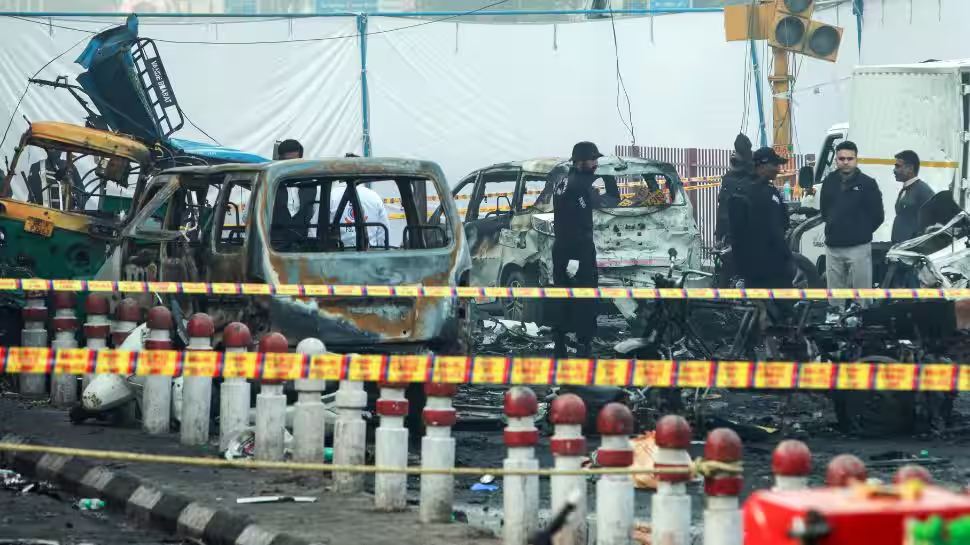

The UN Security Council has blamed Jaish-e-Mohammed (JeM) in connection with the attack near the Red Fort in New Delhi on 9 November that killed 15 people.
In its latest report, the UNSC Sanctions Monitoring Team said, “One Member State noted that Jaish-i-Mohammed (JiM, QDe.019) had claimed responsibility for a series of attacks. It was also reported to be linked to an attack near the Red Fort in New Delhi on 9 November that killed 15 people.”
Fifteen people were killed and several others were injured on November 9 when a car explosion near Delhi’s Red Fort triggered a high-level investigation. The probe reportedly revealed the existence of a sophisticated ‘white-collar’ terror network with alleged ties to Jaish-e-Mohammed.
Add Zee News as a Preferred Source
The report added that Jaish-e-Mohammed (JeM) leader Mohammed Masood Azhar Alvi also announced the establishment of a women-only wing, Jamaat ul-Muminat (not listed), aimed at supporting terrorist attacks.
“On 8 October, Jaish-i-Mohammed leader Mohammed Masood Azhar Alvi (QDi.422) formally announced the establishment of a women-only wing, Jamaat ul-Muminat (not listed), which was aimed at supporting terrorist attacks. Another Member State reported that Jaish-i-Mohammed was defunct,” the report stated.
The UNSC Sanctions Monitoring Team report added, “Separately, it was reported that on 28 July, three individuals allegedly involved in the attack perpetrated in Pahalgam, in Jammu and Kashmir, were killed.”
The UN has designated JeM as an Al-Qaida-associated entity. JeM has been actively involved in terrorist activities in Jammu and Kashmir and elsewhere in India. Since its inception in 2000, the group has carried out several attacks on civilian, economic, and military targets in India. Its leader, Masood Azhar, has been under UN sanctions for years, including travel bans and asset freezes.
Pakistan’s terror cover-up exposed
This report comes as Greek lawyer, journalist, and South Asia specialist Dimitra Staikou recently argued in an analysis that Pakistani state institutions have provided political cover and indirect material support to internationally designated militant groups, allowing them to remain operational while avoiding formal international accountability.
Pakistan has developed a systematic model of managing extremist networks rather than dismantling them, according to an analysis by Dimitra Staikou published by EuropaWire (EW), Europe’s first pan-European newswire service provider.
In the article titled “Pakistan: When the State Does Not Fight Terrorism, but Manages It,” published by EuropaWire (EW), Staikou cited documented cases involving UN-designated organizations, including Lashkar-e-Taiba (LeT) and Jaish-e-Mohammad (JeM), asserting that their leadership, infrastructure, and mobilization activities continue to function openly despite international sanctions.

Comments are closed.