
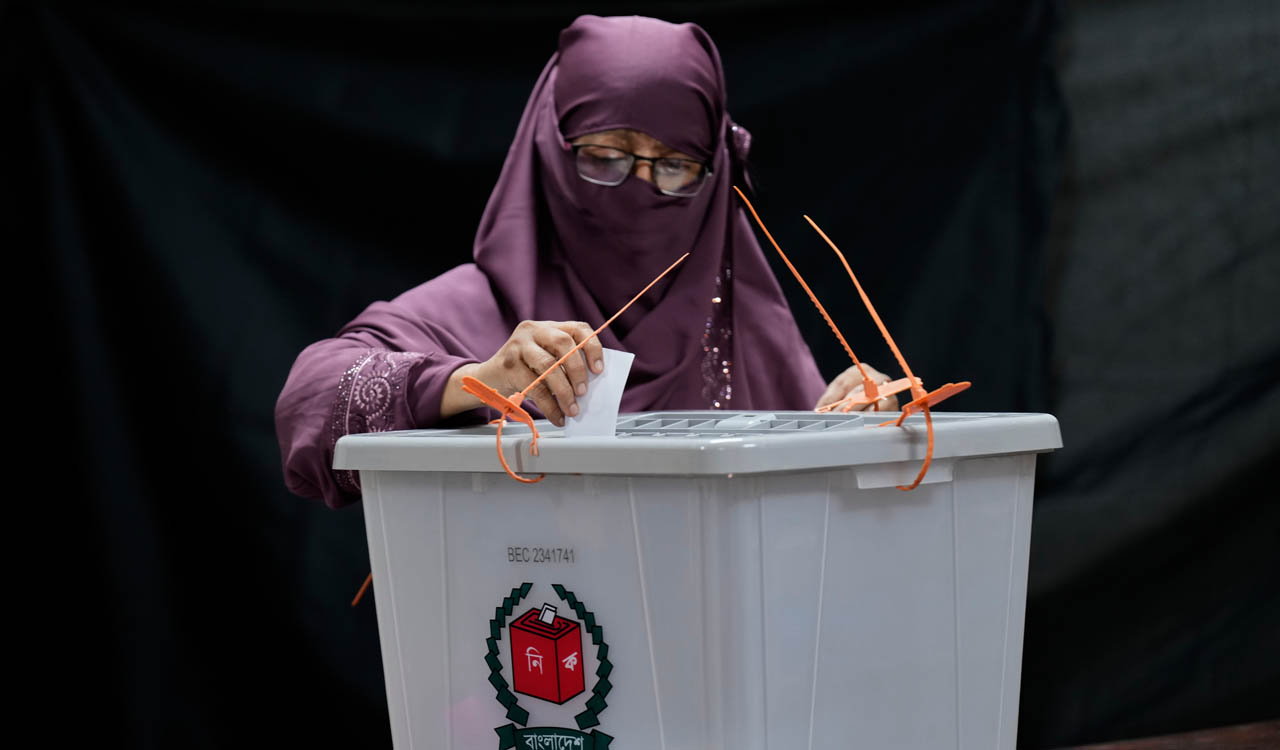

The national election is Dhaka’s pivotal moment — a bid to turn a youth uprising into institutional power and to set the country’s course after Sheikh Hasina’s dramatic fall
Published Date – 12 February 2026, 09:06 PM
Irrespective of the nature of the mandate in the turmoil-hit Bangladesh, which went to the polls on Thursday, its implications would resonate across the region, especially in India. There are enough reasons to worry about. First, the national election, held almost a year-and-a-half after a student-led uprising led to the dramatic ouster of the Sheikh Hasina-led Awami League regime, is not inclusive. Banning a major political player like the Awami League from participating in the elections has robbed the poll process of its legitimacy. Second, the hardline Islamist forces are bound to be catapulted to the political mainstream in the post-poll situation and would be in a position to influence the course of events. Third, there are fears that the country would inexorably move away from secularism. With the Awami League being out of the picture, the Tarique Rahman-led Bangladesh Nationalist Party (BNP) coming to power is almost a foregone conclusion. Jamaat-e-Islami, once an ally of the BNP, is seen as the biggest challenger. Already, there is a clamour from a motley group of extreme right-wing outfits to declare Bangladesh an Islamic nation. Bangladeshi politics has long revolved around two dynasty-driven parties: Awami League and BNP. Along with voting for the 300 seats in parliament, Bangladeshis are participating in a referendum on a constitutional reforms package, proposing term limits for the prime minister, stronger checks on executive authority, constitutional safeguards to prevent the consolidation of power, introduction of a bicameral legislature and granting more independence to the judiciary.
The previous two rounds of national elections held in 2018 and 2024 were marred by allegations of widespread rigging by the Awami League, which later faced a massive revolt. The presence of hundreds of international observers and foreign journalists shows that Bangladesh is drawing global attention to this election. Tariq Rahman, widely expected to head the next government, has vowed to restore democratic institutions and revive a floundering economy. Despite being non-committal on the issue of Hasina’s extradition, India has indicated its willingness to make a fresh start with the new regime in Dhaka. External Affairs Minister S Jaishankar had attended Khaleda’s funeral in December last year, signalling India’s outreach. In a way, the national election is a moment of reckoning for Dhaka — an attempt to convert the youth uprising into institutional power, and to define the country’s geopolitical trajectory after the dramatic fall of Sheikh Hasina. For more than 15 years, Hasina had presided over rapid economic growth, rising per capita income, tough policies to check extremism, and major strides in infrastructure development. However, her regime was also marked by severe oppression of the opposition parties, hollowing out the democratic institutions and weaponising the state machinery to ensure electoral dominance. For India, Hasina was an all-weather friend. Her government had cracked down on anti-India insurgent groups operating from Bangladeshi soil and coordinated closely on counterterrorism.

Comments are closed.