
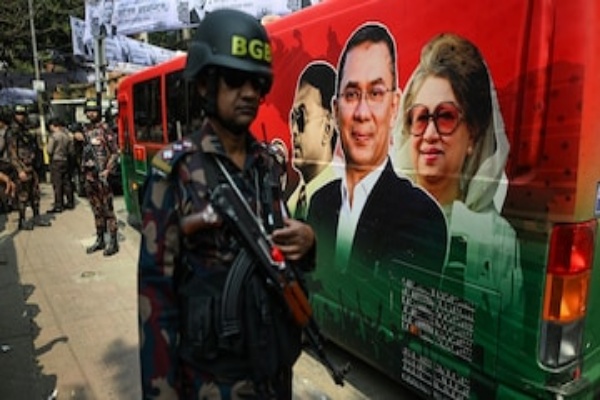

Dhaka, 13 February. In the 13th parliamentary elections of Bangladesh, Tariq Rahman led Bangladesh Nationalist Party (BNP) has achieved a clear majority by winning the maximum 209 seats. Elections were held on 299 seats, while voting could not take place on one seat due to the death of a candidate. BNP alliance has got a total of 212 seats. BNP’s allies Ganosamhati Andolan, Bangladesh Jatiya Party and Gono Odhikar Parishad have won one seat each.
According to political analysts, this election is considered a big change in the politics of Bangladesh because the Awami League, which was in power for a long time, could not contest the elections. BNP President and Prime Ministerial contender Tariq Rehman was in the fray from two seats in this election and he won both the seats, Dhaka-17 and Bogra-6. Preparations have begun for Tariq Rahman, who returned to Bangladesh after 17 years, as Prime Minister.
Jamaat alliance got 77 seats
Jamaat-e-Islami emerged as the second largest party in this election and registered a strong presence by winning 68 seats. Whereas Jamaat alliance has won a total of 77 seats. In this, National Citizen Party (NCP) with lotus symbol won 6 seats while Bangladesh Khilafat Majlis got two and Khilafat Majlis got one seat. Islami Andolan Bangladesh got only one seat while independent candidates won seven seats. The Election Commission postponed the elections for Sherpur-3 (Shribordi-Jhenaigati) seat after the death of Jamaat-e-Islami candidate Nooruzzaman Badol.
There were many parties which were expected to perform better in the election results, but they completely failed. These include dozens of parties including Jatiya Samajwadi Dal (JASAD), Liberal Democratic Party, Workers Party and Communist Party, which could not get even a single seat. This is the reason why it is being said in political circles that this time many parties have been wiped out.
More than 12 crore people voted
Another important aspect of this election was the participation of women. According to reports, six women candidates of BNP were successful in winning. However, this time the election was also historic because after many decades, there was no woman leader in the electoral fray at the top level in Bangladesh politics. Former Prime Minister Sheikh Hasina’s party remained out of the elections while her main rival and former Prime Minister Khaleda Zia died last year.
According to the Election Commission, about 59.44 percent voting took place across the country. Of the approximately 12.7 crore voters, a large number were first-time voters. For security, about one million security personnel were deployed, which is considered to be the biggest security arrangement in the electoral history of the country.
Elections held in Bangladesh after 18 months
It is noteworthy that the last 18 months have not been easy for Bangladesh. During these 18 months, Bangladesh continued to be a victim of violence, arson, looting and chaos. In August 2024, a student-led revolution overthrew Sheikh Hasina’s 15-year-old government. As soon as the government fell, Hasina fled and took refuge in India. During this period, more than 1,400 deaths occurred in violence in Bangladesh. An interim government of Nobel laureate Mohammad Yunus was formed in Bangladesh. Then the opposition parties of Bangladesh had termed it as ‘second independence’.
In the elections held on February 12, every voter had cast two votes. This happened for the first time. One vote was cast to elect a new government while the other was for the ‘July Charter’ i.e. referendum. Its purpose was to take people’s opinion regarding changes in the constitution. According to the results of the referendum, people have overwhelmingly chosen ‘Yes Vote’. This means that the people of Bangladesh want to amend the Constitution.
Doesn’t want.

Comments are closed.