
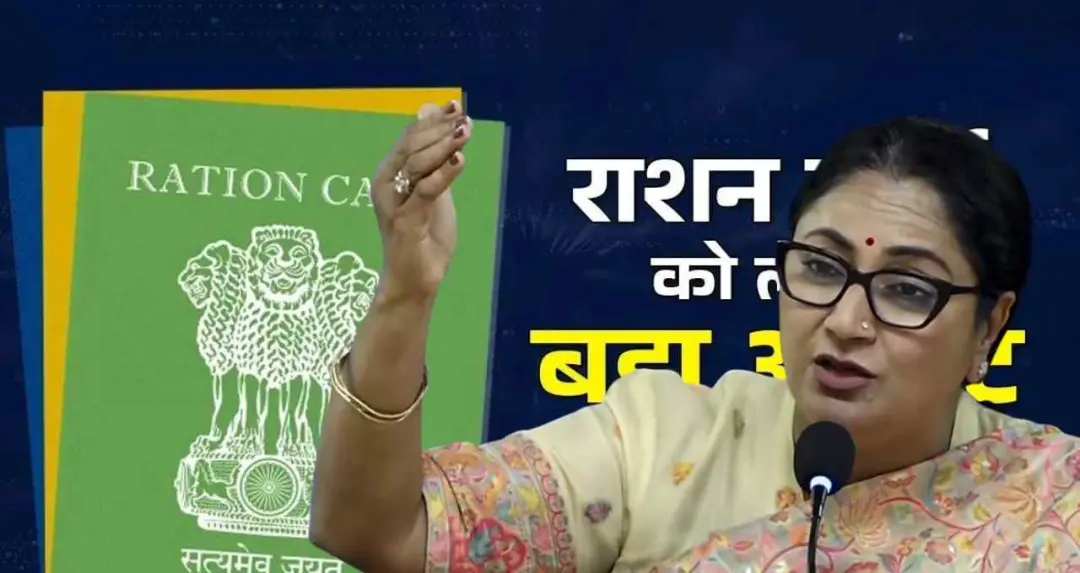

Delhi Government has changed the ration card rules. Now the oldest woman will be the head of the family. The income limit has been increased to Rs 1.2 lakh, which will benefit more needy families.
New Delhi: Delhi Government has taken a big step towards making the Public Distribution System more transparent and socially balanced. By making important changes in the rules related to ration card, Delhi Government has changed the decades old system regarding the head of the family. Now in the ration card, only the oldest woman of the family will be considered as the head of the family. This change has been implemented under the Delhi Food Safety Rules, 2026.
The government says that the purpose of this decision is to bring women forward in decision making and strengthen their role in social security schemes. This change is not limited only to the head, but major amendments have also been made in the income limit, card distribution process and eligibility rules.
who will be the head of the family
According to the new rules, now the oldest female member of the family will be considered as the head of the family in the ration card. Whether she is a worker or a housewife, she should be 18 years of age or above.
However, the government has also clarified that if there is no adult female member present in the family, i.e. the only female member of the household is below 18 years of age, then in such a situation the oldest male member of the family will be considered the head.
This rule is especially important for those families where earlier the male head was automatically accepted. Now this is being considered a major improvement in the direction of giving legal and administrative identity to women.
Income limit increased, now fixed at Rs 1.2 lakh
Delhi government has also changed the income criteria for ration card. Earlier, the limit of annual family income was Rs 1 lakh, now it has been increased to Rs 1.2 lakh.
The government believes that the old income limit was no longer practical in view of inflation and rising cost of living. The new limit will provide relief to those poor and low income group families, who were earlier left out of the purview of ration cards due to small increase in income.
Under the new rules, it will be mandatory for families applying for ration cards to provide income certificate. This certificate will have to be made from Delhi Revenue Department, which can now be easily obtained through online medium.
New formula to decide the number of ration cards
The Delhi government has also decided that the number of ration cards to be issued in a district will be based on the total number of voters there.
According to the notification, in the districts where the number of voters is more, the number of ration cards will also be more in the same proportion. This system will remain in force for the time being.
The government has also made it clear that as soon as the official census data is released, the basis of ration card distribution will be made on census data instead of voter list. With this, the distribution of resources according to the population will be more accurate.
District level committee will decide on new applications
A special committee has been formed at the district level to scrutinize and approve new applications for ration cards. This committee will be headed by the concerned District Magistrate or Additional District Magistrate.
Two local MLAs will also be included in the committee as members. Its objective is to make the decision process more transparent and accountable with the participation of public representatives at the local level.
Apart from this, committees have also been institutionalized at ward level and fair price shop level for grievance redressal and monitoring, so that any kind of irregularities in PDS can be prevented.
Which families will not get the new ration card?
The government has also clearly defined the categories to which ration cards will not be issued under the new rules. Families whose annual income is more than Rs 1.2 lakh will not be eligible for this scheme. If any member of the family has property like house or land in his name, he will not get a ration card.
Families paying income tax have also been kept out of this scope.
If anyone in the family has a personal four-wheeler, then the ration card will not be given. However, those who own taxis or commercial vehicles have been exempted from this. Families having electricity connections of more than two kilowatt capacity will also not be eligible. Government employees and those families who are already taking advantage of any other government food subsidy scheme will also not get the new ration card.
Big sign towards women empowerment
Experts believe that recognizing an elderly woman as the head of the family is not just an administrative change. It is also a social message that the role of women is no longer just that of a dependent but also of a decision maker.
Documents like ration card are directly related to government schemes, subsidies and identity. In such a situation, having women named as heads gives them more rights and security.

Comments are closed.