

At 6 p.m. on Feb. 9 Le Minh, 27, left his office on Pham Van Bach Street in Cau Giay Ward. After a stressful day finalizing accounts, he chose a taxi over his motorbike in the hope of getting some rest. The decision quickly proved to be a mistake.
It took 30 minutes for the car to inch past the company’s exit gate after picking him up. Through the window, Minh saw motorbikes spill onto the sidewalks. More than two hours later he had only reached Nguyen Trai Street, a five-kilometer drive from his office. A few hundred meters before reaching home, he was still stuck amid a sea of vehicles that had backed up into the distance.
At 8 p.m. he had had enough, and so paid the fare and got out to walk. He squeezed through narrow gaps between cars, engine heat blasting his face.
“I had never felt the journey home was such a physical ordeal,” he says, adding that he skipped dinner out of sheer exhaustion.
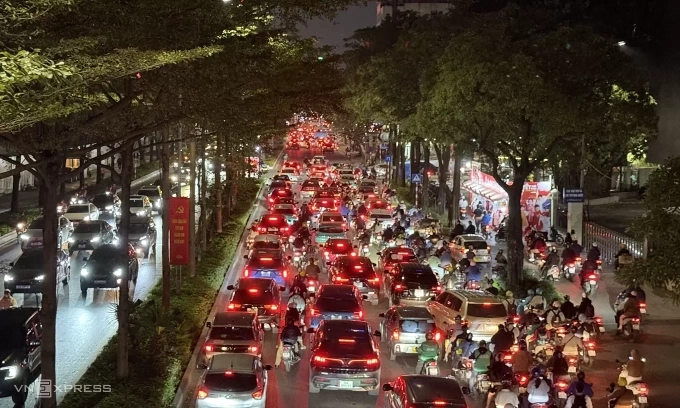
Vehicles clog a carriageway on Dao Tan Street in Hanoi’s Giang Vo Ward at 8 p.m. on Feb. 8, 2026. Photo by Read/Quynh Nguyen |
Many others have been facing similar commutes during the runup to the Lunar New Year holidays, which run from Feb. 14 to 22.
Thanh Lieu, 30, who lives in Tay Ho Ward, says she learned her lesson after spending three hours every day, stuck on the 8.5-kilometer stretch from Tran Duy Hung Street in Yen Hoa Ward to her home, over the past week. One evening she left work on her motorbike equipped with bread, milk and a fully charged phone.
“I had to eat on the bike because I knew I would be trapped for hours,” she says.
Normally she stays until late in office to avoid rush hour, but that strategy is not working now as snarl-ups persist well into the night. During her commute, she often sees children dozing off on their parents’ backs.
“My trip home takes longer than my coach ride from Hanoi to my hometown in Thanh Hoa Province,” she remarks.
Over the past week, traffic updates on social media have documented widespread congestion. Major routes including Ring Road 2, the elevated Ring Road 3 and key arteries such as Lang, Truong Chinh and Giai Phong have been consistently marked in red on traffic maps. The congestion has been plaguing Hoan Kiem, Cau Giay, Thanh Xuan, Nam Tu Liem, and Bac Tu Liem districts, with many drivers complaining that travel takes three or four times the normal duration.
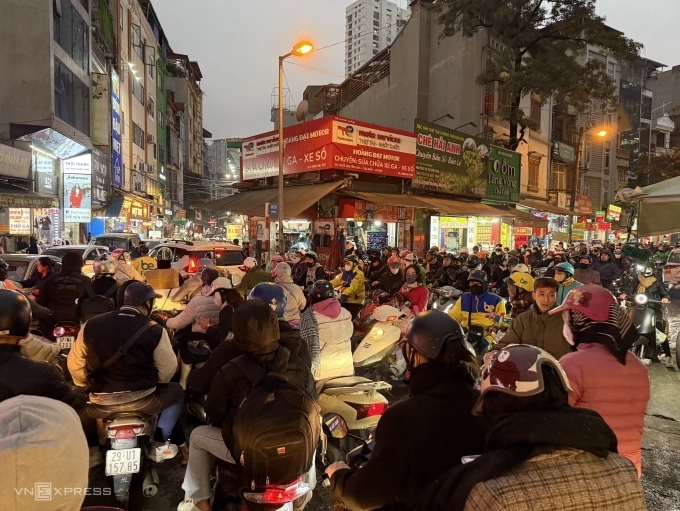 |
Traffic stalls on Yen Hoa Street in Hanoi’s Yen Hoa Ward on the evening of Feb. 9, 2026. Photo by Read/Quynh Nguyen |
Public transport users have also struggled. Thien An of Hoang Mai Ward says her bus was nearly stalled on Mai Dong Bridge on the afternoon of Feb. 6. After the driver announced it could take another 90 minutes to clear the congestion, she and several passengers got off and walked home, weaving through traffic.
At 7:30 p.m. traffic map apps still showed roads across the city in red, prompting her to scrap plans to go out for dinner.
Nguyen Xuan Thuy, former director of the Transport Publishing House, paints population growth and inadequate infrastructure as the villains. Hanoi has more than 9.2 million vehicles but only 12-13% of its land area for them to ply, far below the recommended 20-26%.
Another traffic expert said year-end congestion stems from five factors: a surge in travel and shopping ahead of the holidays, trucks delivering bulky goods to the city, sidewalks encroached upon by vendors selling ornamental plants, construction barriers, and a decline in traffic discipline amid heavy road use.
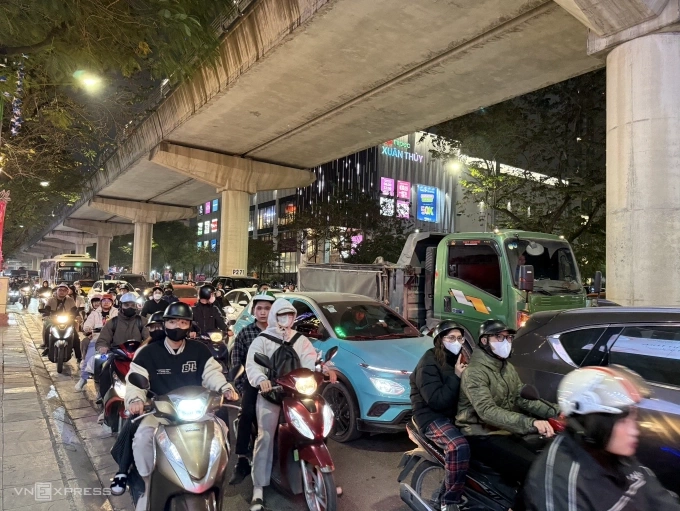 |
Xuan Thuy Street in Cau Giay Ward is clogged with vehicles at 9 p.m. on Feb. 8, 2026. Photo by Read/Nga Thanh |

Comments are closed.