
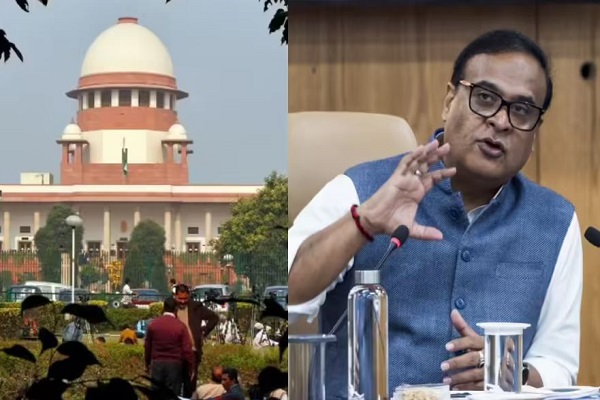

New Delhi14 February. The Supreme Court is likely to hear petitions demanding action against Assam Chief Minister Himanta Biswa Sarma on Monday (February 16). Recently, a video of Sarma has surfaced, in which he is allegedly shown aiming a rifle and firing at people of a particular community. After this, action has been demanded against Sarma. According to the Supreme Court cause list, a bench of Chief Justice (CJI) Surya Kant and Justice Joymalya Bagchi will hear the case.
It is noteworthy that on February 10, leaders of CPIM and CPI filed an application in the Supreme Court demanding action against Himanta Biswa Sarma for his remarks targeting a particular community. On the same day, the Supreme Court had agreed to consider listing the petition of the Left party leaders.
Advocate Nizam Pasha mentioned the matter before the bench headed by CJI Surya Kant and demanded an immediate hearing. Pasha told the bench that he wanted the immediate intervention of this court in the matter of the disturbing speeches of the sitting Chief Minister of Assam, including a recently posted video in which he was shown firing at people of a particular community. He said that complaints have been lodged, but no FIR has been registered. The CJI said, ‘The problem is that whenever elections come, some part of the election is fought inside the Supreme Court. This is the problem. We will find out…will tell the date.
In the petition filed by CPIM, it has been said that the petitioner demands immediate intervention of the Supreme Court so that cognizance can be taken of the pattern of continuous hate speech by respondent number 4 Himanta Biswa Sarma, who currently holds the constitutional post of Chief Minister of Assam.
The petition asserted that the speeches have targeted, intimidated, and incited hostility and open violence against the Muslim community of Assam. The plea said Sarma has on several occasions made public speeches and made statements inside and outside the territorial limits of the state, which have been widely circulated on print, electronic and digital media platforms.
“Taken together, these statements constitute clear hate speech because they denigrate a minority community, spread false and defamatory views, incite social and economic exclusion, and encourage exclusion and violence against that community,” the petition said.

Comments are closed.