
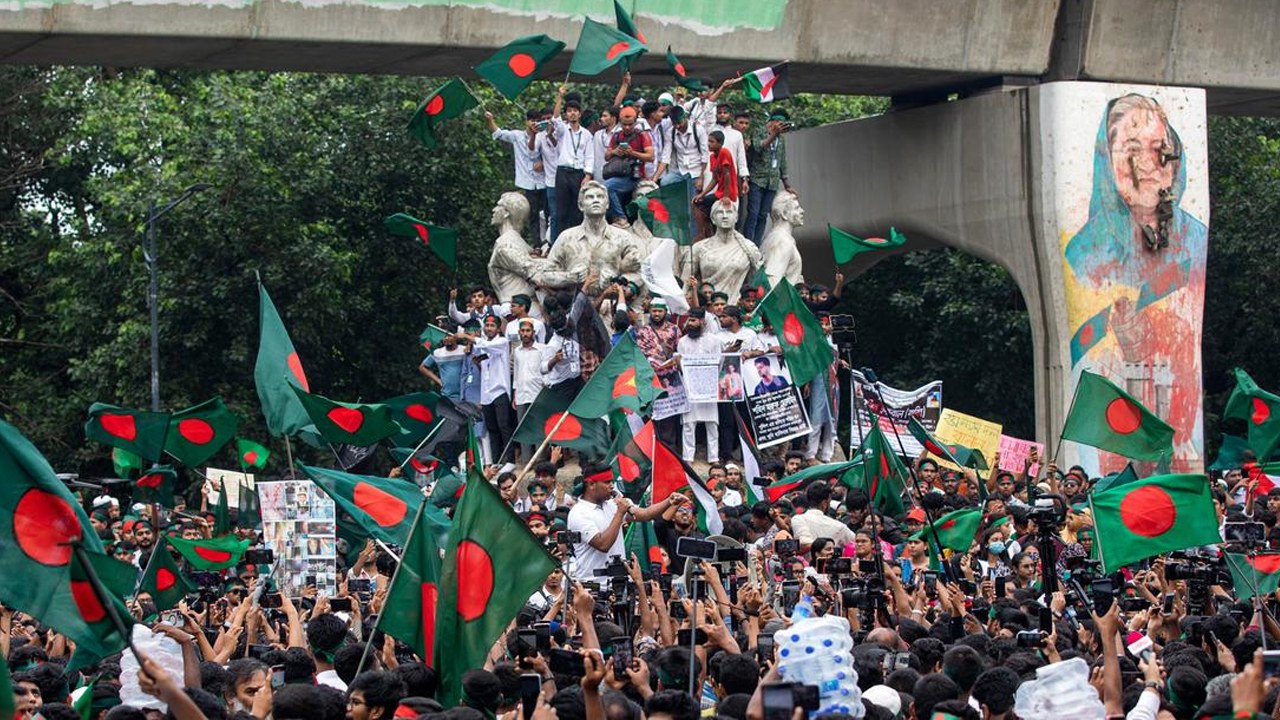
Sheikh Hasina’s ‘coup’ Why did the heroes become zero in Bangladesh elections? Inside story will blow your mind

Why NCP Defeated in Bangladesh: Politics is a game of chess where one wrong move changes the entire game. The latest election results of Bangladesh have proved this once again. Tariq Rehman, who endured a long period of exile, lawsuits and political coldness, laid his chessboard with patience and registered a record-breaking victory.
On the other hand, the student leaders who made headlines across the world by overthrowing Sheikh Hasina in the country got badly messed up in electoral mathematics. After all, what happened that yesterday’s ‘revolutionaries’ Did you prove to be a failure in the election field today? Let us try to find the answer to this question&8230;
BNP won 212 seats
In this electoral battle for the 300-seat Parliament, voting took place on 299 seats. Elections on one seat were postponed due to the death of a candidate, while the court has stayed the release of results for Chattogram-3 and Chattogram-8 seats. According to the results released so far, Tariq Rahman’s Bangladesh Nationalist Party (BNP) has won a landslide victory on 212 seats.
Jamaat-e-Islami limited to 77 seats
On the other hand, Jamaat-e-Islami alliance was reduced to 77 seats. The most surprising thing was the performance of the National Citizen Party (NCP), which had led the movement against Sheikh Hasina. This party could win only 6 seats, while the remaining 8 seats went to ‘Others’.
Rebel students’ party got 6 seats
Sheikh Hasina’s party Awami League was barred from contesting elections in Bangladesh, so the contest was mainly between BNP, Jamaat and the new student party NCP. Before the elections, it was believed that NCP would do wonders, but as soon as the ballot box opened, all hopes were dashed. NCP had fielded its candidates on 30 seats, but won only on six.

Bangladesh Election Analysis (Infographic-AI)
Why did NCP lose so badly?
Big faces of the party, Naheed Islam and Hasnat Abdullah were successful in saving their seats, but this success was not as big as was expected. Now the reasons for the defeat are being reviewed and there is only one reason on everyone’s lips that the support of Jamaat-e-Islami proved too much for NCP.
Why did Jamaat-e-Islami decline?
History is witness that Jamaat-e-Islami has been against the existence of Bangladesh. It supported Pakistan in the liberation war of 1971. Its militia associates (Razakar, al-Badr and al-Shams) collaborated with the Pakistani army to kill intellectuals, carry out large-scale rape and genocide of Hindu minorities.
Tariq Rehman showed wisdom
Due to these crimes, Sheikh Mujibur Rahman had banned it, however later Ziaur Rahman gave him a chance to return to politics by removing the word secular from the Constitution. Tariq Rehman’s party BNP had also run governments with the Jamaat in the past, but in this election, Tariq showed wisdom by not giving up the Jamaat’s ‘infamous image’. Kept distance from. From which he got tremendous benefit.
Committed suicide with the Jamaat!
On the other hand, NCP, the party of student leaders, felt that their enthusiasm was high, but the roots of the organization were weak. To cover up this weakness, he took the help of the same Jamaat-e-Islami, from which BNP had distanced itself. This decision proved suicidal for him.
As soon as the Jamaat joined hands, cracks appeared within the party and many leaders left the party expressing public disagreement. The biggest blow came from those voters who considered themselves centrist or progressive. He did not at all like the company of the Jamaat which practiced radical politics of religion. However, party convenor Nahid Islam defended it by calling it not an ideology but an election strategy, but this argument did not go down well with the voters.
Yunus’s close friend drowned in NCP
Apart from this, NCP’s closeness with Mohammad Yunus also took a toll. During the interim government led by Yunus, the security system in Bangladesh had collapsed, atrocities on minorities increased and inflation broke its back. Since there were some student advisors associated with NCP in the Yunus government, the public’s anger was directed at them also.
Also read: Muhammad Yunus will become President…will Tariq Rehman be given big responsibility? Political turmoil increased in Bangladesh
Yunus was also accused of delaying the elections so that NCP could get time to strengthen. Due to all these reasons, while on one hand Tariq Rehman returned to power with patience and right strategy, on the other hand the student leaders missed out on creating history due to their immaturity and wrong alliances.

Comments are closed.