
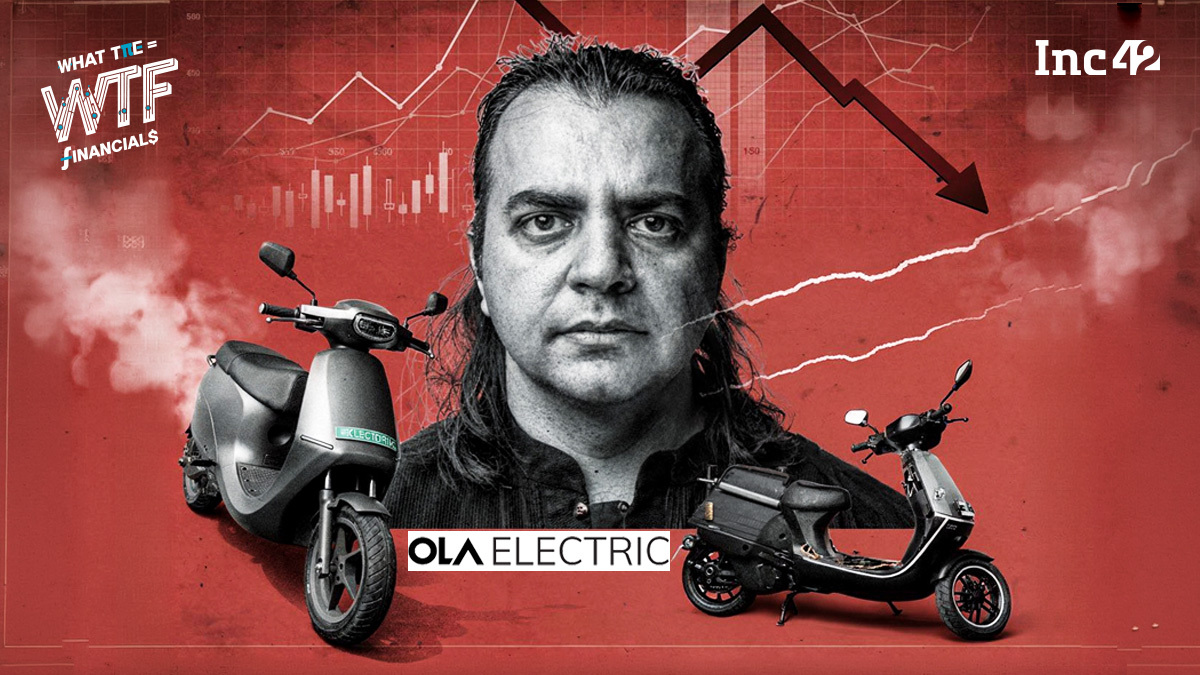

Emkay Global downgraded its rating for Ola Electric to ‘sell’ from ‘buy’ and cut the target price by 60% to ₹20 apiece from ₹50 per share
The company reported a 55% YoY decline in its operating revenue to ₹470 Cr in Q3 FY26
Ola Electric said its biggest focus going forward is to stabilise after-sales service, while also building product superiority and streamlining operations to improve margins
The shares of EV major Ola Electric plunged 7.02% to touch an all-time low at ₹28.73 during the intraday trading today after the company reported a 55% YoY and 32% QoQ decline in its revenue to ₹470 Cr in Q3 FY26 on February 13 (Friday).
At 13:20 IST, the stock was trading 6.15% lower at ₹29. The company’s market capitalisation stood at ₹12,800 Cr (about $14.11 Bn).
Following the Q3 results, brokerage Emkay Global downgraded the company’s rating to ‘sell’ from ‘buy’ and cut the target price by 60% to ₹20 apiece from ₹50 per share earlier.
“The underlying E2W (electric two-wheeler) theme is strong; the industry is seeing healthy growth (33%/24% YoY in Jan/Feb-26), with a revival in penetration following a dip due to recent GST cuts. However, Ola has seen a consistent volume decline to 32K units in Q3 (Q1:125k) and market-share loss (ranked 5, with 6% share),” the brokerage said.
Ola Electric’s income from auto sales halved during the quarter under review to ₹430 Cr amid a consistent decline in its market share in the E2W segment. Notably, it slipped to the fifth position in terms of vehicle registrations in January. This was after it started 2025 firmly positioned as the top E2W seller in the country, having doubled its sales numbers over the prior year. In Q3 FY26, the company sold 32,680 E2Ws, a 61% drop from 84,029 units in the year-ago quarter.
While it managed to trim its net loss by 14% to ₹487 Cr and expenses by half to ₹741 Cr over the preceding year, the company had a negative cash flow from operations of ₹866 Cr during the first nine months of the current fiscal year owing to continued operating losses and lower-than expected growth in sales volume.
Ola Electric’s Servicing Troubles
Over the weekend, it was also reported that a bailable arrest warrant was issued against the company’s founder and CEO Bhavish Aggarwal after he was a no show for a scheduled hearing earlier this month at the District Consumer Disputes Redressal Commission of South Goa over a missing escooter that was submitted to a service centre in the state.
Acknowledging that the after-sales service issues had eroded customer trust in the brand, Ola Electric claimed that the service backlog has nearly halved with about 80% of tickets now resolved the same day under its scaled ‘Hyperservice’ initiative. Its biggest focus going forward will be to stabilise this further, while also building product superiority and streamlining operations to improve its margins.
Its cost reset will include store rationalisation to 700 outlets, higher manufacturing yields, automation, AI-led back-office efficiencies and leaner corporate structures. It is pertinent to mention that Ola Electric announced last month that it will lay off 500-600 employees, making up about 5% of its workforce.
“However, we believe that this could be a difficult, long-drawn process, especially amid greater focus from incumbents and scale-up at Ather. Also, the turnaround would necessitate Ola to have a strong cash balance to survive this phase. We prefer to play the E2W theme with Ather, TVSL, and Bajaj Auto,” Emkay Global said.
The brokerage further noted that upside risk could stem from a strategic stake sale in Ola Electric’s battery business, which could result in a meaningful cash infusion. The company earned ₹9 Cr from the sale of its cells during the quarter as production zoomed to 72,418 from 30,800 in the previous quarter.
Ola Electric’s cell manufacturing unit, Gigafactory, is set for completion in March 2026, which will scale installed cell capacity to 6 GWh from the current 2.5 GWh. Beyond automotive integration, Ola Electric aims to tap broader energy storage demand, expanding into new cell formats, LFP chemistry and next-generation technologies.

Comments are closed.