
Tata Motors Launches JLR’s First Indian Manufacturing Plant, Targets Production of 3 Lakh Cars Per Year

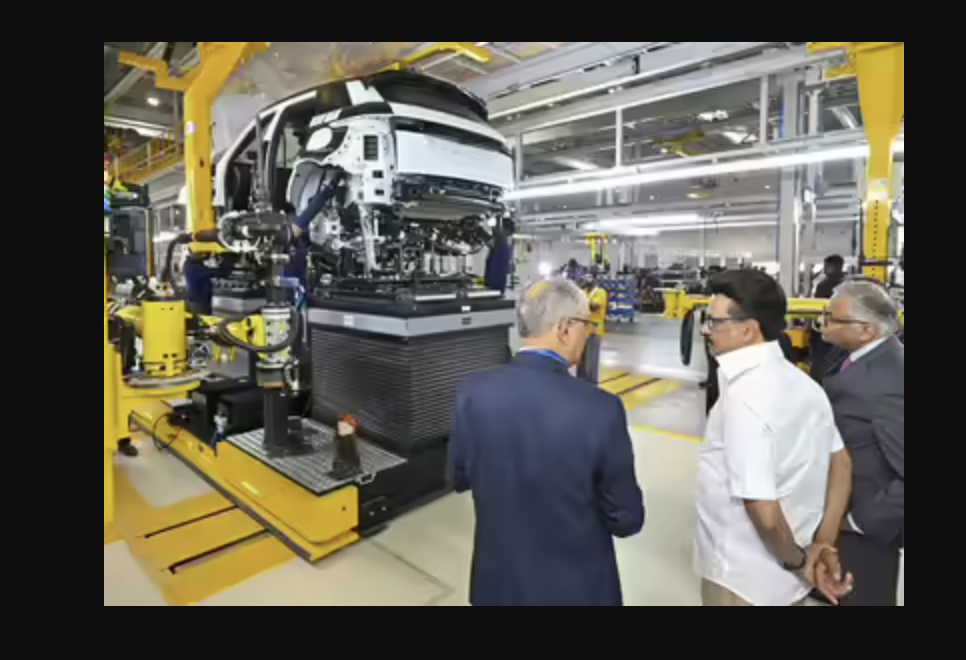
Tata Motors has taken an important move forward in India’s automotive manufacturing environment by establishing a new Jaguar Land Rover (JLR) production facility in Panapakkam, Ranipet district, Tamil Nadu. The plant, the first of its kind in India, will manufacture both Tata Motors Passenger Vehicles and JLR models. It was inaugurated on February 9, 2026, in a high-profile event attended by Tamil Nadu Chief Minister M.K. Stalin and Tata Sons Chairman N. Chandrasekaran. With an expenditure of ₹9,000 crore, the facility aims to establish India as a worldwide manufacturing hub for luxury vehicles, capable of producing up to 3 lakh cars per year.
The advanced factory, located within the SIPCOT industrial complex, represents a significant extension of Tata Motors’ manufacturing base and shifts India’s role from car assembler to production hub for premium and next-generation models. It is expected to manufacture automobiles for both domestic and export markets, aligning India with other important nations where JLR has production plants, including as the United Kingdom, China, and Brazil.
Inauguration Marks New Manufacturing Era for Tata and JLR:
The Ranipet plant’s inauguration was welcomed as an important moment for India’s automotive industry. Chief Minister M.K. Stalin personally drove the first domestically produced Range Rover Evoque off the assembly line, marking the start of full-fledged production at the factory. The event emphasized the state’s commitment to promoting industrial growth and establishing a favorable environment for large-scale investment.
Spread across roughly 470 acres within the SIPCOT complex, the new facility has been developed in multiple phases and reflects a long-term vision for automotive manufacturing excellence. The initial phase alone has attracted an estimated ₹9,000 crore in capital commitments, signalling confidence in India’s capabilities as an automobile production hub. Tata Sons Chairman N. Chandrasekaran described the launch as a “golden day” for the group and emphasised that the factory would elevate India’s position in the global automotive supply chain.
At present, JLR vehicles in India had previously been assembled on a completely knocked-down (CKD) basis at Tata Motors’ Chakan facility near Pune. With the start of local production in Tamil Nadu, the domestic manufacturing process will expand substantially, enabling Tata and JLR to build vehicles from more sophisticated stages of assembly and cater to growing demand.
Production Plans and Economic Impact:
The Ranipet plant’s initial production focus is on the Range Rover Evoque, a premium luxury SUV that has strong demand in both Indian and global markets. In time, additional models from JLR’s portfolio as well as select Tata Motors passenger vehicles will also be manufactured at the facility as capacity expands. The plant is planned to scale up production over the next five to seven years, reaching an annual output ranging between 250,000 to 300,000 vehicles. With full build-out and optimisation, this figure could exceed 3 lakh vehicles per year.
This expansion is expected to generate substantial employment opportunities. More than 5,000 direct jobs will be created at the factory, with many more roles expected indirectly through the development of a strong supplier ecosystem in the region. The availability of skilled and semi-skilled labour, combined with targeted training programmes such as Tata Motors’ own Lakshya skill development initiative, will support growth and enhance workforce capabilities in automotive manufacturing.
Most importantly, sustainability is highlighted heavily in the Ranipet facility. The factory is set up to be water-positive and run entirely on renewable energy, meeting international standards for environmental performance and ethical business practices. Environmentally friendly manufacture, according to authorities, will enable JLR and Tata Motors satisfy global requirements and establish India as a leader in sustainable vehicle manufacturing.
Future Prospects and Industry Transformation:
As the Ranipet plant expands operations, Tata Motors plans to add more models and new technology into production, including electric vehicles for both domestic and foreign markets. The facility’s participation into JLR’s global manufacturing network strengthens India’s position as a reliable partner for premium vehicle production around the world.
The plant is expected to enhance Tamil Nadu’s standing as one of India’s top automotive hubs, joining Chennai and other areas that now house significant manufacturing bases for both domestic and foreign brands, in addition to the economic and industrial advantages. Tamil Nadu is ideally positioned to accommodate this increased automotive footprint because to its strong transportation and logistics infrastructure, which will promote further investments and industrial diversification.
The opening of Jaguar Land Rover’s first Indian production plant in Ranipet is, all things considered, a major turning point for Tata Motors, JLR, and the Indian auto sector. With a yearly production capacity of up to 3 lakh vehicles, the facility is expected to create jobs, strengthen local manufacturing capabilities, and establish India as a major worldwide hub for the production of high-end and next-generation automobiles.

Comments are closed.